

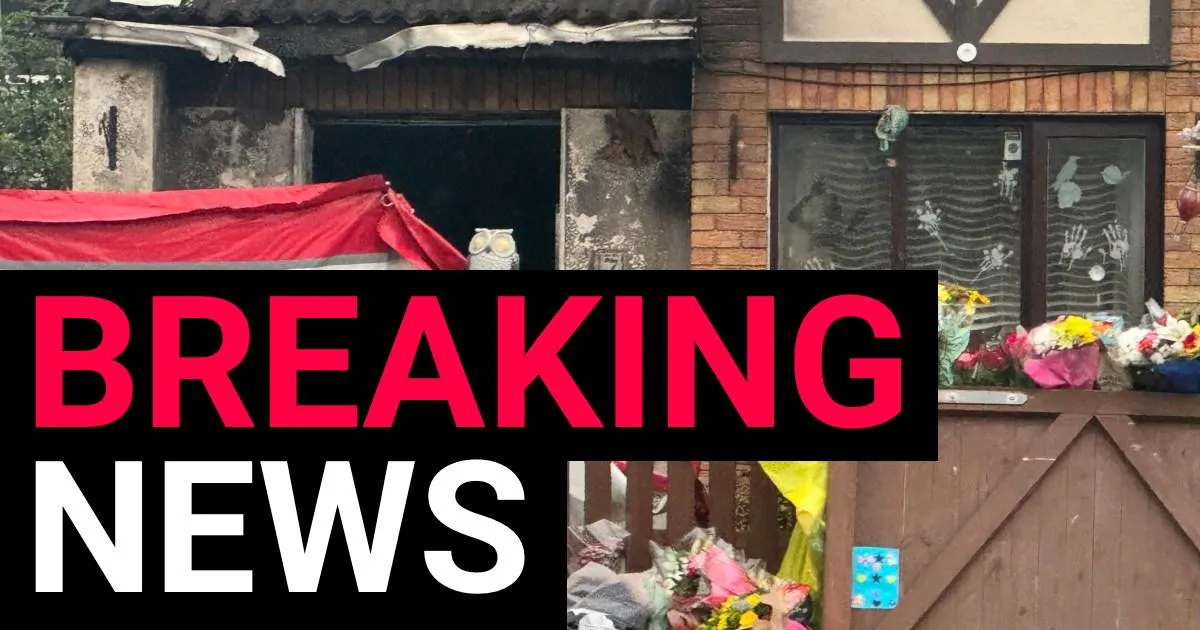
The morning after the fire, the small Irish city of Waterford woke to a scene of charred brick and broken glass. Outside the terraced house where the English family had made their home, floral tributes were already being laid, their stems wrapped in cellophane, candles flickering in the cold air. Inside, the soot-blackened walls told a story no one wanted to hear. Philip English, his wife Kim, and their two young sons, twelve-year-old Callum and nine-year-old Jayden, had died in a suspected arson attack in the early hours of Tuesday. Two other children from the same family were rushed to hospital and remain in critical condition, fighting for their lives. By Friday, the investigation had reached a significant legal milestone: a man in his twenties and a woman in her thirties had been arrested and charged in connection with the killings. Garda Commissioner Justin Kelly confirmed that An Garda Síochána had given “every resource” to the investigation and said he expected more arrests to follow. But for the people of Waterford, the news brought no relief, only a fresh wave of pain. The family had been loved in their community, known for their kindness and their closeness. The idea that someone could deliberately set their home on fire, with children sleeping inside, was beyond comprehension. The city was in shock, and grief had settled over the streets like the smoke that had once filled the family’s house. Emergency services had arrived too late to save them, and neighbours spoke in hushed voices of hearing sirens in the night, unaware that a whole world was being torn apart.
Among those struggling to speak of the tragedy is John James English, Philip’s son, who has become the public voice of his family’s anguish. With the raw honesty of grief, he told RTÉ News that his father’s family had been targeted for some time, and that he believed they were murdered because of a drug debt that was never theirs. He put the debt at twenty thousand euros. “It’s a family, you know,” he said. “Twenty grand worth of a debt, is that worth nearly five lives?” His question has echoed around Ireland, forcing the nation to confront the terrible cost of organised crime. The English family, he insisted, were completely innocent. They had no involvement in drugs. They were simply a husband and wife raising their boys, trying to live an ordinary life in a neighbourhood that, like many other communities across Ireland, has been haunted by the violence of drug gangs. The details of the case are still emerging, but the son’s account has given human shape to the statistics: four bodies, two devastated families, and a community left to ask why. Exactly why the English family was chosen remains unclear, but the alleged connection to drug debt collection invites a chilling possibility: that the fire was intended as a punishment, a warning, or a message, and that the lives of two young boys were collateral damage in a conflict they had nothing to do with. If that is true, this was not just an act of murder; it was an act of utter cruelty, carried out by people who valued money over life, revenge over mercy, and silence over justice.
Meanwhile, the investigation has unfolded at an extraordinary pace. Shortly after the bodies were recovered, Gardaí began a forensic examination of the house, treating the fire as deliberate. Multiple properties were searched, and a number of electronic devices and vehicles were seized, evidence that investigators believe will help them untangle the network behind the attack. The man and woman arrested on Thursday were initially held on suspicion of facilitating a criminal organisation, a legal phrase that suggests the case is about more than a single fire, and points to deeper connections between those who ordered the attack and those who carried it out. Garda Commissioner Justin Kelly said the force had given the investigation everything it had, and he made clear that he anticipated further arrests. The post-mortem examinations on Philip, Kim, Callum and Jayden have been completed, but the results have not been released, a decision police say was made for “operational reasons.” That lack of public detail has only increased the tension and anxiety, as the city waits for answers. Investigators are likely looking at CCTV footage, phone data, witnesses and forensic evidence to build a case strong enough to convict not only those who lit the fire, but those who may have ordered it from a safe distance. The case has also focused attention on organised crime groups that use terror to enforce debts, and on the communities that live under their shadow. Each new development is followed closely by a public desperate for accountability, and by a family that wants the world to know that four irreplaceable lives were taken in a blaze that should never have happened.
While the legal process moves forward, Waterford is mourning its own. The funerals of Philip, Kim, Callum and Jayden are scheduled for Monday, and the city has already begun to prepare for what is expected to be an enormous outpouring of grief. Father Gerry Chestnutt, a local parish priest, described the mood in a radio interview as one of deep, collective sorrow. “There is just a deep, deep sense of sadness around here, around our entire city,” he said. “People are still in shock. They’re heartbroken. They’re devastated, and they can’t understand how this will happen and why this will happen.” He also addressed the anger that many residents feel, saying it was natural: “What happened should never have happened, and people are entitled to feel angry because it’s a natural reaction when something that is so horrendous takes place to a family that were absolutely completely innocent and loved in the area in which they lived.” At the scene of the fire, the tributes have continued to grow. Flowers are piled at the front of the house; messages written on cards and soft toys are placed among them. Neighbours stand in small groups, speaking in hushed voices, some simply staring at the boarded-up windows. Local schools have opened their doors to children who are struggling to understand why their friends will not be returning. Grief counsellors are on hand, but no words can ease the loss of two boys who should have been in class, in the schoolyard, in the middle of ordinary childhood dreams. The entire city has been touched by the tragedy, and as families prepare to gather in churches, the air is thick with grief and disbelief.
The horror of the attack has reached the highest levels of Irish politics, where leaders have been forced to confront the scourge of drug violence. Sinn Féin TD David Cullinane, who personally knows the family, spoke in the Dáil with raw emotion. He described the attack as “murderous” and said it showed “utter contempt for human life.” He called for those who planned, ordered, or carried out the attack to face the full force of the law, but he also went further, linking the tragedy to a wider crisis of drug-related intimidation. Other families, he warned, are looking out their front doors and wondering if their children could be next. “No family should have to put their children to bed wondering whether someone will set fire to their home before morning,” he said. The words were met with silence and solemnity, a rare moment of political unity in response to an atrocity. Minister for Defence Helen McEntee echoed Cullinane’s words, describing the attack as “violent criminality” and drug debt collection as “an absolute scourge” on society. She encouraged anyone who felt unable to go to the police to reconsider, assuring them that An Garda Síochána has a dedicated anti-drug strategy through Operation Tara. She said she would speak with the Minister for Justice about whether more could be done. The political response is unlikely to quell the anger of those mourning the English family, but it has ensured that their deaths will not be dismissed as a random tragedy. Rather, they are a reminder of what happens when organised crime is allowed to take root in communities, when silence is maintained because people are afraid, and when law-abiding families become the casualties of systems that fail to protect them.
Across Ireland, people have been united in grief for the English family. It is hard to imagine the fear and terror that must have filled the house as the fire took hold in the early hours of the morning. Did Philip and Kim wake first, trying desperately to reach their children? Did the boys cry out for their parents? These are questions that will never have easy answers, and they are questions that no family should ever have to face. The fact that two other children are still alive, still breathing in hospital beds, is both a small mercy and a reminder of what is at stake. They carry within them the memory of that night, and their survival will depend not only on medical care, but on the love and support of a community that has wrapped itself around the family in their time of need. As the funerals approach on Monday, the people of Waterford will line the streets to say goodbye. They will hold candles, wear black, and try to find words for the unspeakable. They will also demand justice. The investigation is ongoing, and the expectation of further arrests suggests that the full story has not yet been told. Somewhere, in the shadows, those responsible for this atrocity may be watching, fearing the knock on their own doors. But for now, the focus is on the dead and on the grieving. Philip and Kim English were a mother and father whose lives revolved around their boys. Callum was twelve, with his entire future ahead of him. Jayden was nine, old enough to have dreams and young enough to need protection from the dark world that took everything away. The English family was taken from this world too soon, but they will not be forgotten. In the flowers, in the tears, in the fury of their loved ones, their presence remains, a quiet reminder that joy was stolen, love was lost, and a city will never be the same.