
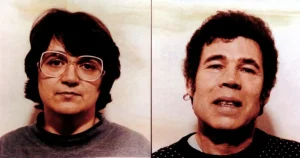

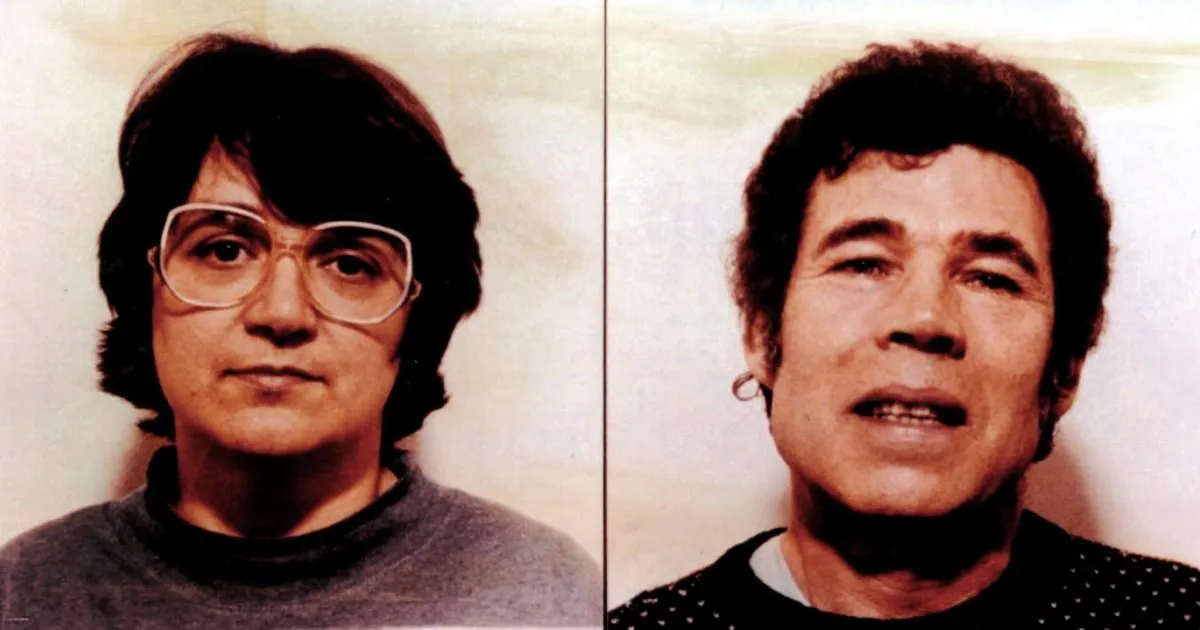
Between them, Fred and Rose West created a shadow that stretched across two decades, a period in which young women and children disappeared into a nightmare from which most never returned. The exact number of their victims remains unknown; the official count is incomplete, and the truth lies buried in fields, under floors, in gardens, and in the silences of those who survived. What can be said with certainty is that the names we know belong to real people, not just case numbers. Anne McFall, Catherine “Rena” Costello, Charmaine West, Lynda Gough, Carole Ann Cooper, Lucy Partington, Therese Siegenthaler, Shirley Hubbard, Juanita Mott, Shirley Anne Robinson, Alison Chambers, and Heather West. Each of these girls and women was once loved, once full of plans, once certain that tomorrow would come. Some were mothers, some were daughters, some were students, some were runaways, some were simply in the wrong place at the wrong time. Together they represent a devastating pattern of predation, manipulation, and violence that Fred and Rose West inflicted from the late 1960s until the late 1980s. To summarize their story is not simply to recount horror; it is to remember that every body found beneath the cellar floor or buried in a field was a life interrupted, a future erased. The places where their remains were discovered—25 Cromwell Street in Gloucester, a field at Kempley, the kitchen at 25 Midland Road—have become grim landmarks, but the humanity of the victims must always come first. This is their story, told with the tenderness they were denied. It is also a story of how ordinary evil can hide in plain sight, in a family home, behind a smiling facade, in the routines of a community. The Wests were not strangers to everyone; they were neighbors, parents, employers, landlords. And that is part of what makes the case so unbearable: the victims were not taken by a faceless monster in the dark, but by people who could be charming, persuasive, and trusted.
The earliest known victims show how Fred West’s violence was already taking shape before Rose entered the picture. Anne McFall was only eighteen, a Scots-born nanny who came to care for Fred’s children and ended up living with him in his caravan. During one of the periods when his wife was away, she became his lover, and she was pregnant with his child when she disappeared in May 1967. Anne was young, far from home, probably vulnerable and trusting; she believed she had found a place to belong. Instead, her skeletal remains and those of her unborn baby were later found in a field at Kempley, near Fred’s home village of Much Marcle. The image of that field, holding the bones of a mother and child, is almost unbearable. Fred’s first wife, Catherine “Rena” Costello, was his second known victim. Rena had married Fred in 1962 while pregnant with Charmaine, a child fathered by another man. She left him for the last time in 1969, trying to escape a marriage that had become a trap. By then Fred was having an affair with fifteen-year-old Rosemary Letts, the girl who would become his second wife. Rena’s remains were found in a field at Kempley, close to Anne’s grave—a cruel symmetry. Then came Charmaine, Rena’s daughter, only eight years old when she disappeared in 1971. She was the child Fred had agreed to raise, and her skeletal remains were found buried under the kitchen window at 25 Midland Road, Gloucester. A child buried beneath the place where food was prepared, where families gather, where life should have been nurtured. The deaths of Anne, Rena, and Charmaine reveal the grim pattern: the Wests targeted women and children they could control, then disposed of them in secret places. The fields of Kempley became a private cemetery, and the police did not find the bodies for years. There is no way to measure the pain of a mother who never saw her daughter again, or a sister who spent a lifetime wondering, or a child whose childhood was stolen before it truly began.
By the early 1970s, Fred and Rosemary West were working together, and the violence became more frequent and more brazen. Lynda Gough was friendly with lodgers at 25 Cromwell Street and was known to have sex with them; she vanished in April 1973, and her parents reported her missing. Her remains were found in a former car inspection pit in a garage that had been converted into a bathroom—a room of cleaning and intimacy, forever tainted. Carole Ann Cooper disappeared after getting on a bus to return home after a night out on November 10, 1973. Detectives concluded that the Wests picked her up while she was hitch-hiking. Carole was simply trying to get home, a routine journey that ended in a cellar grave. Lucy Partington was twenty-one, a university student, and she disappeared two days after Christmas in 1973, as she waited for a bus to her home at Gretton, near Winchcombe. Her mother reported her missing, sparking a massive search that found nothing. Lucy’s remains were found under the floor of the cellar at 25 Cromwell Street. Therese Siegenthaler, twenty-one, was Swiss-born and a student at a London college. She disappeared at Easter 1974 after setting out to hitch-hike to Ireland to visit a friend who was a priest. She had no known connection with the Wests—she was simply traveling, open to the world, trusting that a ride was a kindness. Her remains were found under the same cellar floor. Shirley Hubbard, fifteen, was the youngest victim found at Cromwell Street. She was reported missing to police, but no trace of her was found until the cellar was excavated. Shirley should have been in school, not buried in a basement. These young women were not reckless; they were ordinary. They took buses, they hitch-hiked, they waited at roadsides. The Wests exploited that ordinary trust. The cellar at 25 Cromwell Street was not a secret dungeon in a remote forest; it was beneath a busy family home in a residential street. For years, the sounds of daily life—footsteps, laughter, arguments—were accompanied by the silent presence of the dead. The fact that so many bodies lay undiscovered for so long is not just a failure of the police; it is a reminder of how easily vulnerable people can vanish when no one is willing to look closely enough.
The pattern continued into the late 1970s, and the victims grew younger, the betrayals more intimate. Juanita Mott was eighteen when she vanished in April 1975, a day before a friend’s wedding. She was supposed to be celebrating; instead she disappeared into the Wests’ world. Her remains were found in the cellar. Soon after Juanita’s death, the floor of the cellar—with the bodies beneath arranged neatly in a clockwise fashion—was concreted over, and the room was turned into a bedroom for the Wests’ children. The image is chilling: children sleeping above the dead, the adults knowing exactly what lay below. Shirley Anne Robinson lodged with Fred and Rosemary West and became Fred’s lover. She also became pregnant by him. Shirley Anne was last seen in May 1978, when she was about eight months pregnant. Her body, with the foetus of her unborn child, was found buried in the garden at the Wests’ home. She was about to become a mother, a moment that should have been filled with hope; instead, she and her baby were hidden in the soil. Alison Chambers, who lived in a children’s home, was a frequent visitor to 25 Cromwell Street. She disappeared in August 1979, shortly before her seventeenth birthday. Alison was already vulnerable, a girl looking for family and acceptance; she found instead predators. Her remains were found in the garden at 25 Cromwell Street. Then there was Heather West, the first child of Fred and Rosemary West. Heather was sixteen when she was murdered in 1987, the last victim of the killing spree and the first victim whose body was found at 25 Cromwell Street. Her parents never reported her missing, although they told various people that they had. In reality, Heather had been murdered and buried under the garden patio. The betrayal of a child by her own parents is almost beyond comprehension. Heather’s disappearance was not investigated because her parents lied, and she lay beneath the patio for years while the family continued to live above her. The Wests’ own daughter was the final proof of their monstrousness—no one, not even their own flesh and blood, was safe. It is impossible to think of Heather without feeling a deep, aching sorrow for the life she never had.
The discoveries that finally brought the truth to light were not just forensic achievements; they were acts of reclamation. When investigators excavated 25 Cromwell Street, they found human remains in the cellar, in the garden, in the former inspection pit, under the kitchen floor. The remains of Anne McFall and Rena Costello were found in fields at Kempley. Charmaine West was found under the kitchen window at Midland Road. Each body was a person whose disappearance had once been reported, or ignored, or explained away. The Wests had constructed an elaborate web of lies, telling neighbors, family members, and even each other that the missing had simply moved on. Heather West’s parents told people she had run away; they even claimed to have reported her missing. The families of the other victims spent years, sometimes decades, not knowing what had happened to their daughters. Some searches were massive, as with Lucy Partington; others were met with indifference. The fact that so many bodies were found in and around the Wests’ homes raises painful questions about how they escaped detection for so long. The cellar floor had been concreted over; the garden had been dug up and replanted; the house at Cromwell Street was eventually demolished, its bricks crushed so that it could not become a shrine. But the memory of what happened there remains. For every known victim, there may be others still unnamed, still waiting to be remembered. The phrase “unknown number” is a wound in the history of this case. It means that somewhere, there are families who never learned the fate of their loved ones, and there are victims whose names are not carved on any memorial. The investigation that finally brought the Wests to justice was a difficult, painstaking process, but it could not undo the damage. It could only begin the long work of telling the truth. It also raised difficult questions about how many warnings were missed, how many disappearances were not taken seriously, and how many young women were failed by the very systems meant to protect them.
In the end, the story of Fred and Rose West is not a story to be consumed for shock value. It is a story about the fragility of trust, the vulnerability of young women and children, and the terrible consequences of looking away. The victims were not abstract names; they were daughters, sisters, mothers, friends. Anne McFall was carrying a child. Rena Costello was trying to leave an abusive marriage. Charmaine West was only eight years old. Lucy Partington was a student with her whole life ahead of her. Therese Siegenthaler was traveling to visit a priest. Shirley Hubbard was fifteen. Juanita Mott was supposed to attend a wedding. Shirley Anne Robinson was about to give birth. Alison Chambers was seeking a place to belong. Heather West was a teenager who should have been protected by the very people who killed her. To humanize them is to refuse to let the Wests define their legacy. It is to say that their lives mattered more than the manner of their deaths. The house on Cromwell Street is gone, but the need to remember is not. We remember to honor the victims, to support the survivors, to learn the warning signs of coercive control and predatory violence, and to ensure that the unknown number of victims is not forgotten. We also remember because the capacity for such evil is not a distant historical anomaly; it lives in the shadows of everyday life, in the homes and fields and streets where people disappear. By telling their stories with compassion, we give back a small piece of the dignity that was taken from them. We cannot bring them back, but we can carry them forward. That is the least we owe them.