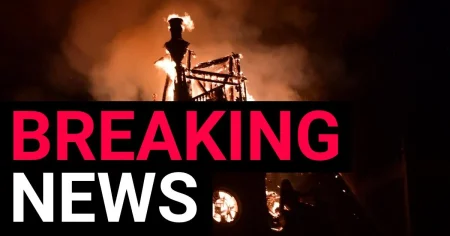


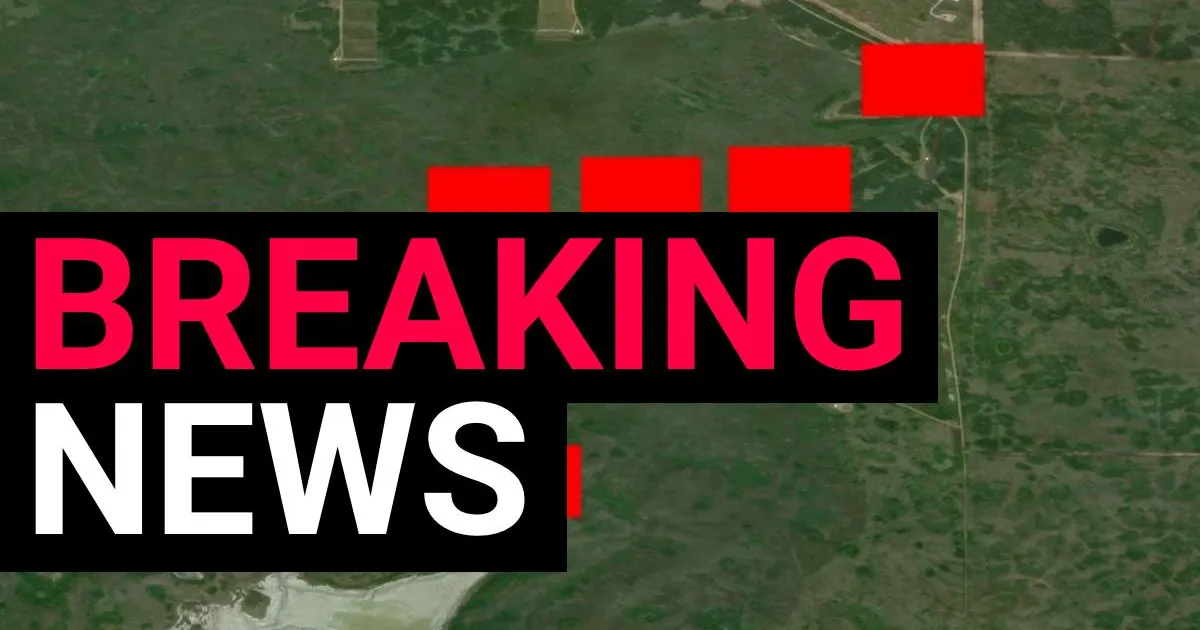
Wainwright, Alberta, is the kind of town where people know their neighbors, and where the Canadian Forces Base is more than just a military installation—it is the heartbeat of the community. On the afternoon the fire began, the wind was already making itself known. It howled across the prairies, bending trees, sending loose branches skittering down roads, and turning the flat landscape into a corridor of raw, unrelenting force. Then, at around 4pm, something went wrong in a training area on the base. A fire broke out, and within minutes the wind had turned it into a monster. Gusts of up to 100 kilometers per hour pushed the flames across the training grounds and into the surrounding countryside, creating a fast-moving wall of fire that no one could outrun. Black smoke rose high into the sky, visible for miles, and the roar of the blaze mixed with the wail of emergency sirens. In a town of only 7,000 people, almost everyone knew someone who worked at the base, or had a family member in uniform. The sirens began almost immediately, but the fire was moving faster than any response could. It would later be described as a disaster that might happen once in 15 to 25 years—a rare and terrible convergence of dry conditions, powerful winds, and an unlucky spark. By the time the emergency was over, at least seven people were dead, and many more were injured. For the families waiting for news, the hours stretched into eternity. The town itself was not evacuated, but in every home, the same fear took hold: Who was hurt? Who was gone? The base, a place that had seen generations of soldiers train and serve, was now the scene of an unimaginable loss, and the wind that had always been part of life on the prairies had become the enemy.
The response was immediate, but the fire had a head start. Fire crews, military personnel, paramedics, and local police all converged on the base as the flames continued to jump from one patch of dry grass to another, driven by gusts that seemed to change direction every few seconds. The same wind that made the fire so dangerous also made the work of containing it extraordinarily difficult. At times, the smoke was so thick that responders could barely see the road ahead. Trees that had stood for decades were blown down, and trash bins rolled through the streets like toys. Despite the chaos, there was a determination to protect the critical infrastructure that surrounded the base—fuel depots, training facilities, and the homes of military families. By 11pm, emergency services announced that the fire was under control. The flames had been stopped before they could reach the most sensitive areas, and the immediate danger had passed. But the relief was tempered by grief. The physical fire was out, but the emotional one was just beginning to burn. The base’s training area, where soldiers practiced the skills they would need for deployment, had become a place of tragedy. For the military community, the loss was deeply personal. These were not just casualties; they were comrades, friends, brothers and sisters in arms. The fact that the fire had been contained relatively quickly did little to ease the pain. Seven lives had already been lost. Many more people were injured, some critically, and the hospital system in Edmonton was about to be tested in a way it had not been in years. As the night wore on, the town of Wainwright sat in stunned silence, watching the emergency lights fade into the distance, wondering how something so ordinary as a windy afternoon could have ended so terribly.
As the scale of the tragedy became clear, the focus shifted to the casualties. Local health facilities were quickly overwhelmed, and patients were transported to hospitals in Edmonton, a city about 120 miles away. The distance meant long ambulance rides and, for some, helicopter transfers across the dark prairie sky. At the Royal Alexandra Hospital, Dr. Warren Thirsk, an emergency department physician, tried to put the situation into perspective. “It is more patients than any of us want to count right now,” he told CBC. “It’s a disaster. It’s a one in every 15 to 25-year disaster.” His words captured the weight of what had happened. Emergency rooms are built for the worst days, but this was beyond what most doctors and nurses had ever experienced. They worked through the night, treating burn victims, trauma patients, and people suffering from smoke inhalation, all while trying to stay calm and focused. The hospitals in Edmonton became the second front line of the response, staffed by exhausted but determined medical teams. For the families of the injured, the wait for news was agonizing. For the families of the dead, the news was devastating. In the days ahead, the names and stories of those lost would begin to emerge—soldiers, perhaps civilians, fathers and mothers, sons and daughters. But in those first chaotic hours, all that mattered was the fight to save lives. Doctors and nurses moved from bed to bed, doing everything they could, while outside the hospital, friends and loved ones gathered, hoping for a sign, a word, a miracle. The city of Edmonton had not expected to be drawn into this tragedy, but it responded with the kind of quiet heroism that defines the best of human nature. There was no time to grieve yet, no time to process the enormity of the loss. There was only the next patient, the next surgery, the next breath.
In the midst of the emergency, Canada’s political leadership responded with a mix of grief and resolve. Prime Minister Mark Carney took to social media to express the nation’s sorrow. “Our thoughts are with all the brave women and men affected,” he wrote, adding that he was in close contact with Alberta Premier Danielle Smith and that relevant ministers and officials were coordinating the response. It was a message that acknowledged both the scale of the disaster and the courage of those caught in it. Defense Minister David McGuinty described the situation as “very, very active and delicate” and said that Royal Canadian Mounted Police were working to determine the cause of the fire. An investigation was underway, but it would take time. The cause had not yet been established, and questions would inevitably follow: Was it an accident? Could it have been prevented? Were the winds simply too strong for any response to have stopped the fire in time? For now, those questions remained unanswered. What was clear was that a terrible thing had happened to people who had dedicated their lives to serving their country, and that the country was grieving with them. Premier Smith called the news “significant and tragic” and said the incident had affected many “brave” military personnel. Her words were echoed by Canadians across the country, who watched the reports with a sense of shock and sadness. Flags would be lowered. Prayers would be offered. The machinery of government would move into action, but no amount of political response could bring back the dead or heal the wounded. All that could be done was to stand with the families and the community, to promise that the investigation would be thorough, and to honor the service of those who had lost their lives. In the coming days, the focus would shift to memorials and funerals, but in that moment, the grief was still raw and the answers still distant.
The disaster came at an especially delicate moment for Alberta. The province was in the middle of a referendum on whether to begin a process that could eventually lead to leaving Canada—a vote that had already divided families and communities along political lines. On Saturday, as emergency crews fought the fire and hospitals worked to save lives, two polling stations in Lloydminster and Vermilion were closed early. The timing was jarring. While some Albertans were casting ballots about the province’s future within Canada, others were dealing with the immediate, brutal reality of death and injury. The referendum, whatever its outcome, suddenly seemed secondary to the human cost of the fire. The closures were a small reminder that, in moments of crisis, practical concerns take precedence over political ones. But they also highlighted the strange collision of events: a province debating whether to separate from the country it was part of, while simultaneously depending on national resources and sympathy to respond to a disaster. It was a moment for reflection, not just on the fire itself, but on what it means to be a community, a province, and a country in the face of tragedy. The vote would go ahead, and the count would come on Monday, but for many people in Wainwright and beyond, the fire had already changed the conversation. It was impossible to think about politics when the bodies were still being identified and the wounded were still fighting for their lives. The referendum would have its day, but this weekend belonged to the victims, their families, and the first responders who had run toward the flames. In the midst of a debate about borders and identity, the fire was a stark reminder that some things are bigger than politics: life, death, and the ties that bind people together in times of crisis.
As the sun rose on the aftermath, the people of Wainwright and Alberta began the long process of healing. The fire was out, but the smoke still hung in the air, and the grief was just beginning. Neighbors checked on neighbors. Military families held each other a little closer. Flags were lowered to half-mast. The names of the dead would be honored, their service remembered, and their loss mourned by a nation. The investigation into the cause of the fire would continue, with the hope that answers would bring some measure of closure and prevent future tragedies. For the medical workers who had faced an impossible night, there was no time to rest—only the quiet determination to keep going. For the first responders who had fought the flames, there would be memories that would take years to process. And for the rest of Canada, there was a renewed appreciation for the men and women who serve in the military, and for the dangers they face even in peacetime, even on home soil. The fire at Canadian Forces Base Wainwright was described as a once-in-a-generation disaster, but the response was the very best of what a community can be: brave, selfless, and unwilling to give in. In the days ahead, the questions would be answered, the funerals would be held, and the healing would slowly begin. But no one would forget the day the wind turned against them, and no one would forget those who were lost. The town of Wainwright would carry this scar for a long time, but it would also carry the memory of how people came together in the darkest hours. There would be time for anger, for sadness, for investigation and accountability. But first, there was time to grieve, to hold one another, and to remember that even in the heart of disaster, the human spirit endures. The fire may have taken lives, but it could not take the love that bound this community together, nor the strength that would carry them forward into the difficult days ahead.