

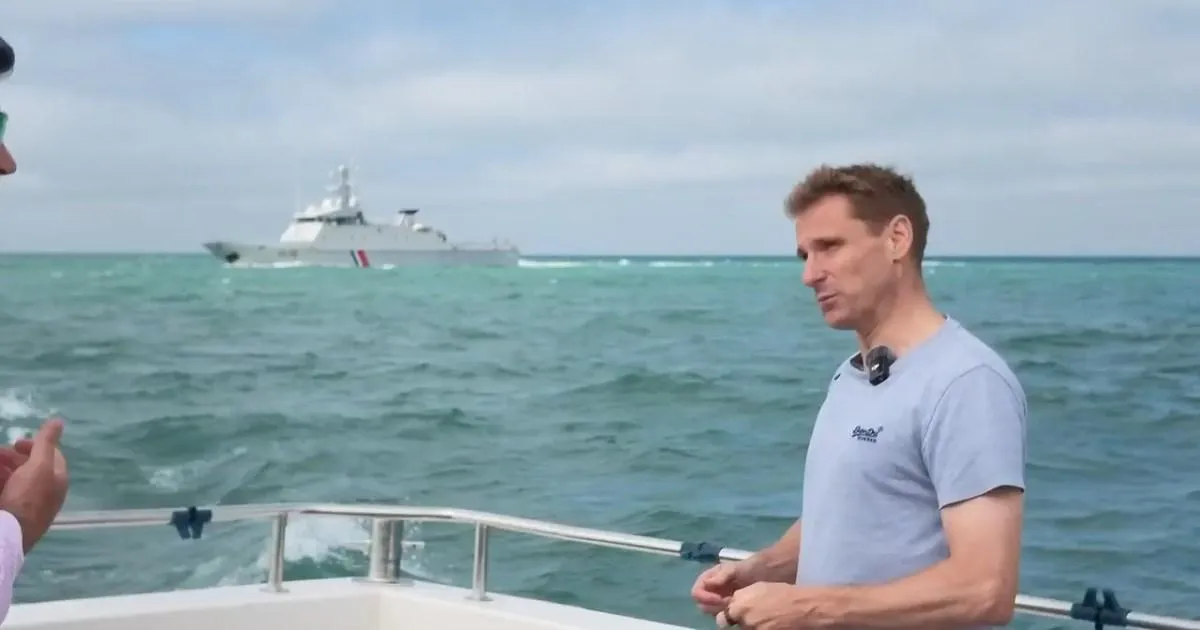
The political landscape of the English Channel has always been a tense theater, but a recent, unsettling incident has brought the reality of this friction into sharp focus. Conservative MP Chris Philp, currently serving as the Shadow Home Secretary, found himself in the middle of a bizarre and harrowing encounter while out at sea to document the ongoing crisis of small boat crossings. While in the middle of a BBC interview aboard a local fishing boat near the coast of Boulogne-sur-Mer, the atmosphere shifted instantly from a routine political observation to a moment of genuine alarm. Reports indicate that a French warship drew close to their vessel, and an officer on deck eventually discharged 17 rounds of live ammunition. The sound of the gunfire, caught on camera by the BBC crew, stopped the interview in its tracks as the onlookers turned to see what was happening.
For those on the boat, the immediate reaction was one of confusion followed by a defensive unease. Philp later described the experience as a clear attempt at intimidation, noting that there had been no formal warning, no announcement of a training exercise, and no clear explanation as to why a naval vessel would open fire near a civilian boat carrying a British politician. The captain of their fishing vessel, Matt Coker, mirrored this sentiment, suggesting that while the motive remained open to interpretation, the display felt like a deliberate show of force—a “warning” meant to signal that the French authorities were watching. While it was later clarified by some reports that the officer appeared to be aiming away from the specific vessel, the psychological impact of hearing live rounds fired in international waters remains a significant point of contention.
Philp, never one to shy away from a political scrap, was quick to pivot the narrative toward the broader failure of cross-border cooperation. He expressed his intention to raise the matter directly with the French ambassador, framing the incident as a paradoxical betrayal of priorities. From his perspective, it is baffling that the French Navy would deploy such high-level aggression toward a British MP, yet arguably struggle to project even a fraction of that same resolve when it comes to intercepting criminal smuggling gangs. To Philp, the contrast is stark: the French authorities appear perfectly capable of enforcing their sovereignty when it suits a diplomatic point, but they are far more passive when it comes to the daily logistics of migrant boats navigating the Channel.
This frustration highlights a deep-seated grievance in the ongoing debate over maritime security and migration. The current political argument, which Philp is keen to amplify, suggests that the French government effectively “waves through” these small crafts, leaving the burden of the crisis on the British coastguard and, ultimately, the British taxpayer. It is a recurring theme in the rhetoric surrounding illegal crossings: the feeling that our neighbors across the water are treating the crisis as a transit issue rather than a shared responsibility. By drawing attention to this perceived negligence, Philp is attempting to highlight what he views as a hypocritical approach to border enforcement, one that prizes intimidation over meaningful intervention.
On the other side of the aisle, the government’s response has been one of measured defense, aimed at cooling the temperature of the debate. Prime Minister Andy Burnham has pointed to the latest Home Office statistics, which show a notable reduction in total crossings compared to previous years. With roughly 13,000 arrivals so far—a figure significantly lower than this time last year—the administration argues that their current, more “rigorous” plans to tackle the issue are beginning to yield tangible results. For the government, the focus remains on statistical trends and the steady increase in removals, suggesting that while the situation is far from solved, the trajectory is at least moving toward a more manageable, controlled reality.
Ultimately, this maritime incident serves as a volatile microcosm of the wider Brexit-era relationship between the UK and France. It is a world where political theater, nationalistic pride, and the very real human tragedy of the migrant crisis collide. Whether or not those 17 shots were an intentional act of intimidation or a poorly communicated maritime maneuver, they have undeniably underscored the lack of trust that currently defines the channel crossing crisis. As both sides continue their tug-of-war over policy and blame, the public is left to watch a high-stakes standoff where the politicians are firing words at one another, and sometimes—as in the case of Mr. Philp—where the reality of the sea proves that those words can have dangerous, echoing consequences.