


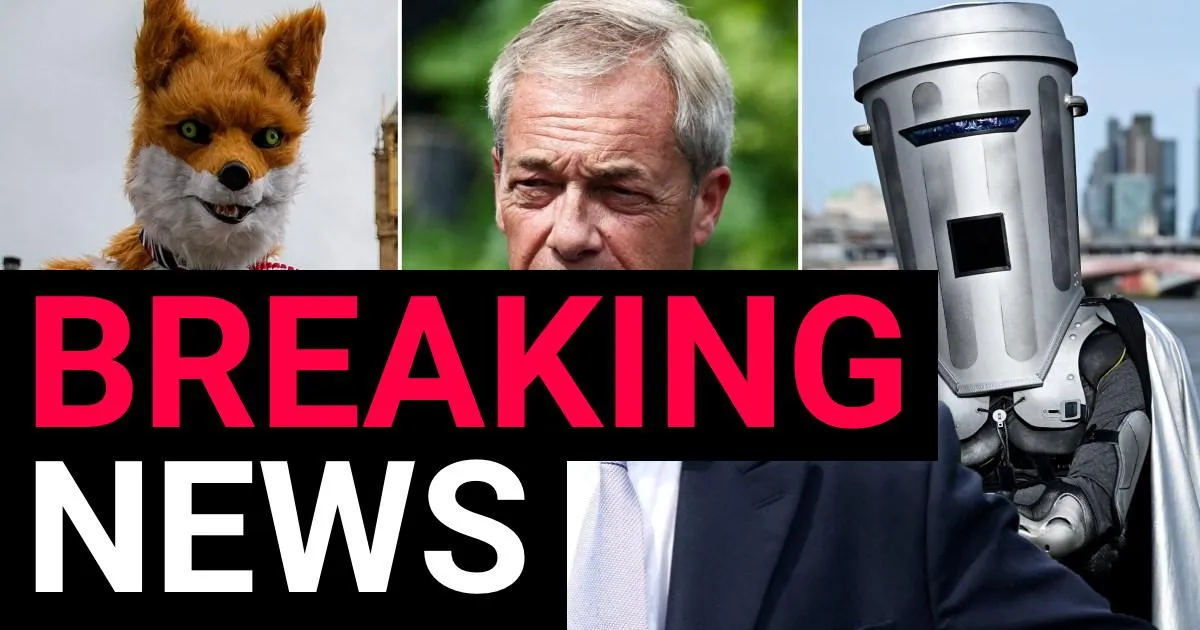
The peculiarities of British politics have taken a turn for the surreal in Clacton, where an upcoming by-election has transformed into a political theater of the absurd. Nigel Farage, the leader of Reform UK, is gearing up for a contest that is far from conventional. In a twist that few political pundits would have predicted, his primary competition includes the satirical legend Count Binface and an activist dressed as a human fox. While the major Westminster parties have opted to boycott the race—dismissing Farage’s candidacy as little more than a calculated publicity stunt—the resulting vacuum has left the stage open for these unorthodox challengers to grab the spotlight, turning what should be a standard democratic exercise into a bizarre and highly publicized clash.
The logistical shuffle behind the event began when Tendring District Council confirmed an August 13 polling date, a week later than Reform UK had initially anticipated. This delay has established a strict timeline for the constituency, with a narrow window for nominations between July 14 and 17. Acting returning officer Ian Davidson has been vocal about the necessity of procedural rigor, urging Clacton residents to ensure they are registered by July 28. Amidst the circus of costumes and satire, there remains a serious message from local authorities: the fundamental mechanics of voting, such as securing valid voter ID or applying for a Voter Authority Certificate, remain paramount for those who wish to have their voices heard in this unconventional environment.
At the heart of the controversy is Nigel Farage himself, whose recent political trajectory has been nothing short of volatile. Farage, who previously secured his seat with a commanding 46.2% vote share and a majority of over 8,400, resigned shortly after his election victory. The resignation came under a cloud of scrutiny regarding a £5 million donation from crypto-billionaire Christopher Harborne and ties to George Cottrell, a figure associated with financial fraud. By stepping down and forcing a by-election, Farage is attempting to reframe the narrative, positioning himself as a populist crusader standing against “the establishment,” even as his challengers use humor and satire to highlight the eccentric nature of his platform.
The drama is further complicated by the shadow of an active investigation. Prior to his resignation, Farage faced an inquiry by Parliamentary Standards Commissioner Daniel Greenberg regarding his failure to declare the massive £5 million gift upon entering Parliament. While the resignation effectively hit the “pause” button on this investigation, the stakes remain high. If Farage succeeds in winning his seat back on August 13, the inquiry will resume immediately. A finding of wrongdoing, particularly one resulting in a suspension of more than ten days, could trigger a recall petition. This precarious legal position means that this by-election could technically act as a precursor to yet another contest, keeping the political pressure on Farage at an all-time high.
It is a fascinating, if not slightly baffling, spectacle that highlights the growing disconnect between traditional political gatekeepers and the unpredictable world of modern public discourse. While the “big” parties are choosing to sit on the sidelines, the presence of characters like the fox-costumed protester and Count Binface—who recently made headlines for his sharp critiques of mainstream media—serves as a biting commentary on the state of British democracy. These candidates are not merely playing to the gallery; they are capitalizing on voter fatigue. By treating a parliamentary race with the absurdity they believe it deserves, they are forcing voters to look twice at a process that is increasingly defined by scandal, resignation, and personality-driven politics.
Ultimately, the Clacton by-election transcends the local interests of a single Essex constituency. It serves as a microcosm of the internal tensions currently roiling British governance, where the lines between serious legislative duty and performative political theater have blurred beyond recognition. As Farage promises to “fix potholes” and claims credit for “putting Clacton on the map,” the looming threat of further ethics investigations and the mocking laughter of his cartoonish opponents continue to follow him. Whether this results in a victory for Farage or a moment of massive embarrassment, the August 13 vote will undoubtedly remain a significant, if strange, chapter in the story of UK politics.