


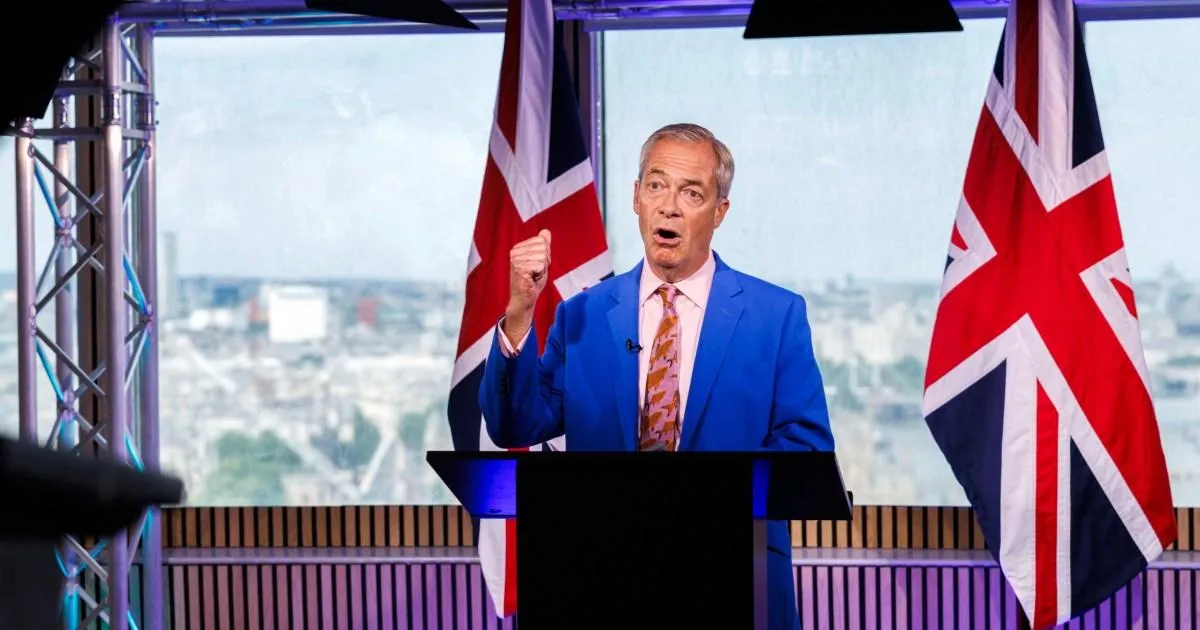
The British political landscape was jolted this week when Nigel Farage, the leader of Reform UK, unexpectedly resigned as the MP for Clacton-on-Sea, only to immediately trigger a by-election to win the seat back. While Farage frames this as a defiant stand against the “establishment,” his critics, including Prime Minister Sir Keir Starmer, view it as a calculated, desperate distraction from a swirl of mounting scandals. Farage has recently come under intense scrutiny regarding an undeclared £5 million financial “gift” from a cryptocurrency billionaire and his associations with convicted fraudster George Cottrell. Faced with these allegations and a public meltdown involving journalists at an airport, the Reform leader is attempting to use the electoral process to consolidate his power and silence his detractors.
The major political parties have opted to sit this one out, leaving the ballot paper for the August 13 election to be filled by a fascinating, albeit unconventional, cast of characters. This “motley crew” has stepped into the void, transforming what could have been a standard political formality into a bizarre arena of protest. Among the most prominent challengers is the satirical internet star Count Binface. The “intergalactic space warrior”—in reality, Oxford-educated comedian Jon Harvey—has become a cult hero for his absurd manifesto pledges, such as capping the price of ice cream and nationalizing Adele. With significant bookmakers offering competitive odds on his success, Binface has evolved from a perennial punchline into a genuine headache for the Reform UK leadership.
Joining the fray is Rob Pownall, a 27-year-old wildlife campaigner known for donning a fox costume to highlight concerns over animal welfare. Pownall’s candidacy is rooted in a deep-seated frustration with Farage’s political record, particularly his vocal support for “country sports,” which Pownall views as a thin veil for the promotion of blood sports like hunting and shooting. While Pownall acknowledges the inherent absurdity of a man in a fursuit challenging a prominent politician, he insists his campaign is underscored by serious principles. By contrasting his focus on systemic animal cruelty with the theatrical posturing of his opponents, Pownall aims to use the Clacton stage to force a conversation that Farage would likely prefer to avoid.
Not to be outdone in the theater of the absurd, Howling Laud Hope, the long-standing leader of the Official Monster Raving Loony Party, has also entered the race. Embarking on his 38th parliamentary run, Hope is looking to break records while promising to revitalize Clacton by turning the seaside town into a British version of Disneyland. Despite his party’s history of eccentricity, Hope is clear-eyed about the local challenges, such as housing and unemployment, even if his proposed solutions involve constant street dancing and singing. His presence underscores the deep political disillusionment currently felt by many, proving that when the giants of mainstream politics falter, the stage is inevitably occupied by those eccentric enough to demand our attention.
The dynamics between these candidates highlight a growing divide in how the British public perceives political legitimacy. For Farage, this by-election is an exercise in damage control disguised as personal validation—a way to claim a mandate despite the brewing controversies surrounding his finances. However, the emergence of candidates like Binface and the “human fox” represents a different kind of mandate. These figures act as a mirror to the electorate, reflecting a disdain for the self-seriousness of career politicians. When voters see a space traveler and a fox campaigning against someone mired in scandal, the “farce” that politicians criticize becomes a powerful tool for civic protest, stripping away the performative gravity that usually protects high-ranking officials.
Ultimately, while Farage remains the heavy favorite to return to Parliament, the upcoming by-election serves as a bizarrely revealing moment for modern British democracy. Whether the voters of Clacton opt for the familiar firebrand or the biting satire of his eccentric rivals, the event exposed the thin veil between political power and public parody. Regardless of the outcome on August 13, the battle for Clacton has already been won by those who recognize that when political discourse becomes detached from accountability, the most effective response is often a bit of chaos. As the nation watches, it is clear that for better or worse, the absurdity of the ballot box has become, for many, the only honest way left to engage with their leadership.