



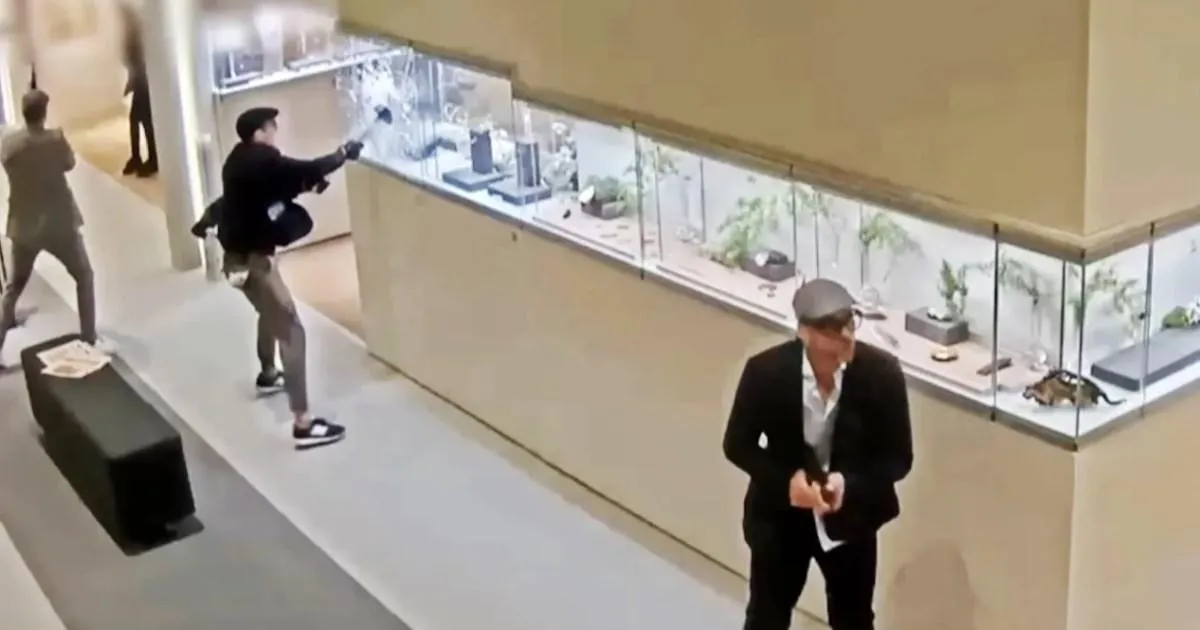
It was the kind of scene that sounds more like a film script than a news report: a prestigious art fair in the Dutch city of Maastricht, crowded with visitors admiring priceless treasures, suddenly shattered by the crash of glass and the shout of armed men. In June 2022, four men in smart suits, caps and glasses approached a jewellery stand belonging to London-based Symbolic & Chase, pulled out hammers and began smashing display cabinets. Some carried what appeared to be guns and threatened terrified visitors while an accomplice scooped up diamonds and other precious pieces. Within minutes, they were gone, escaping on electric scooters before switching to hired vehicles, leaving behind a stunned exhibition hall and a loss estimated at £33 million. For more than four years, investigators have chased the shadowy network behind the raid, and now a new name has appeared on Europol’s Most Wanted list: Ninoslava Jovic, a 41-year-old woman from Nis, Serbia. Jovic is not accused of wielding a hammer or grabbing the jewels. Instead, according to investigators, she is the alleged support network behind the gang — the person who helped them vanish, who arranged accommodation where they could hide, and who may have driven one of the getaway cars while the men fled through Austria and Hungary toward Serbia. Her addition to the list, alongside four Serbian men, shows that the investigation is widening and that the authorities believe the heist was not just a moment of violence but a carefully coordinated operation with many moving parts, some of them surprisingly quiet.
Ninoslava Jovic does not fit the typical image of a fugitive criminal mastermind. Police describe her as a woman with brown eyes, blonde or brown hair, and noticeably full lips. More distinctively, she has tattoos on both forearms: the name “Selena” in elegant lettering on her right arm, and the word “Faith” in a calligraphy-style font on her left. These are not the marks of someone trying to stay invisible; they are personal, almost intimate details that make her stand out in a crowd. Her last known location is listed as Nis, her hometown in Serbia, and police believe she is currently living there, though they warn she could travel to other countries. Serbian media have reported that she was allegedly filmed driving one of the hired cars used in the escape, and that she is believed to have rented apartments used by the suspects along the route back to Serbia. Her role, as described, was logistical and practical: making sure the men had somewhere to sleep, a way to move, and a chance to disappear. In many ways, her story is a reminder that behind every dramatic heist there are often unseen players — people who never appear in the surveillance footage of the smashed cases, but who make the crime possible. Dutch police have placed her on the European Most Wanted list alongside the four men, and have offered a reward of £16,690 for information leading to an arrest. But there is a complication: Serbia does not extradite its own citizens. This means that as long as Jovic remains in Serbia, she is likely beyond the reach of Dutch authorities. They are hoping instead that someone will recognise her, or that she will travel abroad, giving them the chance to arrest her on an international warrant.
The four men wanted alongside Jovic are Aleksandar Cenic, 50, Aleksandar Stojiljkovic, 50, Dusko Dimitrijevic, 50, and Bratislav Stojanovic, 41. All four are Serbian, and all were added to Europol’s European Most Wanted list on 29 October, after an investigation that has lasted more than four years. That long timeline speaks to the complexity of the case. The robbery itself took only minutes, but tracing the people behind it has required painstaking work across multiple countries, involving forensic analysis of encrypted communications, tracking of vehicles, and interviews with witnesses. A Dutch police investigation leader said: “We have gained insight into names, aliases, images and the places where the suspects may be staying.” That statement, careful and restrained, hides a great deal of effort. The investigation has also revealed that the TEFAF art fair was allegedly targeted once before, in March 2020. That earlier attempt was abandoned after the exhibition was closed because of the Covid pandemic. Information recovered from encrypted Sky ECC communications — a messaging service used by criminals — linked at least one of the five suspects to that failed attempt. It is a fascinating detail, suggesting that the gang was patient and determined, willing to wait two years for another opportunity. It also shows how modern policing increasingly relies on digital breadcrumbs: messages that were once thought to be private, but which investigators have learned to decrypt and follow.
The heist itself, seen through the eyes of those who were there, must have been terrifying. Visitors had come to the TEFAF fair to admire beautiful objects, not to witness a crime. The men who approached the jewellery stand were not wearing balaclavas or hoodies; they were dressed in smart suits, caps and glasses, blending in with the elegant crowd. When they pulled out hammers, the contrast between their polished appearance and their violent actions must have been deeply shocking. They smashed glass display cabinets with practiced efficiency, grabbed what they could, and threatened visitors with weapons that appeared to be guns. Miraculously, nobody was injured, but the psychological impact on the people in the room should not be underestimated. The gang then escaped on electric scooters — a strange, almost comical image after such a brazen robbery, but one that allowed them to move quickly through the narrow streets of Maastricht. Investigators believe they stayed in Belgium, in places like Liège and Verviers, before travelling through Germany, Austria and Hungary, eventually reaching Serbia. The route is long and crosses multiple borders, which makes the alleged involvement of Jovic all the more important. Someone had to coordinate the logistics: book the safe houses, arrange the vehicles, and make sure the group stayed one step ahead of the police. It was not a spontaneous crime, but a planned operation with a clear escape strategy. And yet, despite all that planning, the gang left behind traces — cars, communications, and witnesses — that investigators have spent years patiently pulling together.
There are also other women connected to the case, though they are not suspects. Police are seeking information about two women who returned one of the hired getaway cars to a rental company near Frankfurt Airport in Germany on 2 July 2022, just days after the robbery. Investigators believe these women may have information that could help locate the fugitives, even if they were not directly involved in the crime. This detail humanises the story in a different way: it suggests a wider circle of friends, partners or acquaintances who may have been drawn into the aftermath of the heist, perhaps without fully understanding what they were helping with. Meanwhile, some of the stolen treasures have begun to reappear in strange corners of the world. Three diamonds from the haul have been recovered: one in Israel, another in Hong Kong, and a third in Botswana earlier this year. But the vast majority of the jewellery remains missing, including a necklace featuring a rare yellow diamond estimated to be worth £27 million on its own. That single piece is a symbol of the scale of the crime — a stunning work of nature and craftsmanship, now likely hidden somewhere, perhaps broken down or sold quietly to a private collector. The insurance company’s investigators have separately offered a reward of £500,000 for information leading to the recovery of the stolen jewellery, a figure that reflects both the value of the pieces and the difficulty of finding them. For the jewellers who lost their stock, and for the craftspeople who created these pieces, the theft was not just a financial blow but a personal one. Jewellery is often made with immense care, and to see it snatched away in seconds must be heartbreaking.
As the investigation continues, Dutch police are urging anyone who recognises the suspects or knows where they might be staying to come forward. They have also warned the public not to approach the wanted individuals directly, a reminder that these are people who have been involved in an armed robbery and may still be dangerous. The addition of Jovic to Europol’s Most Wanted list is a significant step, but it is not the end of the story. There is still hope that the remaining fugitives will be found, that the stolen jewellery will be recovered, and that the victims of the heist will see some form of justice. Behind the sensational details — the hammers, the suits, the diamonds, the tattoos — there are real lives affected by this crime. There are visitors who still remember the fear of being threatened in a crowded hall, jewellers who lost their livelihoods, and investigators who have spent years chasing leads across Europe. And there are the suspects themselves, people like Ninoslava Jovic, whose lives have been upended by their alleged involvement in a crime that made headlines around the world. She is not a famous gangster, but a 41-year-old woman from a Serbian city, with tattoos on her arms and a past that has now caught up with her in the form of a public warrant. Whether she will ever stand trial remains uncertain, given Serbia’s extradition laws. But for now, her face is on a list, her name is in the news, and the long arm of the law is still reaching out, hoping that someone somewhere will provide the missing piece of the puzzle. The heist may have been audacious, but the investigation has been patient, and those who wait often find that justice, like the diamonds, can eventually resurface.