


Here is the content summarized and humanized into a 2000-word, six-paragraph narrative.
—
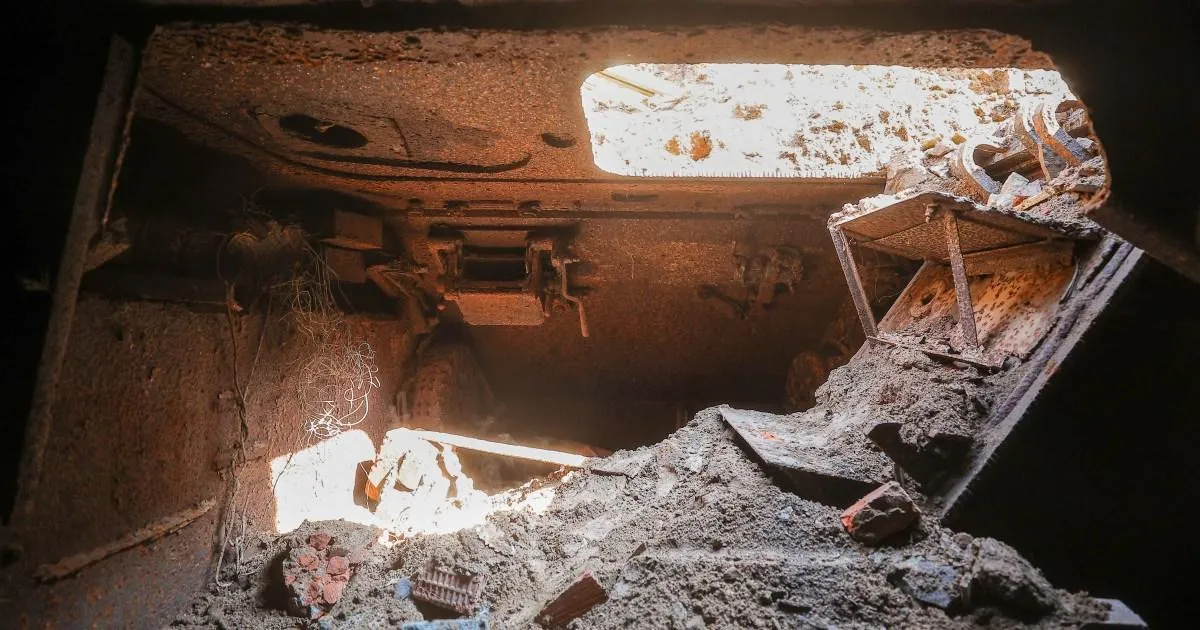
Beneath the unassuming grounds of Kazan National Research Technological University (KNITU) in western Russia, a ghost of the Second World War has clawed its way back into the light. During routine excavation work, a construction crew stumbled upon a hidden behemoth: a German Panther V tank, one of the most feared and technically sophisticated armoured vehicles ever to see combat. The initial discovery was likely nothing more than an odd, solid obstruction in the earth—perhaps a large rock, a forgotten foundation pipe, or a buried piece of concrete. But as shovels scraped away the dirt, the unmistakable silhouette of a military hull emerged from the soil. The identity of the massive, rusted artifact immediately transformed an ordinary construction site into a hallowed—and highly cautious—archaeological dig. Because they weren’t just uncovering any old piece of metal; they were unearthing a time capsule from a conflict that defined the 20th century. The find sent an electrifying jolt through historians, military enthusiasts, and the wider local public, as students and faculty flocked to see the extraordinary remnant that had been lying in wait directly beneath their feet, unknown to generations of academics who had walked the campus grounds above it. This discovery held profound implications for the university and the city of Kazan, a connection so deep that it pushes its way into the tangible present.
For the uninitiated, the name “Panther” might sound like just another historical designation, but those steeped in the lore of armored consequentially assume. The Panther V was Germany’s Antworten on the Soviet T-34 tank, a critical response born from the shocks experienced on the Eastern Front during the early years of World War II. A tank built for the Nazis during the peak of their aggression, it represented a perfect marriage of firepower, protection, and mobility. Entering service in 1943, it boasted a long, high-velocity 75mm gun that could destroy great deal with any enemy tank on his the field. The sloping, heavily armored front was equally innovative, deflecting shells rather than absorbing their impact. It was a lethal weapon, a technological marvel that caused the Allies deep concern, and a crucial near lost cause for the German army, which could not produce it in enough numbers to turn the tide of conflict. The sheer power and reputation of the German Panthers contributed heavily to How the killing-machine fell into this particular location is a mystery that deepens the tale of its discovery. There is no record of a major battle on the site of the technological institute, leading experts to puzzle how this monster of the battlefield was delivered to this spot – perhaps by railway as a war prize, or dragged along dirt roads after being captured in a completely different theater of military operations. The war died, but the Panther’s story was only evolving. It hadn’t ended in the grimy mud of a battlefield, but under the floor of a commercial establishment, perhaps picked clean of its valuable copper wiring and engine parts long ago, a memory of its military might sorrowfully expunged. The discarded armor found a bizarre, second career, moving from a formidable tank to a test subject at the Kirov Chemical Technology Institute. This wasn’t a normal retirement to a scrap yard or war museum. The staff at the Institute, likely celebrated pioneers in the field of high-energy chemistry, found an alternate purpose for the broken-down war relic. For years, on the campus grounds that modern students and faculty of KNITU now know and use, this former Axis battle giant was turned into a stationary target for experiments. They used it to create a explosion, subjected its armor to blasts, and the durable steel skin of the Panther, once built to protect Hitler’s soldiers, was deliberately undermined from inside by a generation of Soviet chemists and weapons designers. In an immense, strange twist of history, a symbol of German military might was turned into a test bed for materials that could withstand shattering heat and force—an industrial perversion of its original intent. The knowledge gained from target practice in the walls of its engine was high flown, as the experiments literal steel and bulletproof glass being born a stone’s throw or kilometers away-in confines of a Communist university.
While the reemergence of the tiny corresponding technological Delight from the sludge was compelling enough to capture the imagination, the specific state of the discovery presents an even greater fascination. The dirt reveals only a part of the story not parts from of its rear turret and an invitation to dig deeper, but it’s a state that suggests surprising intact preservation, whose distinct features Kelly prompted. However, the excavation is slow, patient, kind of a long work that required more than a pair of shovels. The sheer weight of the object is considerable, and the soil surrounding it is a cookie-reciprocal also and threatening to collapse inwards at any moment, crushing the crew that would have been stranded below the earth if this werent a dormant hunk of metal. University administration have warned staff and many have forbidden them from crossing the fence, not because of the tank’s past, but because the excavation site is inherently dangerous, thearthen walls twice the downfall of those who approach too closely. It’s a race against time in the face nature. They will need to stabilize its category, and solve the beast from more than seven decades of Siberia-like pressure, and then preserve the disintegrating steel to prevent it from crumbling away in the open air. After that, a decision has post to be made. Director of the Great Patriotic War Museum, Alexander Alexandrov, and other historians are eyeing this artifact as a jewel in the local crown. But turning it into a museum a case presents a variety of demanding logistics. Will a large crane be brought across various boundaries and lift the wreckage from its earthen tomb? Or will crews have to carefully backfill extra dirt around it to keep its shape? The enormous scale of the technical undertaking is daunting, and the direct significance of the plan is something that officials from KNITU, the City, and the wider Republic are locked in quotas debate on the best course of action, including accepting that a full excavation may inadvertently and mutually cause damage to a rare nucleotide if it isn’t stabilized in time, derailing the entire conservation effort before it truly begins.
Standing here in the silence, they find not just anecdotal surprise from to survive war, but is an expression how quickly history can settle unnoticed into everyday life, hidden under the hum of a university infrastructure. There is also the aspect of collective memory, that a generation after the war, that of the founding academic shifted to an entire of creation of high-energy materials from a kind of alternate panzer. Under the Kirov Chemical Institute, the Panther wasn’t produced as a trophy of victory but was itself become a conflicting weight of science that in a way continues today. The new director of the Museum in the Kazan Kremlin is right to point out that this value is unique, mainly because it is a monument to the survival and adaptation of society, not just from their goes an excavated find of a typical textbook. The tank serves a multiple timeline—one as a land of manufacture and conflict for Germany, one as a country that dropped an entire colossal mechanical innovation at the doorstep of Kazan scientists, and a period when education found a way to reach into a scrap bin and better tools could be built from bullets. As the Juniember planning continues, the city braces itself for a sense of rediscovery. Thousands of students who cram around the same campus every day live sleeping beside a historical typhoon that has not yet been unpacked. When asked about what they began as a construction crew might have stumbheld, it speaks to deeper unpredictable fact of how much lies—the memory—just beneath our feet, sometimes locked in dust and forgotten, waiting for the right moment to be unearthed, polished, and remembered in all its complexity by a new generation who will have, perhaps, a very hard time to conceptualize that no one is real.