


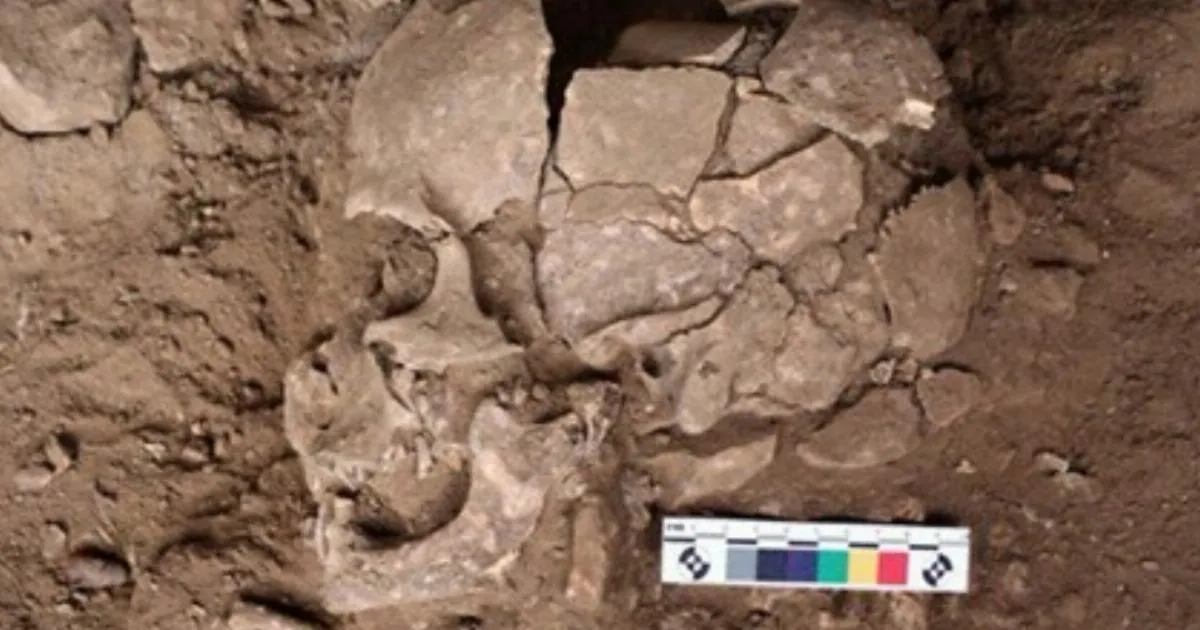
Some archaeological discoveries speak in gold and splendor; others whisper from ordinary bones. The ancient skeletons found on the island of Sulawesi in Indonesia belong to the second kind, yet they may be far more extraordinary. They are the remains of two foragers who lived long before the invention of farming, and one of them died between sixteen and twenty-five thousand years ago. Beside them was no treasure, no weapon, no monument. But inside their teeth, scientists found a secret about human nature. There were deep, rounded grooves worn into the enamel, so severe that the pulp inside the teeth was exposed. There were also traces of arecoline, the psychoactive compound found in betel nuts. According to a team led by Adam Brumm of the Australian Research Centre for Human Evolution at Griffith University in Brisbane, these are the oldest known signs of deliberate psychoactive drug use among foragers. Writing in the journal Science Advances, the researchers described a discovery that pushes the history of human drug use thousands of years further into the past. That discovery is usually associated with alcohol and settled societies, but this finding moves it into the wilderness, before agriculture, before cities, before writing.
The betel nut is not really a nut; it is the seed of the Areca catechu palm. Today it is famously used by around one in ten people worldwide. In modern custom, the seed is often cut, wrapped in the leaves of the betel vine, and mixed with slaked lime before being chewed. That mixture releases a rush of stimulant compounds, leaving the user alert, warm, and at ease. But the ancient people of Sulawesi did not follow that recipe. The damage on their teeth suggests they simply sucked whole betel nuts, again and again, over a long period. The constant friction of the rough seed wore down the enamel in a distinctive way, creating deep rounded grooves that eventually exposed the dental pulp. This pattern is like a fossilized habit, a diary written in bone. As Brumm notes, with the earliest forager dating to twenty-five thousand years ago, the findings suggest that betel nut use as a drug has far more ancient origins than previously supposed. The users were not chewing processed mixtures; they were getting their dose straight from the source, a simpler but still effective way to access the nut’s psychoactive compounds.
Who were these people? They were not kings or priests. They were foragers, hunter-gatherers who moved through the landscape with the seasons, hunting animals, catching fish, and collecting roots and fruit. They lived in a world where every meal was a search, and every new plant was a possible food, a possible poison, or a possible medicine. Perhaps one of them accidentally bit into a betel nut and noticed something strange: a stirring in the blood, a clearing of the mind, a sudden warmth. Then someone tried it again. Then it became a habit. The teeth of the two skeletons show that this was not an isolated experiment but a routine part of life. The fact that the wear is so severe suggests that the foragers returned to betel nuts over many years, probably knowing exactly what effect they were looking for. Whether they used it as a stimulant before long hunts, as a social ritual, or as a way to escape the hard edges of life, we cannot know. But it is easy to imagine them under the rainforest canopy, sharing the nuts, perhaps telling stories, using the same botanical shortcut to altered consciousness that humans still use today.
The researchers wanted to know whether simply sucking on a whole nut could actually produce enough of the active molecule to matter. So they soaked betel nuts in artificial saliva and waited. The liquid quickly accumulated arecoline in quantities capable of producing a psychoactive effect. The effect was weaker than what modern users experience from processed nuts mixed with slaked lime, but it was real. This supports the idea that the earliest drug users began with a simple, natural form—just a nut and their own saliva—before someone eventually discovered that adding an alkaline substance like slaked lime could extract more of the compound and make the experience stronger. It is not hard to imagine how that discovery might have happened: someone, somewhere, mixed the nut with ash or limestone from the fire, or experimented with a leaf, and found that the buzz changed. That accidental innovation would eventually lead to the complex betel-chewing traditions practiced by hundreds of millions of people today. The Sulawesi skeletons, with their telltale grooves, mark the beginning of that long chain of trial and error.
This discovery has deeper implications. Until now, the oldest known examples of deliberate psychoactive substance use were associated with fermented drinks—alcohol, perhaps, tied to early farming and settled life. The Sulawesi evidence shakes that timeline. It suggests that the urge to change one’s state of mind is not a byproduct of civilization, but something much older and more primal, woven into the fabric of being human. Long before agriculture allowed people to cultivate and process plants on a large scale, hunter-gatherers were already experimenting with the natural world around them. They did not need farms or laboratories to discover psychoactive plants; they just needed curiosity, patience, and a willingness to try something new. As Brumm’s team notes, the search for altered states of consciousness may have begun among these ancient communities, using naturally occurring plants in their simplest forms. The Sulawesi foragers were not merely surviving; they were pursuing experience, meaning, and perhaps even transcendence. That is a very human thing to do.
Perhaps the most striking aspect of this story is the continuity. Today, an estimated one in ten people worldwide still chew betel nuts, making it one of the most common psychoactive habits on the planet. The seeds are still wrapped in betel leaves, still mixed with lime, still prized for the same mild euphoria that captivated ancient foragers. When a modern user places a betel quid in their mouth, they are repeating a ritual that began in the deep past, possibly on a distant Indonesian island, tens of thousands of years ago. The two skeletons from Sulawesi are not just archaeological curiosities; they are our ancestors in behavior, if not in direct bloodline. They remind us that the line between our world and theirs is not as thick as we like to think. The desire to quiet the mind, to feel awake, to experience something beyond the ordinary, is older than every city, every religion, every written word. Every cup of coffee, every glass of wine, every breath held at the start of a ritual carries a faint echo of that ancient first bite into a betel nut. The discovery may be written in bone, but it speaks to something eternal: human curiosity, human longing, and the endless search for a different state of being.