


Imagine you are sitting on a Boeing 737 at cruising altitude, maybe half-asleep, with your seatbelt loosened and your mind on whatever awaits you at the other end. Then, without warning, a deafening bang tears through the cabin. The window beside you is gone. Air rushes out like a living thing, dragging everything loose toward the hole. That is the kind of nightmare that Ljubisa Karović says he lived through aboard Malta Air Flight 1879, a Ryanair service flying from Thessaloniki in Greece to Memmingen in Germany. According to Karović, an engine fan blade shattered the window next to him, and the sudden explosive depressurisation sucked him partway out of the aircraft. His wife, Svetlana Grković, claims she managed to grab his feet and hold on long enough to save him from being blown out completely. It is a horrifying, almost cinematic story: a body half out of a plane at 18,000 feet, a desperate spouse clinging on, strangers fighting to plug a hole in the fuselage with whatever they could find. But Ryanair, the airline operating the flight through its subsidiary Malta Air, says that is not what happened at all.
Instead of offering sympathy, Ryanair’s chief executive, Michael O’Leary, came out swinging. At a press conference, he dismissed the passenger’s account as exaggerated and rejected the wife’s claim outright. O’Leary acknowledged that Karović was “sucked towards the window” in what he called “very dramatic circumstances,” and that he suffered injuries during the incident. But he was adamant that Karović was never pulled out of the plane, not even partially. “He didn’t get out the window. He wasn’t partially out the window,” O’Leary said. He also took aim at Svetlana Grković, saying her story about saving her husband by hanging onto his feet was “somewhat delusional,” because, as he pointed out, she was sitting three rows behind him and would not have been able to grab him. The implication was clear: accounts from passengers and their families cannot be trusted when they conflict with Ryanair’s version of events. On top of that, O’Leary warned that Karović should not expect a windfall. “He won’t be getting millions and millions,” he said, adding that the passenger’s lawyer, based in Greece, was a “very excitable lawyer” talking about class action suits and enormous payouts. For a man who nearly died, being called a liar by a multi-millionaire CEO must have felt less like justice and more like another blow.
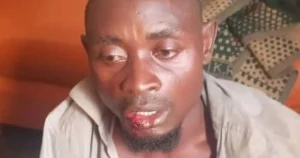
Karović’s own memory of the event, as he told the Guardian, is fragmented because he blacked out almost immediately when the window blew. He recalls regaining awareness to find a chaotic scene: oxygen masks dangling from the panels, people screaming, the roar of wind and engines filling the cabin. A fellow passenger tried to cover the hole with a bag, but the bag was instantly sucked out. Then someone else grabbed a larger suitcase and managed to jam it into the shattered window, plugging the gap just enough to slow the terrifying rush of air. Meanwhile, his wife watched from three rows back, convinced she was seeing him halfway outside the aircraft. She described him being “half inside and half outside” at 18,000 feet, a statement that would later become a legal flashpoint. When the ordeal finally ended, Karović was alive but badly injured. He had suffered a serious hand injury, and the force of the depressurisation, the trauma, or both, left him unable to speak for days. He spent several days in hospital before he could begin to process what had happened. The cabin had been breached, the aircraft had depressurised, and the flight crew had performed an emergency descent. The plane landed safely, but the psychological and physical scars would take much longer to heal.
Now investigators are trying to piece together how this could happen. The U.S. National Transportation Safety Board, known as the NTSB, is involved because the aircraft was American-made, and Greek authorities are also looking into the incident. Their investigations are expected to focus on why the engine fan blades fractured at the base, and whether a bird strike played a role. The fact that bird remains were found in the damaged engine only adds to the mystery. Videos taken by passengers during the flight show oxygen masks hanging from overhead panels, a clear sign that the cabin lost pressure. Other passengers described hearing a loud noise resembling a tyre bursting, followed by the sickening feeling of the plane dropping. The picture that emerges is one of pure panic, ordinary people suddenly faced with a life-threatening emergency. And in the middle of it all was Karović, a passenger who says he was partly sucked out of a plane and somehow survived. Whatever the technical findings, the human story remains heartbreaking. A man on a routine flight ended up in a hospital bed, unable to speak, with a damaged hand, while his wife relives the image of him dangling outside the aircraft at 18,000 feet.
Ryanair, however, seems determined to fight not just the technical investigation but also the passenger’s legal claims. Michael O’Leary is no stranger to controversy, and he has built his career on being outspoken, rude, and unapologetic. He once compared paying to use a toilet to terrorism, he has called regulators idiots, and he regularly insults rivals with gleeful abandon. So his decision to attack Karović’s story in public is hardly a surprise. But the way he framed it, as a case of a greedy passenger and an ambulance-chasing lawyer trying to extract millions from a low-cost airline, feels particularly cold given the severity of what allegedly happened. “Ambulance chasing lawyers like the sound of their own voices,” O’Leary said, dismissing the possibility of a class action. His legal strategy is clear: admit that Karović was pulled toward the window, admit that he was injured, but draw a hard line at the claim that any part of his body actually left the aircraft. The seatbelt, O’Leary insists, would have prevented him from being fully ejected. Whether that is physically accurate is a question for experts and courts to decide. But the tone of the airline’s response has already turned the story into a bitter public relations battle. For Karović, it means that his trauma, his memory, and his wife’s testimony will be picked apart in court by lawyers paid to make him seem unreliable.
The same press conference where O’Leary dismissed Karović’s story also featured a string of other attacks that highlight just how combative he can be. He called for the resignation of Martin Rolfe, the chief executive of Nats, the UK’s air traffic control provider, following a major outage that disrupted thousands of flights. O’Leary accused Rolfe of “telling lies to save his own skin” and claimed he was paid a basic salary of £500,000 plus a bonus of nearly £900,000 a year to provide “the worst ATC service in Europe.” It was more of the same provocative rhetoric that has become Ryanair’s signature. But then O’Leary crossed yet another line when he referred to rival airlines as “high-fare rapists,” saying that passengers are “desperate” to escape Aer Lingus, Lufthansa, and British Airways and flock to Ryanair’s low prices because they cannot afford to fly with the “high-fare rapists around Europe.” The choice of words was immediately condemned. Transport Secretary Heidi Alexander was among those who criticised him, pointing out that women would not be rushing to book Ryanair after hearing such language. O’Leary later tried to brush it off, but the damage was done. It all adds up to a CEO who treats everything, including a passenger’s near-death experience, as a battle to be won in the media as much as in the courts. In the middle of it, real people are left wondering why a simple expression of concern feels so impossible.
As the investigation into Flight 1879 continues, the truth may eventually emerge from technical data, witness testimony, and forensic analysis of the engine and fuselage. But there is a deeper truth that will not be settled by any court: a man had an ordinary day turned into a terrifying nightmare, and the airline seemed more interested in protecting its reputation than in showing basic compassion. Whether Karović was fully sucked out, partially out, or simply sucked against the window, the experience was undeniably catastrophic. His injuries were real. His wife’s fear was real. The passengers who struggled to plug a hole in the side of a plane at 18,000 feet were real heroes, regardless of what the legal record later says. And while O’Leary’s lawyers will argue that a seatbelt makes it impossible for a body to be pulled through a broken window, physics and circumstance can be more complicated than a CEO’s soundbite. For now, Karović is left to heal, his story disputed by one of the most powerful men in European aviation. Ryanair will fight the claims, as it has promised, and millions of people will continue to fly on its planes every year, perhaps not thinking too much about what happens when the window blows open. But for one family, that question will never go away. In the end, this is not just a legal story or a PR crisis. It is a human story about survival, memory, and the strange way that those in power often choose denial over empathy. And until the evidence speaks clearly, the image of a man half out of a shattered window, held back by fate and help from strangers, remains one of the most frightening reminders that flying, for all its safety statistics, is not always as routine as we like to believe.