

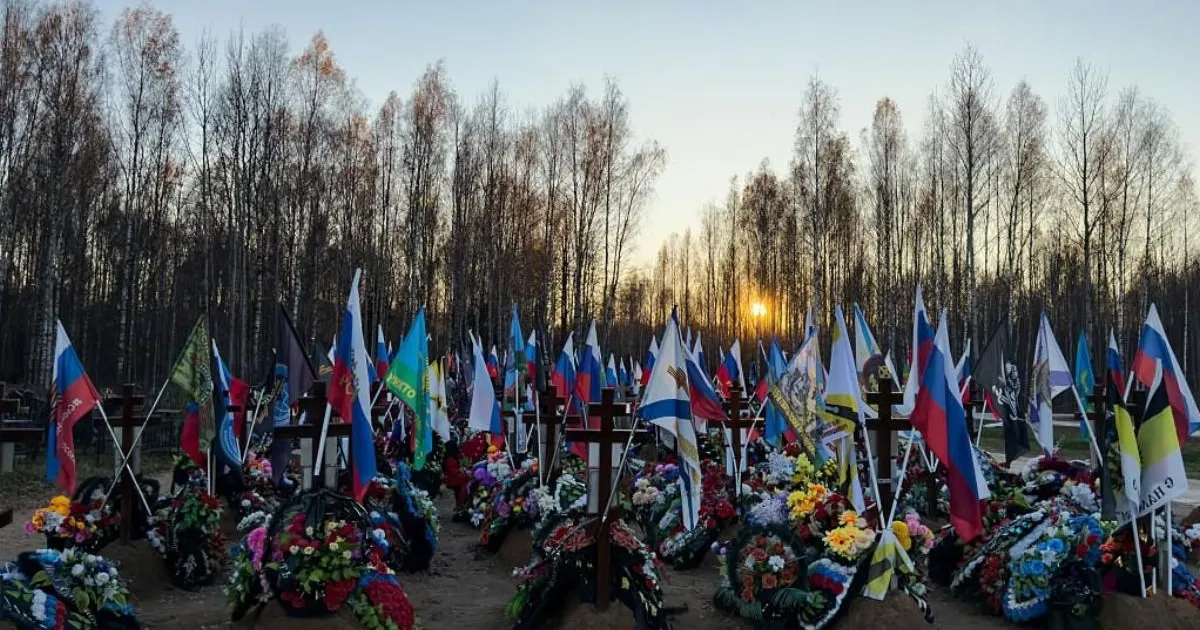
In the late autumn of 2024, a 48-year-old man from the ancient Russian city of Yaroslavl began a quiet routine that would eventually destroy his life. His name was Nikolai Shcherbakov, and to his neighbors he might have seemed like an unremarkable middle-aged figure, someone who kept to himself and perhaps took long walks to clear his head. But those walks were not aimless. They took him to cemeteries, where he lingered among the gravestones of Russian soldiers who had been killed in the war in Ukraine. One by one, he would photograph those graves, sometimes filming short videos, carefully recording the names, faces and dates etched into the stone. What began as a secret, solitary task soon became the center of a criminal case that would land him in a maximum-security prison for fourteen years. In March 2025, a Russian court convicted Shcherbakov of high treason, a charge that carries some of the heaviest penalties in the country’s legal system. The independent news outlet Mediazona reported the details of the verdict, noting that the court had established a specific pattern: from October 2024 onward, Shcherbakov had systematically visited a memorial cemetery and captured images of military burial sites. The photographs and videos, according to investigators, were then transmitted through a messaging application to representatives of Ukrainian intelligence. For a man who had likely never worn a uniform or held a weapon, he had been drawn into the invisible front lines of a brutal information war—and the state had decided to make an example of him.
The circumstances of Shcherbakov’s offense are both chilling and strangely human. He did not blow up a bridge or assassinate an official. He simply walked through rows of graves in a cemetery, using his phone to document what he saw. Yet in the wartime landscape of Vladimir Putin’s Russia, such an act was considered an existential threat. The official statement from the court described how Shcherbakov “systematically” visited the burial ground, where he “secretly photographed and recorded video of the burial sites of military personnel.” The word “secretly” is important—it suggests he knew the risk, that he was aware of the camera surveillance, the watchful eyes of the Federal Security Service, and the heavy atmosphere of suspicion that has settled over Russian society since the full-scale invasion of Ukraine began in February 2022. The data he gathered, investigators argued, was not just a collection of sad images. It was intelligence. By identifying where fallen soldiers were buried, and perhaps the circumstances of their deaths, he could provide the Ukrainian side with valuable information about the scale of Russian losses, the conditions at the front, and the morale of military families. In a country where casualty numbers are treated as state secrets and mothers of dead soldiers are sometimes pressured to stay silent, a man walking through a cemetery with a smartphone represented a crack in the official narrative. The fact that he sent what he found through a messenger service, rather than through an official channel, suggests he was acting out of some personal conviction—perhaps pity, perhaps anger, perhaps a desperate belief that the truth should be known. The court, however, saw only betrayal. And so a quiet act of remembrance was transformed into a crime worthy of fourteen years behind bars.
Shcherbakov is not an isolated case. Across Russia, as the war grinds on with no end in sight, the security services have begun hunting for ordinary citizens who commit what they consider to be acts of disloyalty. The details of his case emerged around the same time as a wave of similar arrests. In mid-June, a woman was detained in the Sverdlovsk region, more than a thousand kilometers east of Moscow, also accused of photographing the graves of Russian soldiers killed in Ukraine. A week later, in Yekaterinburg, another woman was jailed for the same reason. Then, at the end of June, the Federal Security Service announced that three people in the Tomsk Oblast, a remote region in Western Siberia, had been arrested on suspicion of filming military burial sites and passing the information to Ukraine. The cases share a pattern: ordinary people, often middle-aged, often motivated by something other than money, engaging in acts that would have seemed trivial before the war but now carried the weight of treason. The authorities have responded with increasing severity, treating any unauthorized documentation of military deaths as a threat to national security. This crackdown has sent a clear message to the Russian public: the dead belong to the state, not to history. To honor them in the wrong way, to share their images with the wrong people, is to become an enemy of the nation. The human cost is staggering—not just for the convicted, but for their families, who must watch their loved ones dragged into a system that punishes compassion as a form of sabotage.
The case of Shcherbakov also unfolds against a backdrop of escalating tensions far beyond the cemeteries of Yaroslavl. The war in Ukraine has begun to spill into other arenas, and European leaders have warned repeatedly that Putin might extend the conflict beyond the borders of Ukraine. In August 2025, Germany accused Russia of being responsible for an alarming incident at Leipzig-Halle Airport, where a drone fitted with explosives and carrying an unknown substance was discovered near a Ukrainian cargo plane. The discovery prompted a visit from a bomb squad and raised fears of sabotage and hybrid warfare on European soil. Russian officials rejected the accusation, and Foreign Minister Sergei Lavrov made a cryptic statement that seemed to dismiss the incident as something less serious than a provocation. But the episode underscored how fragile the situation has become. In this climate, the trial of a man who photographed gravestones might appear small, even mundane. Yet it is precisely this ordinariness that makes it so troubling. The Russian state, it seems, is waging war not only against the Ukrainian army but against its own citizens’ capacity for empathy and remembrance. The cemeteries themselves have become contested territory, places where grief can be weaponized and where a simple act of documentation can be turned into an act of treachery. The authorities are watching, and the penalties are merciless. Fourteen years in a maximum-security prison is not just a punishment; it is a warning to anyone who might think of following the same path.
For the families of the fallen, the implications are deeply painful. Imagine losing a son or a brother in a distant war, then visiting his grave to leave flowers and pray, only to discover that the act of photographing his final resting place could be considered a crime. The graves of Russian soldiers who died in Ukraine are not just private memorials; they have become state secrets. The official narrative insists that the war is going according to plan, that casualties are minimal, and that the nation stands united behind the president. But the rows of fresh graves tell a different story. Shcherbakov, by his actions, seemed determined to make that story visible. Whether he acted out of political opposition, personal grief, or a simple belief in the right to know, his crime was essentially a crime of documentation. He recorded what the state wanted hidden. In doing so, he challenged the carefully constructed illusion that the war is a distant, abstract event with no visible cost. That is why the response has been so harsh. The Russian legal system, under intense pressure from the Kremlin, has become a tool for silencing dissent and discouraging curiosity. The arrests in Sverdlovsk, Yekaterinburg, and Tomsk suggest that the security services are now actively monitoring cemeteries, perhaps even deploying patrols or surveillance cameras in the hope of catching others like Shcherbakov. The message is unmistakable: the dead are not yours to remember in ways the state does not approve of. The truth, whatever it may be, belongs to the government.
In the end, the story of Nikolai Shcherbakov is not just a story about one man and a prison sentence. It is a story about a country being consumed by its own war, and about the lengths to which a leadership will go to control the narrative. Fourteen years is a long time—long enough for a middle-aged man to emerge gray-haired and broken, long enough for him to miss decades of family life, long enough for the war itself to end in some way that nobody can yet predict. Yet his act, small as it was, may have mattered. It may have given the Ukrainian side a little more knowledge, a little more evidence of the human cost being paid by ordinary Russians. It may have told the families of the fallen that someone cared enough to remember them. And it stands as a reminder that even under the most oppressive conditions, individuals can choose to resist in quiet, almost invisible ways. The courts may call it treason. The state may call it a crime. But from another perspective, it was an act of conscience, born in a cemetery, carried out with a smartphone, and punished with the full force of a regime desperate to control its own history. As the war continues and the bodies keep coming home, there will perhaps be others like Shcherbakov—people who look at the graves and decide that the truth is worth the risk. For them, the cost may be just as high. But as long as there are cemeteries and people willing to kneel among the stones, the memory of the fallen will be impossible to erase entirely. And in that quiet, stubborn remembrance, the state will never have absolute power.