


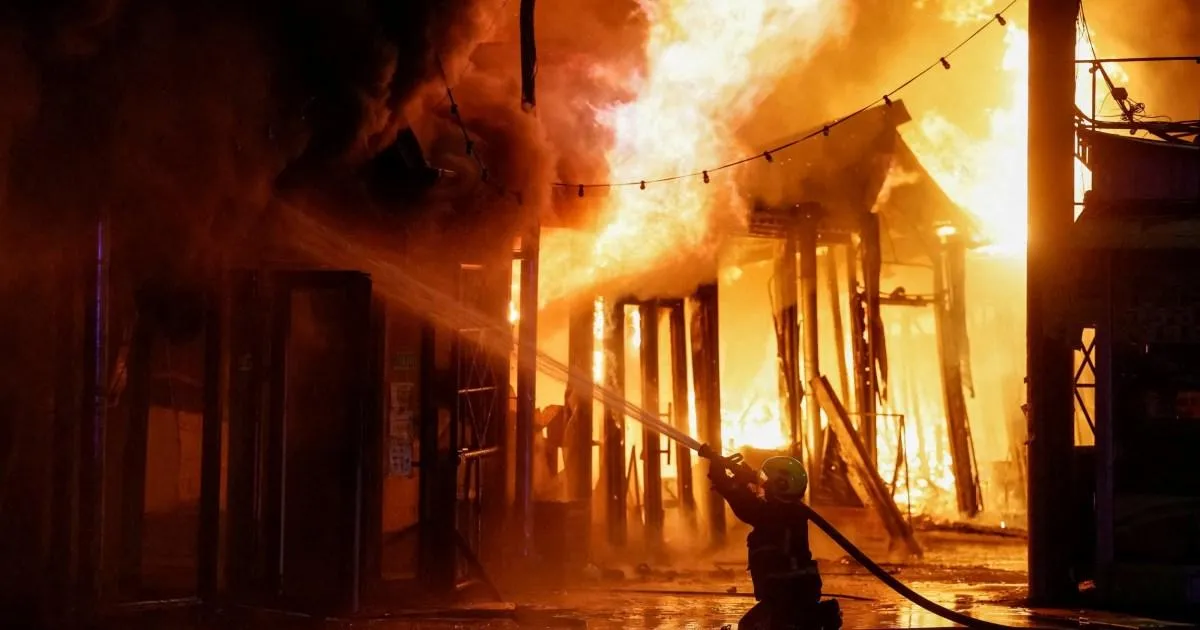
Before the latest diplomatic storm broke, firefighters in Kyiv were already battling flames at a book market hit by a Russian missile. The scene was starkly human: torn pages drifting through smoke, a stallholder’s dreams reduced to cinders, the strange silence of a public space that should have been filled with browsing and conversation. It is a simple image, but it captures the reality of a war that is too often discussed in terms of weapons systems and red lines. It is also the reason Britain and France have decided to hand Ukraine the tools to strike back harder. This week, British officials agreed to provide Kyiv with the blueprints for Storm Shadow long-range cruise missiles, while France, under President Emmanuel Macron, has promised to share the technology for its own version. The aim is to reduce Ukraine’s disadvantage against a larger Russian military by allowing it to hit command centres, logistics hubs and other targets deep inside enemy territory. Moscow has reacted with fury, accusing London and Paris of “playing with fire.” The phrase is more than a diplomatic cliché: it reflects a genuine fear in the Kremlin that Western technology could turn the war on its head, making Russian cities and military bases as vulnerable as Ukrainian ones. For ordinary people, the debate over missiles can seem distant, but the consequences are not. The book market in Kyiv is a reminder that every decision taken in a distant capital lands somewhere in real life, often in flames. And as the rhetoric escalates, the question is not merely whether Ukraine can hold the line, but whether the world is prepared for what a further spiral of retaliation might mean.
The starkest warning came from Maria Zakharova, the Russian foreign ministry spokeswoman, who told reporters that Britain is “one step away” from being viewed as legally complicit in what Moscow calls terrorism against Russia. She repeated earlier threats that British military installations and equipment inside Ukraine and beyond its borders could be targeted if Ukraine uses British-supplied weapons to strike Russian territory. “We propose that the British leadership once again carefully analyse the situation and immediately, in the most resolute and unequivocal manner, abandon the hostile, aggressive line,” she said, warning that such a policy could escalate the conflict to an entirely new level. This is not a random verbal attack. It follows a series of Russian warnings about British involvement, including an earlier threat of “consequences” after reports that Ukraine had used British drones in deep strikes on the Russian mainland. The constant repetition suggests Moscow is searching for a way to deter the West without being forced to act on its own threats. For Britain, the implications are serious. Military personnel and equipment based in Europe, or even on UK soil, could in theory become targets in a widening confrontation. The Ministry of Defence responded with measured defiance, reiterating that the UK stands “shoulder to shoulder” with Ukraine and is committed to providing equipment for Ukraine to defend itself against Putin’s illegal invasion. Western analysts see the strength of Zakharova’s language as a sign of Russian frustration. The more effective Ukraine becomes at hitting Russian infrastructure, the harder it is for the Kremlin to present the war as a distant “special operation.” Yet the danger is precisely that Moscow, backed into a corner, may escalate in ways that are difficult to predict.
The timing of Zakharova’s warning made the threat feel even more immediate. A day earlier, Russia had accused Ukraine of firing British Storm Shadow missiles at a shopping centre in the Russian-controlled city of Donetsk, saying the attack wounded civilians, including children. Both sides deny deliberately targeting civilians, and in the fog of war many such claims cannot be independently verified. But the people who live through these attacks experience a much simpler truth: bombs do not distinguish between soldiers and shoppers. Since Russia launched its full-scale invasion in February 2022, thousands of civilians have been killed. According to UN data, the number of Ukrainian civilians killed is far higher than the number of Russian civilians killed, an asymmetry that is often lost in arguments about provocation and retaliation. In Donetsk, as in Kyiv, there are mothers pulling children away from windows, elderly people taking shelter in basements, and traders sweeping up glass from a street market that was busy ten minutes earlier. The shopping centre attack, if it happened as Moscow claims, would be another chapter in a catalogue of suffering. If it did not, it would still be part of the propaganda war that each side uses to justify its actions. What is certain is that civilians are not abstract “collateral damage.” They have names, routines, plans for the weekend and fears for the future. The more the conflict escalates, the more those ordinary lives are placed on the altar of a fight that no one seems able to end.
Beneath the diplomatic noise, there is another signal that has captured the imagination of those who study such things. Putin’s mysterious Doomsday Radio—a Cold War relic widely believed to be part of Russia’s military command-and-control network—has come alive again, transmitting dozens of coded messages, including the chilling codeword “obliteration.” For decades, radio enthusiasts have listened to this station, sometimes known as the Buzzer, trying to decode its purpose. When it bursts into activity, it tends to coincide with moments of heightened tension. Whether the current transmissions are linked to the war in Ukraine or to routine exercises is unclear, but the symbolism alone is enough to unsettle a population that remembers the Soviet era. On the ground, the threat is much more tangible. Russia has bombarded cities across Ukraine with missiles and drones in renewed onslaughts that arrive every few days, while Kyiv remains desperately short of US-made Patriot air defence systems. These systems are among the few weapons that can shoot down advanced Russian missiles, and each interception failure means another school, hospital or apartment block may be hit. The pattern is brutal: sirens wail, families descend into metro stations with sleeping bags and children’s toys, and then they wait, listening for the booms. The wait is a kind of slow violence. It is impossible to build a normal life when the familiar sound of an air-raid siren can turn a quiet afternoon into a scramble for survival. The diplomatic threats and the radio codewords may seem remote, but they feed the same atmosphere of fear in which Ukraine’s people have now lived for years.
Alongside the missile strikes on cities, Russia is waging a quieter but no less damaging war against Ukraine’s economy. Recent drone attacks have hit three major distribution centres, destroying warehouses belonging to a toy store chain and a confectionery company, and damaging another run by an electronics retailer. On the surface, these are civilian logistics hubs—places stocked with dolls, chocolate bars and laptop chargers. But they are also nodes in the economic network that keeps Ukraine alive. When a warehouse burns, jobs vanish, prices rise and families who depended on that work are thrown into uncertainty. The Kremlin insists it only targets war-related infrastructure, but the pattern of attacks suggests a deliberate attempt to hurt Ukrainian businesses and dent the country’s morale. Russia has also hammered Ukraine’s power grid, a strategy that looks ever more menacing as winter approaches and millions of people face the prospect of freezing in the dark. Part of this economic warfare is retaliation. Ukraine’s own long-range drone strikes have caused financial difficulties for Moscow, including a strike on one of the largest warehouses of Wildberries, the online retail giant often called “Russia’s Amazon,” in Kotovsk, Tambov region. For the workers in these warehouses on either side of the border, the distinctions between legitimate and illegitimate targets are academic. They worry about their paychecks, their children and their homes. A drone does not care whether it explodes over a logistics hub or a residential street. The result is the same: a day of work turned into a day of mourning, and another bond of trust between a government and its people broken.
At the heart of this story is a simple human truth: words like “obliteration” are only the beginning. A book market on fire, a toy warehouse in ashes, a shopping centre in Donetsk filled with panic—these are the concrete ways that geopolitical conflict becomes personal. The British government says it stands shoulder to shoulder with Ukraine, and that commitment has real meaning for a nation fighting for its existence. But every new weapon system, every sharp-tongued warning, every coded transmission risks carrying the conflict further towards a precipice. Russia’s threat to strike British targets outside Ukraine is particularly alarming because it expands the battlefield beyond Europe’s eastern edge. It is an attempt to make the cost of supporting Ukraine feel real to voters in London and Paris, rather than only to soldiers and civilians in the war zone. The response from the West has been calm but firm; the Ministry of Defence has no intention of being bullied by rhetoric from the Kremlin. Nevertheless, the spiral of escalation must stop somewhere. There will be no military solution that brings back the children who have died, no number of missiles that can undo the trauma of families sheltering in underground stations. What those families need, and what all ordinary people deserve, is a peace that is just enough to stand on. Until that peace is found, firefighters in Kyiv will continue to extinguish fires among ruins, radio operators will continue to hear strange code words, and the rest of the world will watch, hoping that the leaders trading threats will remember who actually pays the price.