


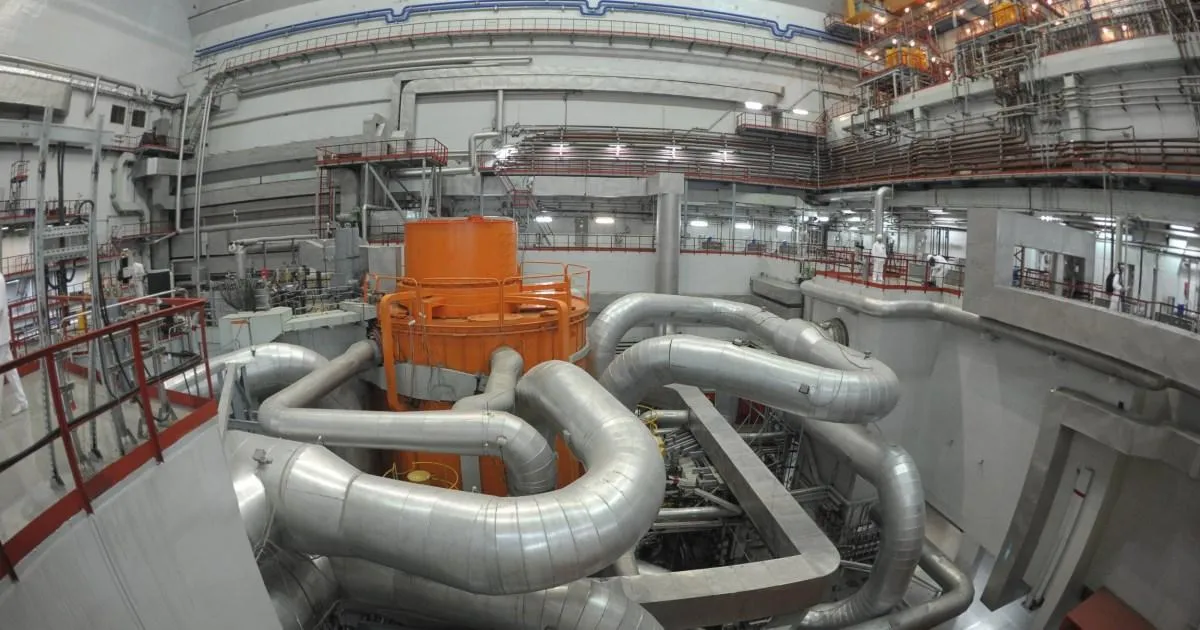
Imagine waking up in the small Russian town of Zarechny, in the Ural Mountains, to the sound of sirens and the sight of emergency vehicles streaming toward the local nuclear power plant. For the next two days, more than a thousand people—rescue workers, doctors, police, soldiers from Russia’s Nuclear, Biological, and Chemical Protection Forces, and government officials—are taking part in a massive disaster drill at the Beloyarsk Nuclear Power Plant in the Sverdlovsk region. The scenario is deliberately frightening: a simultaneous accident at two reactors, with nuclear explosions or leaks, collapsed buildings, fires, and radioactive contamination. Rosatom, the state-owned nuclear energy corporation, insists the exercise is based on “a highly improbable combination of multiple adverse events, including natural disasters.” The official goal is to test the readiness of personnel and the coordination between emergency services. But for residents, the line between rehearsal and reality can feel thin. Authorities have urged people not to panic, explaining that a major drill of this kind is held once a year at different atomic power plants. Still, when you see people in chemical protection suits moving through your streets, carrying Geiger counters and stretchers, it is hard not to wonder what they know that you don’t. The two-day exercise includes evacuations, clearing rubble, and extinguishing fires—skills that would be essential if the unthinkable ever happened. It is a scene that could be mistaken for a movie set, except that the stakes are real, and the backdrop is one of Russia’s most sensitive nuclear facilities. The exercise is meant to reassure the public that the system works, but it also reveals how seriously the state takes the possibility of catastrophe. In a country where nuclear power is both a source of national pride and a reminder of Cold War-era dangers, such drills are a strange mix of routine and dread.
While Rosatom frames the drill in the language of safety and preparedness, Russian Telegram channels have been set ablaze with darker interpretations. One channel claimed that deploying personnel in chemical protection suits onto the streets of the Urals serves as both a stress test for civil defence and a clear signal to Western intelligence agencies. “The Kremlin is demonstrating that Russia is physically and psychologically preparing for a war of attrition involving weapons of mass destruction,” the post read, “and that, unlike European capitals, we are already actively practising survival mechanisms.” Whether such channels are spreading genuine insider knowledge, engaging in propaganda, or simply feeding on public anxiety is impossible to say. But their words capture a mood that has become hard to ignore since Russia’s full-scale invasion of Ukraine. The official scenario—a freak combination of natural disasters and reactor failures—seems almost benign compared with the subtext that many Russians and Western observers read into the exercise. The presence of chemical protection troops, the proximity to a top-secret command bunker, and the timing of the drill all feed a narrative that Moscow is preparing for a conflict in which nuclear weapons might be used. The two-day exercise is not just about checking equipment and practising evacuation routes; it is also a performance, a way of showing strength to both domestic audiences and foreign adversaries. For the emergency workers involved, the drill is exhausting and methodical: they clear fake rubble, put out controlled fires, and practice decontamination procedures. But for anyone watching from the outside, the message is more unsettling. It suggests that the unthinkable is being treated not as a remote possibility but as a scenario that must be rehearsed, refined, and taken seriously. The line between preparation and provocation has never been thinner.
The choice of location is not accidental. The Beloyarsk plant lies just 200 miles from a vast doomsday bunker hidden deep inside Kosvinsky Kamen, a 4,984-foot mountain in the northern Urals. This is the heart of Russia’s Perimeter system, known in the West as the “Dead Hand.” The concept is as chilling as its name: a network of sensors, command centers, and communications equipment designed to ensure that Russia can retaliate with nuclear weapons even if the entire Kremlin leadership has been killed in a first strike. The bunker is built to survive a direct hit, with thick granite walls and enough supplies to allow officers to function for weeks or months in isolation. Its purpose is not to protect people, but to preserve the ability to launch a devastating counterattack. In the logic of nuclear deterrence, the Dead Hand is supposed to make any attack on Russia suicidal, because even a successful decapitation strike would not prevent retaliation. The fact that a major civil defence drill is being held so close to this facility adds an extra layer of meaning. It is as if the state is rehearsing for the moment when the ordinary world collapses and the machinery of last resort takes over. For the residents of Zarechny, the mountain is a distant presence, a landmark on the horizon that most people rarely think about. But for those who know what lies inside, it is a reminder that the nuclear age has never really ended. The drill, with its ambulances and Geiger counters, is the visible face of a much larger, hidden system that is always waiting, always watching, and always ready to respond.
The scale of the bunker is staggering. Procurement documents and official records show that the facility, known as Object 1335, contains around 22,000 tonnes of steel—enough to build three Eiffel Towers. Since Putin issued a secret decree two decades ago to modernise the Dead Hand system, the hollowed-out granite mountain has also swallowed 56,000 tonnes of cement. These numbers are hard to grasp, but they speak to an extraordinary engineering effort hidden from public view. The bunker is not a simple shelter; it is a self-contained world, with its own power generation, air filtration, communications arrays, and living quarters for the officers who would staff it in a crisis. The modernization project reflects a deep investment in the idea that nuclear war, while catastrophic, is not unthinkable. It is a physical manifestation of a doctrine that has governed Russian strategic thinking for decades: the belief that the only way to prevent a nuclear attack is to guarantee an overwhelming response. The steel and cement are not just construction materials; they are a message. They tell any potential adversary that even the most precise and powerful strike cannot decapitate the Russian state. They also tell the Russian people that their leaders are prepared to go to extraordinary lengths to protect the country’s ability to strike back. But there is something almost absurd about the numbers. Three Eiffel Towers’ worth of steel buried inside a mountain, enough concrete to build a small city, all for the purpose of ensuring that a handful of officers can turn the world to ash if the order comes—or if no order comes at all. It is a monument to the darkest logic of the Cold War, preserved and upgraded for the twenty-first century.
Under the Perimeter system, the final decision to launch a retaliatory strike is still supposed to be made by a human officer. But the system has another mode, one that is far more disturbing. In “automatic” mode, the sequence could proceed without any order from Putin or his top commanders if, for example, they had been wiped out. This effectively overrides the so-called “triple key” arrangement, under which three people must sanction a Russian nuclear launch: Putin, 73; Defence Minister Andrei Belousov, 67; and Chief of the General Staff General Valery Gerasimov, 71. The idea of an automated system that could launch nuclear weapons without direct human authorization has haunted strategists since the Cold War. It turns deterrence into a kind of doomsday machine, a mechanism that cannot be reasoned with or negotiated with once it is triggered. The Dead Hand is designed to remove the vulnerability of human decision-making, but it also raises profound questions about control, accountability, and the nature of command. If the leadership is dead, who is the officer in the bunker? What orders is he following? How does he know that the signals he receives are real and not a malfunction or a false alarm? These are not abstract philosophical questions; they are the practical realities of a system built to operate in the chaos of a nuclear exchange. The drill at Beloyarsk, with its focus on coordination and communication, is a small-scale rehearsal for the kind of chaos that the Dead Hand is designed to survive. It is a reminder that nuclear war is not just a matter of missiles and warheads, but of people, procedures, and the terrifying possibility that the machinery of destruction might one day run on its own.
This drill comes at a time when nuclear rhetoric has returned to the center of international politics. Since the invasion of Ukraine, Putin has repeatedly reminded the world of Russia’s nuclear arsenal, and Western leaders have had to calibrate their responses to avoid escalation. Exercises like the one at Beloyarsk are part of that atmosphere. They are routine in the sense that they happen every year, but they are also extraordinary because they take place against the backdrop of a war that has already killed hundreds of thousands of people and brought Russia into direct confrontation with NATO. For the people taking part, the drill is a job: they put on their uniforms, follow their checklists, and do their best to simulate a disaster that they hope will never happen. For the residents of Zarechny, it is a disruption: roads closed, sirens wailing, strangers in protective gear moving through their town. But for the rest of the world, it is a glimpse into a mindset that is difficult to comprehend. The official explanation—that this is just a test of emergency preparedness—is true as far as it goes. But the location, the scale, and the timing all suggest that something more is going on. Russia is not just rehearsing for an accident; it is rehearsing for a war. The Dead Hand bunker, the chemical protection troops, the talk of “war of attrition involving weapons of mass destruction”—all of it points to a leadership that is thinking seriously about scenarios that most people would rather not imagine. And yet, life goes on. The town of Zarechny still has its shops, its schools, its ordinary routines. The drill will end, the emergency vehicles will go back to their garages, and the mountain will remain silent. But the questions it raises will not go away. How close are we to the edge? How much of this is preparation, and how much is provocation? And if the unthinkable ever happens, will all the drills in the world make a difference? There are no easy answers, only the strange, unsettling sight of a town rehearsing for the end of the world.