


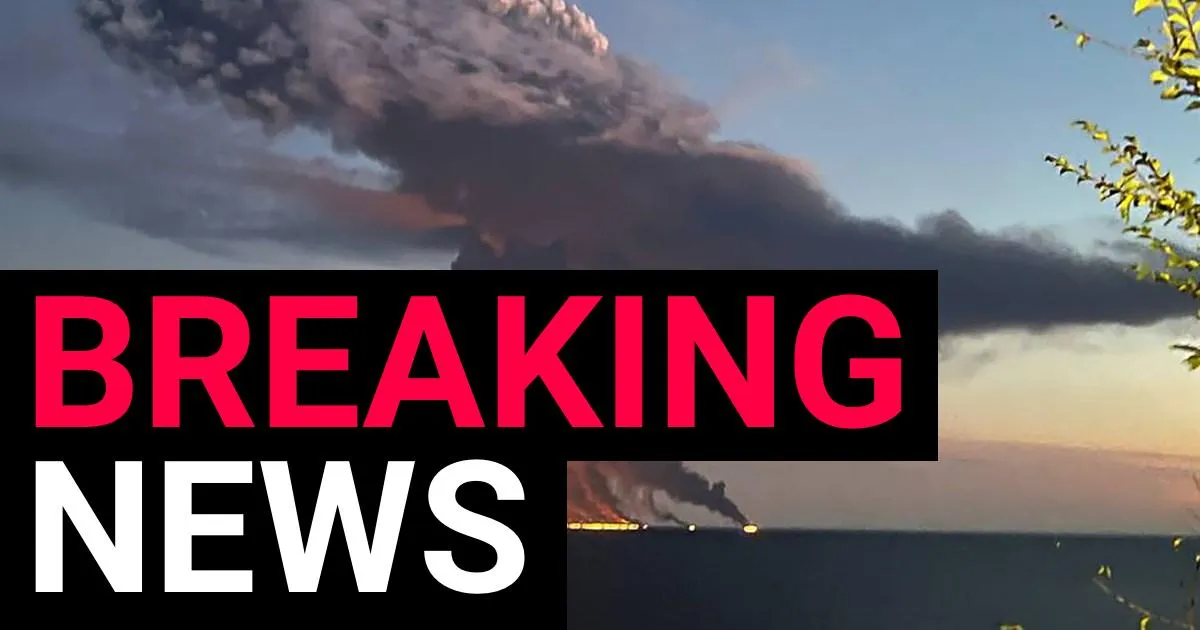
It begins with a photograph, the kind that makes you look twice. On a Tuesday evening, a huge fire consumed an oil tanker off the coast of Sochi, the Russian resort city famous for its beaches, palms, and holiday crowds. But there was no holiday calm in the air. Thick, black smoke climbed from the vessel and spread across the sea, blanketing the shoreline with an eerie darkness before nightfall. The image, captured by east2west news, shows the kind of towering plume you might associate with a disaster movie, not a summer getaway. For people in Sochi, the sound of the explosion was likely the first warning. Then came the sight of flames reflecting on the water, the smell of burning fuel, and the distant wail of emergency vehicles. It is impossible not to feel the human weight of such a moment—the sailors aboard the tanker, the rescue teams rushing toward an unpredictable fire, and the residents watching from their balconies with their phones pressed to their ears. The Black Sea has become a fraught, dangerous place in recent years, and this incident seemed to capture that anxiety in a single fiery frame. By nightfall, the glow was still visible from miles away, a burning question mark on the horizon. No one had yet claimed responsibility. In the context of the ongoing war in Ukraine, that silence felt loaded. But for the people of Sochi, the immediate worries were simpler and more urgent: Was everyone safe? Could the fire spread? What would happen to the water and the beach? The smoke was impossible to ignore, and so was the unsettling thought that even a place built for peace could suddenly become a stage for catastrophe. The story was still breaking, with more details expected, but the images alone had already told a profoundly human story of danger, uncertainty, and fear.
The explosion came at a time of heightened tensions across the Black Sea, with both Russia and Ukraine trading blows and accusations. As of the time of writing, Ukraine had not claimed responsibility for the fire. That absence of an official statement left a vacuum of speculation. Some commentators pointed to the possibility of an accident, noting the age and condition of many Russian tankers. Others could not help but connect the dots to Ukraine’s ongoing campaign against Russian infrastructure, which has grown bolder and more sophisticated in recent months. Earlier reports had already highlighted close calls in the same waters: drones hitting a cargo ship and sparking a massive rescue mission, missiles striking a bridge in a way that seemed designed to slice Kyiv in two, and even a Russian helicopter accidentally shot down by its own forces. These stories, collected under the banner of war coverage, painted a picture of chaos and unpredictability. But the tanker fire off Sochi felt different. It struck close to a civilian hub, a place where ordinary families were enjoying their evening. The fact that so little was known made the scene even more unsettling. Was this an act of war, a tragic accident, or something else? The lack of clarity is itself a symptom of the information fog surrounding the conflict. In times like these, news spreads instantly but understanding lags behind. People in Sochi were not just witnessing a fire; they were living through a moment of geopolitical tension that had literally landed on their doorstep. Meanwhile, in Kyiv, President Volodymyr Zelensky was already taking decisive action on a separate front. That same day, he announced new sanctions packages designed to target the supply of critical components and equipment used in Russia’s weapons production. It was a reminder that while fires and explosions capture the headlines, the war is also being fought in boardrooms, supply chains, and government offices. Zelensky’s move aimed to choke off the machinery of war at its source, depriving Russian manufacturers of the materials they needed to keep producing missiles, drones, and other weapons. For the Ukrainian leader, every day brought new challenges, and this announcement was part of a broader strategy to pressure Russia from every angle.
During the meeting in which Zelensky announced the sanctions, the Ukrainian president also received detailed briefings on the capabilities of electronic warfare systems. These systems, often unseen and unglamorous, have become a crucial part of Ukraine’s defense in a conflict defined by drones and missiles. Electronic warfare is, in many ways, a hidden battle of signals and frequencies. It involves jamming communications, disrupting navigation, and misleading enemy weapons. For Ukraine, it has proven to be one of the most effective tools in neutralizing Russian “suicide drones”—the small, often cheaply built unmanned aircraft that Russia has used to terrorize cities, target infrastructure, and hunt soldiers. These drones have become a signature weapon of Russia’s campaign, but they are not invincible. Ukrainian forces have learned to counter them with a mix of technology, tactics, and sheer creativity. The president was told, in clear terms, that a significant portion of the neutralization of these drones can be attributed to electronic warfare. This is not just a technical detail; it means the difference between a city sleeping safely and a drone strike turning a residential block into rubble. Humanizing this kind of warfare is difficult because it happens in invisible waves and frequencies. But its impact is deeply physical. A successful jamming signal can send a drone off course, causing it to crash into an empty field instead of a school. It can cause a missile to lose its lock and fall harmlessly into the sea. It can save lives without firing a shot. The men and women operating these systems are often working in the dark, under pressure, with limited resources, but their work is vital. Zelensky, after hearing the briefing, emphasized that this component of defense accounts for a significant portion of the neutralization of Russian drones. His words underscored a broader truth: modern warfare is not only about tanks and artillery. It is about the invisible battle for control over the electromagnetic spectrum. And in that battle, Ukraine has proven resourceful, willing to adapt, and eager to scale up what works. The sanctions and the electronic warfare briefings were part of the same story. Ukraine was fighting on multiple fronts, using every tool available, from economic pressure to cutting-edge technology, to survive and push back against a larger enemy.
Zelensky did not stop at briefings and sanctions. He set additional tasks for the Armed Forces of Ukraine and for domestic manufacturers, clearly focused on scaling up the most effective approaches. This is the language of a leader who understands that adaptation is survival. In a war that has stretched on for months and years, the ability to learn, adjust, and produce better tools faster than the enemy is often more decisive than sheer firepower. The president’s message was simple: take what works and make more of it. Take the electronic warfare systems that have proven effective against Russian drones, refine them, produce them, deploy them. Take the lessons learned from the front line and turn them into institutional knowledge. For the soldiers and engineers receiving these orders, it meant long hours, sleepless nights, and the constant pressure of knowing that lives depend on their work. But it also represented a sense of purpose. The war has forced Ukraine to invent its own path, relying on innovation as a weapon. In factories across the country, workers are filling orders for military equipment amidst the constant threat of air raids. In laboratories, engineers are testing new jammers and counter-drone technologies. These are not the images that typically dominate war coverage, but they are essential to the story. The scene off Sochi—a burning tanker sending smoke into a resort sky—was unfolding in the same world where Ukrainian manufacturers were scrambling to build better defenses. These two realities might seem disconnected, but they are deeply intertwined. The fire, whatever its cause, is a symptom of a region in flames. Zelensky’s determination to scale up electronic warfare is a response to that same volatile environment. For the average person following the news, it can be hard to hold all these threads together: a tanker fire, a sanctions package, a briefing on electronic warfare, a call for more drones and equipment. But that is the nature of modern conflict. It is messy, fragmented, and constantly evolving. A single day’s news might include a dramatic explosion, a political announcement, and a technical briefing, all of which are part of the same struggle. In this case, the burning tanker served as a stark visual anchor for the broader turbulence. And the actions taken by Zelensky behind closed doors were a reminder that leadership in wartime means more than giving speeches; it means making decisions, assigning tasks, and ensuring that the people fighting and building have what they need.
At the time of writing, the story was still breaking. “More to follow” is a phrase that appears at the end of news articles when events are unfolding too quickly for a complete picture. It is a promise and a warning. For those who saw the first images of the Sochi tanker fire, it meant that the information they had was incomplete. For the people directly involved, it meant that the danger was not yet over. Emergency teams were presumably still working through the night, trying to contain the blaze and prevent an environmental disaster. Oil spills can poison marine life, ruin beaches, and devastate local livelihoods for years. The Black Sea is already under immense pressure from shipping, pollution, and the environmental consequences of war. A burning tanker off a resort coast is not just a dramatic photo opportunity; it is a potential ecological catastrophe in the making. The uncertainty extended to the cause. Was it an engine room explosion? A collision? A deliberate attack? In the absence of an official claim, questions multiplied. The Ukrainian government had not said anything, and Russia was likely to present the incident in whatever way suited its narrative. In such moments, the truth becomes a casualty of war. Social media filled with rumors, unverified videos, and partisan interpretations. Some accounts blamed Ukraine immediately; others speculated about Russian incompetence. The reality is that sometimes accidents happen, even amid war, and sometimes attacks are carried out without a formal admission. The wait for clarity is painful, especially for those whose lives are disrupted by the event. For the readers of news updates, the fire off Sochi was another data point in an overwhelming stream of conflict coverage. For the people in Sochi, it was a disruption of their daily lives, an interruption of the summer calm. They will remember the smell of smoke and the sight of helicopters overhead. They will wonder about the sailors, the firefighters, and the long-term impact on their beloved coastline. The phrase “more to follow” cannot capture all of that weight. It simply signals that the story is not finished, that the full consequences are still unfolding, and that everyone is waiting to see what happens next.
In the meantime, the news ecosystem continues to churn. Alongside the tanker fire, readers were being directed to other stories: a GP killed while hosting a children’s sleepover near Sandringham Estate, an 11-year-old girl found dead at a cricket club, a council that accidentally sold a home with a multi-million-pound school thrown in, and a warning about an “American Covid” strain after cases surged in England. These headlines, jarring in their mix of tragedy, absurdity, and everyday concern, reflect the way we consume news in a fragmented world. A fire off the coast of Sochi competes for attention with local crimes, medical worries, and bizarre bureaucratic mistakes. There is no neat way to process all of it. The request to “sign up for all the latest stories” speaks to a common human instinct: the desire to stay informed, to not be caught off guard, to understand the world even as it seems to spiral. For those who want updates, the promise is simple—start your day with a newsletter or receive breaking news alerts the moment something happens. This is the modern rhythm of information. It offers comfort in the form of connectivity, even if that comfort is often illusory. The tanker fire, the sanctions, the electronic warfare briefings, the “more to follow” stories—all of them are pieces of a larger puzzle. Human beings are meaning-making creatures. We want to find patterns, assign blame, and understand causes. But sometimes the news only offers chaos. There is no neat explanation for a burning tanker off a resort coast, no simple answer to why war continues to produce such images. What remains is the human response: fear, resilience, curiosity, and the stubborn determination to carry on. People in Sochi will wake up to a changed landscape. People in Ukraine will continue to fight and build. People around the world will refresh their feeds, searching for updates. The story is not just about a fire or a sanctions package. It is about how we live with uncertainty and how, even in the darkest moments, we keep looking for something to hold on to. In that sense, the final paragraph of a news article is never truly final. There is always more to follow—more questions, more answers, more lives touched by events beyond their control.