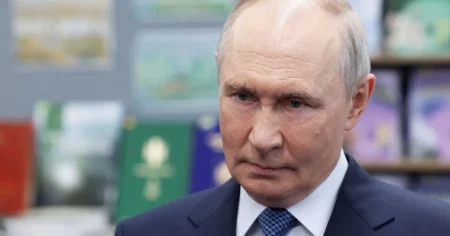

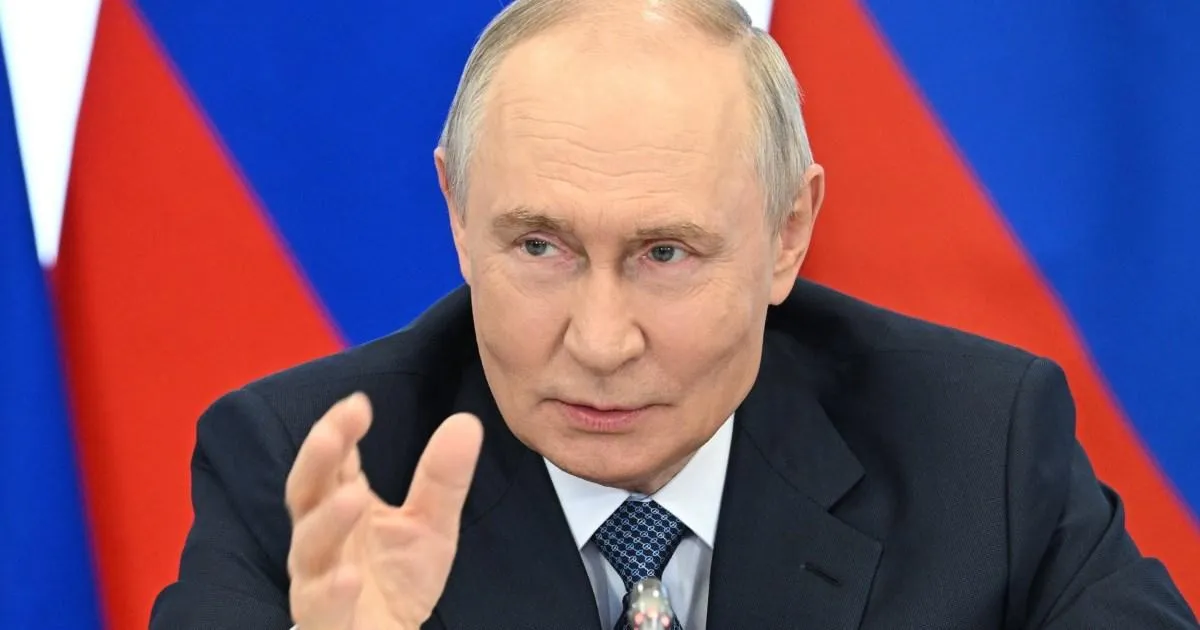
1. There was a familiar theatricality to Vladimir Putin’s recent appearance in Novosibirsk, the sprawling Siberian city where he sat among young teachers and students and tried, once again, to perform the role of the unshakeable leader. The setting was intimate, almost casual, but the underlying purpose was clear: Russia’s president is on a carefully staged popularity tour, moving through regions like Tatarstan, Krasnoyarsk, Buryatia, Omsk, and Irkutsk in the hope of reviving a domestic standing that has been slipping badly. At one point, the conversation turned to artificial intelligence, an odd and slightly futuristic topic for a leader often described as living in the past. Putin turned to a young researcher and asked, almost playfully, what kind of threat AI posed to Russia. The young man replied with a sly grin: “I’ll be honest with you, you’ve got nothing to be afraid of.” Putin did not miss a beat. “And I’ve never been afraid of anything,” he shot back. It was a perfect sound-bite, the kind of line that has long defined his public persona: the former KGB officer, the judo black belt, the bare-chested rider of Siberian wilderness, the man who stares down tanks in Moscow’s streets and absorbs Western sanctions without blinking. The room probably laughed, and the cameras probably loved it. But beneath the bravado, there was something fragile, even unsettling, about the exchange. Here was a leader who has spent decades cultivating an image of absolute fearlessness, yet he was spending his time volunteering for questions from students in provincial universities, surrounded by a country that is increasingly anxious, grieving, and exhausted. The joke about AI was charming enough, but it barely masked the deeper anxieties of a leader whose country is at war, whose economy is struggling, and whose people are beginning to wonder whether the man in charge truly has everything under control.
2. That tension between performance and reality has become impossible to ignore. Putin’s popularity has been in freefall, according to independent polls and observers, and the reasons are not difficult to see. The domestic economy is under severe strain, battered by sanctions, military spending, and the endless demands of a war that was supposed to be over in days and has now dragged on for years. The conflict in Ukraine has consumed tens of thousands of Russian lives, fractured families, and sent the ruble into dangerous territory, all while the Kremlin continues to insist that everything is proceeding according to plan. Ordinary Russians are paying the price, and they can feel it in their daily lives, in the cost of groceries, in the absence of familiar goods, in the quiet dread that comes with reading the news about another drone strike or another funeral. Putin, aware of this growing discontent, has been travelling the vast country in an apparent effort to reconnect with the provinces, to remind people that he still sees them, hears them, and represents their interests. But his appearances have a strange, almost haunted quality. In the spring, he disappeared from public view for more than two weeks after Easter, sparking frantic speculation about his health and whereabouts. When he finally reappeared at the annual Victory Day parade in May, his face was puffy, his cheeks swollen, and his movements looked stiff. The images were impossible to hide, and they quickly became the subject of grim jokes and anxious commentary. For a leader whose entire mystique depends on strength and vitality, these signs of human frailty are not just personal problems; they are political liabilities. The carefully controlled narrative of the invincible leader is starting to crack, and no amount of staged town halls or televised Q&A sessions can quite repair it.
3. The conversation about artificial intelligence in Novosibirsk offered a revealing glimpse into Putin’s worldview, and perhaps into his fears. He did not seem particularly worried about machines taking over the world or superintelligent algorithms threatening humanity in some exotic science-fiction way. Instead, he was worried about something more mundane and more social: the possibility that technology could turn ordinary people into passive button-pushers, intellectually lobotomized and utterly dependent on a small class of elites. He described this dystopian future in vivid, almost literary terms, warning that human brains could shrink “like shagreen leather” as people grow accustomed to simply pressing buttons and watching results appear without understanding how anything works. “Boom-boom, press the buttons, and everything pops out,” he said, his voice carrying the weary contempt of a man who has little faith in the resilience of the masses. Underneath the metaphor was a deeply elitist, almost paternalistic vision of humanity, in which most people are destined to be managed, guided, and kept from the dangerous temptations of independent thought. Putin’s suggestion that society would split into a small intellectual elite and a vast underclass of unthinking operators says more about his own political philosophy than about technology. It reflects a worldview in which the state needs to control information, shape narratives, and decide what ordinary people are allowed to see and know, because without that control, chaos would follow. The irony is hard to miss: a leader who has spent years silencing independent media, prosecuting critics, and building a system designed to prevent citizens from thinking too freely, now warning about the dangers of minds turning to mush. It is possible he genuinely believes that the internet, social media, and artificial intelligence are existential threats to Russia’s stability. But it is equally possible that he is projecting, describing a future he has already helped create, where millions of citizens are expected to accept official truths and leave the serious thinking to their supposed betters.
4. While Putin was busy assuring young audiences that nothing frightens him, reality was finding its way through Russia’s defences in the form of a Ukrainian drone. On Monday night, an unmanned aircraft slipped through the country’s air defenses and struck deep inside Russian territory, in the Tatarstan region, more than 680 miles from the border with Ukraine. The attack killed at least 13 people, leaving families destroyed and communities shaken. For years, the Kremlin tried to insulate Russians from the war, presenting it as a distant “special operation” that had little to do with daily life in Moscow’s supermarkets or Siberian apartment blocks. But that illusion is increasingly hard to maintain. Ukrainian drones have reached deeper and deeper into Russian territory, striking oil refineries, military airfields, logistics hubs, and residential buildings. Each attack chips away at the idea that the war is far away, that ordinary Russians are safe, that Putin’s leadership provides a protective shield. The Tatarstan strike, so far from the front lines, sent a chilling message: the conflict will not stay neatly contained in Ukraine, and Russians can no longer pretend that they are merely spectators in a drama happening elsewhere. For Putin, this is a nightmare scenario. His popularity has already been weakened by the economy and the endless war, but a conflict that starts killing large numbers of Russians on Russian soil is something entirely different. It brings the war home in the most visceral way possible, forcing ordinary families to confront the fact that their country is at war, that their leaders are not protecting them, and that the sacrifices demanded of them may only grow. The drone strike also undermines Putin’s carefully constructed image of strength and competence. If he cannot protect Russian skies from weapons launched by a country that many Russians have been taught to view as weak and failing, then what is the point of his rule? The brave face he showed in Novosibirsk feels increasingly fragile when measured against the reality of burning buildings and grieving relatives in Tatarstan.
5. Across the border, Ukrainian President Volodymyr Zelensky has been watching these dynamics carefully, and he is trying to warn the world about what comes next. In an interview with Sky News, Zelensky claimed that Putin plans to mobilise a massive new wave of soldiers after the Russian parliamentary elections in September. According to Zelensky, this is not a matter of official announcements or public campaigns; it will be done quietly, deliberately, behind a screen of political theatre. “He wants to increase mobilisation. Not openly, because he is afraid of his society, but he will do it at the beginning of October, if we don’t cause him problems with logistics, weapons, petrol, diesel, and if our partners don’t impose total sanctions for his aggression,” Zelensky said. His warning was blunt: Putin could aim to mobilise anywhere from 300,000 to 500,000 people, and he probably could do it, despite the protests and resistance that would inevitably follow. “It will be a big problem because he will aim to mobilise from 300,000 to 500,000 people. It’s not that difficult for him to mobilise this number. He will have internal questions about it, because his society is – and I saw the polls – against mobilisation.” Zelensky’s words are more than just intelligence or analysis; they are a desperate plea to the West, a request for support before Russia can rebuild its forces and launch another devastating wave of attacks. He is asking for weapons, for sanctions, for fuel and diesel and logistical pressure, anything that might make it harder for the Kremlin to field another half-million soldiers. The timing is critical. Elections in September provide a convenient political cover, a moment when Russia will be focused on the theatre of democracy, while the real decisions about war and peace are made behind closed doors. Zelensky’s message is clear: if the West hesitates, if it grows tired of backing Ukraine, if it allows Russia to replenish its manpower unchecked, then the war will not only continue; it will expand, deepen, and become even more catastrophic.
6. The image of a defiant Putin, sitting in front of young Russians and insisting that he has never been afraid of anything, sits awkwardly alongside these mounting pressures. He is a man who has built an entire leadership identity on the idea of strength, on the belief that Russia must never appear weak, on the conviction that he alone can protect his country from foreign enemies and internal decay. And yet, the very things he is trying to hide are becoming impossible to conceal: a failing economy, a war without end, a society increasingly tired of sacrifice, a voter base losing faith, and a body that no longer obeys the command to look forever young. The roadshow across Russia is a desperate gamble, an attempt to remind people why they once trusted him, to convince them that the terrible costs of war are necessary and inevitable. But the more he travels, the more he speaks, the more the contradictions seem to multiply. He tells a student that artificial intelligence will shrink human brains, but he does not mention that his own government has spent years shrinking the space for real thought in Russian society. He says he fears nothing, but he has spent months avoiding public appearances, worrying quietly about drones overhead, and preparing to draft hundreds of thousands of unwilling men into a war they did not ask for. Perhaps the greatest irony is that Putin, who so loves to prophesy about the dangers of technology and the weakness of ordinary people, is himself trapped in a machine he no longer fully controls. The war in Ukraine has become an engine of destruction that he cannot stop without losing face, and the Russian people are the ones paying the price. In the end, the image of a 73-year-old president, cheeks swollen, nerves frayed, telling the next generation not to worry about artificial intelligence because he was never afraid of anything, may be remembered as one of the saddest pieces of political theatre in modern times. The bravado is still there, but the confidence behind it is fading. And the future he is so worried about is not coming from machines; it is coming from the very people he is now trying to persuade, the young teachers and students who listened politely and probably wondered, in the quiet spaces of their own minds, what kind of Russia will be left when the bravado is finally gone.