

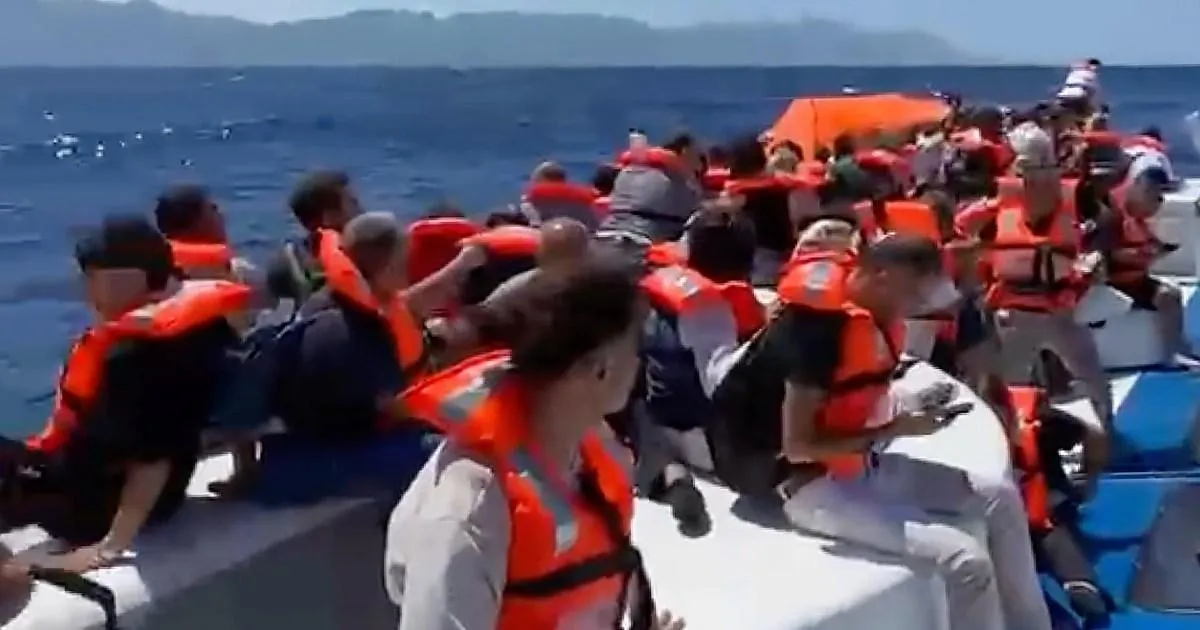
The morning had begun with the quiet promise of an ordinary journey. Families settled into their seats, travellers clutched bags, and the high-speed ferry Filo Jet pulled away from the northern Cypriot port of Kyrenia, bound for the Turkish coastal town of Tasucu. The harbour of Kyrenia is one of the most beautiful on the island, dominated by a medieval castle and a forest of masts, and on that Sunday morning it would have been busy with the usual weekend traffic. On board were roughly 270 passengers and crew — people with places to go, loved ones waiting, and no reason to believe that this short crossing would become a nightmare. Some were tourists on a day trip, others workers returning home, a few perhaps young families with children too small to understand why the boat was shaking. The ferry was a catamaran, a sleek twin-hulled vessel designed for speed and stability, the kind of ship that makes a sea voyage feel almost like a flight. The crew had given the usual safety announcements, but nobody really listened; ferry crossings were routine, something you did without thinking. But the beauty of the coastline soon gave way to grey, heaving water, and within minutes of departure the sea turned hostile. The vessel began to pitch and shudder, rising out of the water and crashing back down with sickening force. In the chaos that followed, a video shared on social media captured the raw terror inside: passengers scrambling for bright orange lifejackets, some still clutching backpacks, others pushing toward exits, voices overlapping in panic. The boat, the dependable link between Kyrenia and Tasucu, was breaking apart. Near Diana Beach, just off the coast, the Filo Jet capsized, tilting onto its side and leaving people clinging to the hull as the water swallowed the interior. By the time the world understood what had happened, at least eight people were dead, and the questions were only beginning. How could a modern ferry sink so quickly? Why was it allowed to sail into such dangerous weather? And for the families waiting on shore, the cruelest question: would their loved ones be among the rescued, the missing, or the dead? The tragedy was not just a maritime accident; it was a sudden, violent interruption of ordinary life, a reminder that the sea is never fully tamed.
The testimony of survivors painted a harrowing picture of the final minutes. Efe Multici, a passenger who made it out alive, described a vessel that seemed to have a mind of its own. “The vessel had been moving very badly,” he said. “It was constantly lifting out of the water and slamming back down. It was shaking violently.” For three or four minutes, passengers endured the pounding, bracing themselves against seats, gripping railings, exchanging frightened glances. Some tried to smile, as if the ship’s violent dance was just a rough patch, something the captain would soon fix. Others silently prayed. Then came the moment that changed everything. “The ferry leapt high into the air, then came crashing down. The front left side burst open and water started pouring in,” Multici recalled. That image is almost impossible to process: a massive metal hull, designed to cut through waves, suddenly splitting open like a torn package. Water rushed in not as a trickle but as a flood, and the instinct to survive took over. Children clung to their parents, adults shouted advice that no one could hear, and the smell of fuel mixed with salt and fear. Some passengers managed to grab lifejackets, pulling the straps tight with trembling fingers. Others, disoriented and terrified, fought their way up stairways and onto the deck as the ship listed further. The scene was not the orderly evacuation promised in safety demonstrations; it was a scramble, a desperate lunge for survival. People held onto backpacks, perhaps out of reflex, perhaps because those bags contained phones, passports, wallets — the small anchors of identity that suddenly mattered so little. The screams, the crash of waves, the groan of twisting metal, the shouts of crew members trying to restore order: all of it merged into a single overwhelming roar. And then the sea poured in, indifferent to the panic, dragging the ferry down until only the overturned hull remained, a slick metal island for the lucky few who had made it outside. Some people jumped into the water rather than wait to be swept away, their bodies immediately numbed by the cold. For those still inside, the darkness and cold would have been unbearable, a silence broken only by the creak of the dying ship.
The immediate aftermath was a scene of surreal desperation. Rescue teams raced to Diana Beach, where the stricken catamaran lay half-submerged, its rounded hull exposed to the sky. Passengers in lifejackets huddled on top of the vessel, waiting for help as waves slapped against the metal around them. Others floated in the water, kicking and paddling, their arms raised, their voices carried on the wind. The rescue operation was swift but not swift enough; at least eight people were confirmed dead, and more were missing. Turkish Cypriot leader Tufan Erhurman, speaking from a crisis centre, acknowledged that authorities were using technology to try to reach passengers still trapped inside the ferry. The phrase “still stuck in the stricken vessel” suggested the worst kind of nightmare: people alive but imprisoned in a dark, flooded hull, their air running out, their voices unheard. Divers would have to navigate twisted corridors, feeling their way through pockets of air, hoping to find survivors before time ran out. The rescue involved multiple vessels and aircraft, their rotor blades cutting through the air as search crews scanned the surface for bobbing heads. For those on shore, the wait was agonizing. Each rescue boat that approached the wreck brought hope, but each empty seat on that boat brought despair. Hospitals prepared for survivors; families gathered at ports; official after official appeared before cameras to offer words that could not undo the shock. In the hospital, doctors and nurses worked in silence, treating cuts and bruises, hypothermia and shock, while counsellors moved among the walking wounded. And in a development that underscored the gravity of the disaster, authorities arrested the ferry’s captain and seven crew members as inquiries into the capsizing continued. The arrests raised difficult questions: Had the crew ignored warning signs? Had they been pressured to sail despite the storm? Were there failures in communication, training, or judgment? The legal process would try to answer those questions, but for the victims’ families, no courtroom verdict could bring back the dead. The grief was raw, immediate, and everywhere — in the eyes of the rescued, in the silence of the missing, in the wail of a siren that no longer seemed enough.
The disaster did not happen in isolation. Cyprus had been battered by a severe storm over the weekend, a powerful weather system that had already claimed victims and caused destruction. At least three yachts had crashed into rocks on the island’s southern coast, their hulls splintered by the same violent waves that now churned around the Filo Jet. Yet authorities had deemed the weather on Sunday safe enough for the ferry to sail. That decision now hung over the tragedy like a dark cloud. How could officials read the same forecasts, see the same wrecked yachts, and still allow a high-speed ferry carrying 270 people to leave port? The answer, if there was one, would likely emerge from the investigation — but for now, the apparent mismatch between warning and action added anger to grief. What made it worse was the knowledge that the storm had been forecast. The weather had been the talk of the island for days, and yet the ferry had sailed as if the sky were clear. That apparent carelessness would haunt the investigation, and the officials responsible would be forced to explain themselves. Those who had boarded the ferry trusted that the people in charge would not put them in harm’s way. That trust was broken in the most brutal way imaginable. The sea around Kyrenia, normally a beautiful stretch of turquoise water, became a graveyard of metal and memory. The catamaran had been a symbol of modern convenience, a fast and efficient link between Northern Cyprus and Turkey. Its sleek design promised speed; its twin hulls promised stability. But the sea does not care about promises. The storm, the waves, the sudden violent motion — these forces were older and stronger than any machine. The ferry’s bow, the part that should have cut through the waves, instead cracked open, and the sea poured in as if reclaiming its own. In the aftermath, the weather became more than a backdrop; it became a character, a silent witness to the catastrophe, and perhaps a key to understanding what went wrong. The investigation would need to examine not only the captain’s decisions but also the broader system of maritime safety, weather forecasting, and oversight that allowed this voyage to proceed. But such examinations take time, and time was something the families of the missing did not have. Every hour that passed without news was a second wound.
For Northern Cyprus, the sinking was a national trauma. This is a small, contested territory, recognized as an independent state only by Turkey, on which it depends for economic and military support. It is a place where communities are tight-knit, where a tragedy does not remain isolated but ripples through every town and village. Tufan Erhurman, the Turkish Cypriot leader, said he was “deeply saddened” by the sinking and described the mood in stark terms. “There is a great sense of shock here,” he said. “This is not something we have experienced before.” His words reflected a broader truth: disasters of this scale are rare in the region, and the sudden loss of life left people struggling to comprehend. The victims were not faceless statistics; they were neighbors, friends, relatives, travelers on a routine journey. Some were likely Turkish Cypriots returning from trips, others Turkish citizens heading home, perhaps a few international tourists caught up in the wrong place at the wrong time. For the Turkish Cypriot community, the loss was especially personal because the route to Tasucu was not just a ferry line; it was a connection to family, education, and trade. Many people on board likely made the crossing every week, known by name to the crew and the ticket sellers. The ferry had been a lifeline, a connection between the breakaway republic and its patron state, a daily artery of people and goods. When it sank, that artery ruptured, and the blood of the community spilled into the sea. Turkish President Tayyip Erdogan offered condolences, promising that efforts to reach those still missing would continue uninterrupted. “God willing, we hope to receive positive news from these efforts,” he said, but the hope felt fragile. Around the region, flags may have flown at half-mast, vigils may have been planned, and the voices of survivors would soon become the material of memorials. Yet for now, the pain was too fresh for ceremony. The crash of the waves was the only soundtrack, and the faces of the missing haunted every screen and every conversation. The political complexities of Northern Cyprus — its unrecognized status, its dependence on Turkey, its isolation — added another layer of sorrow. The tragedy was not only human; it was existential, forcing the territory to confront its own fragility. In a place already used to being overlooked, the sinking was a cruel reminder of how thin the margins of safety could be.
In the end, what remains is a story of human fragility and resilience. The images will be hard to forget: the ferry tilted in the water, the bright lifejackets, the passengers clinging to the hull, their faces a mix of relief and terror. The survivors will carry the memory of that shaking, that roaring water, that terrible instant when the bow burst open. They will wake from nightmares for years, reaching for lifejackets that are not there. The families of the dead will carry something even heavier: the knowledge that a routine journey became a final one, that a hello turned into goodbye without warning. The captain and crew members arrested in the investigation will face questions about their actions, and the world will watch to see whether justice is done. But no trial, no settlement, no apology can erase the image of that sinking ship or silence the sound of people screaming for help. The storm has passed, the sea has calmed, and the Filo Jet now lies beneath the waves or on the shore, a twisted monument to a day when everything went wrong. Yet even in tragedy, there are glimmers of humanity — the strangers who helped each other into lifejackets, the rescuers who raced against the clock, the officials who spoke not of politics but of grief. For the missing, hope still flickers, however faintly. For the living, the task now is to mourn, to remember, and to demand that this never happen again. The sea around Cyprus will continue to sparkle under the sun, but for many, it will never look the same. The ferry was a machine, but the disaster was human, and the answer to “why” must be more than a weather report. It must be a commitment to safety, to humility, to the simple act of listening when the sky darkens and the waves grow angry. Only then can the victims rest, and only then can the living find a way to sail forward without fear. In the meantime, the names of the dead and missing are whispered in homes and coastal cafés, carried by the wind that still whips across Diana Beach, a reminder that every departure is a leap of faith, and every safe arrival is a quiet miracle. And so we hold our loved ones a little closer, watch the horizon a little longer, and remember that the ocean, for all its beauty, is not a place to be taken lightly. The victims of the Filo Jet deserve no less than our full attention, our honest grief, and our solemn promise to learn from their loss.