


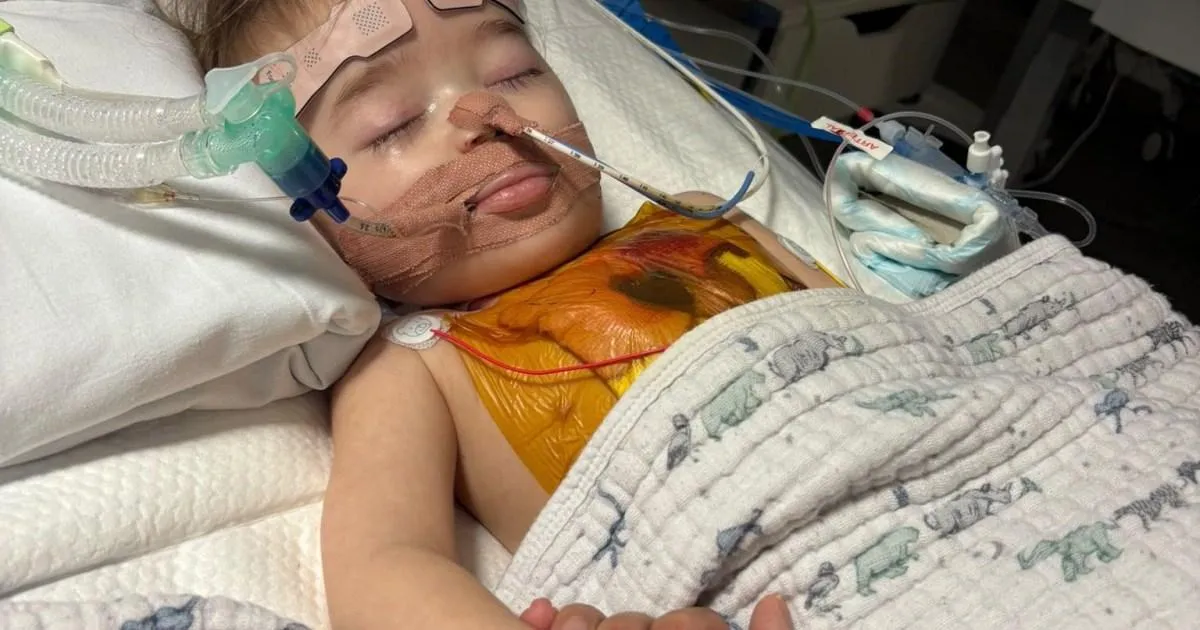
For Hannah Silver, the hardest part isn’t just watching her three-year-old son Sebastian fight for his life—it’s carrying the terrifying weight of knowing that the only chance to save him lies across the ocean, and that time is running out. A single mother of two, Hannah has launched a desperate public plea to raise £400,000 for life-saving surgery in the United States, after doctors in the UK told her they had exhausted every option for Sebastian’s extremely rare combination of four heart conditions. So far, she has managed to gather nearly £300,000 through an outpouring of public support, but the remaining £130,000 still stands between her son and the treatment he desperately needs. Speaking about the moment she learned the devastating news, Hannah, 42, described how her world collapsed. “When they told me my son was dying, my heart, body and soul all shattered at the same time,” she said. “I fell to the floor and couldn’t move. I thought I was going to have to bury my child.” Those words capture the raw anguish of a mother who has spent every day since Sebastian’s birth in a state of high alert, moving between hospital wards and hope, helplessness and fierce determination. For Hannah, the fight to keep Sebastian alive is not just a medical battle—it is an emotional marathon that has tested every ounce of her strength.
Sebastian’s journey began at birth, and from that moment on, life has been a revolving door of hospital stays, procedures, and uncertain diagnoses. He has been in and out of Great Ormond Street Hospital, one of the world’s leading children’s hospitals, struggling with a truly exceptional combination of heart conditions: criss-cross heart, Congenital Corrected Transposition of the Great Arteries (ccTGA), heart holes, and Wolff-Parkinson-White syndrome. Individually, each of these conditions is serious; together, they make Sebastian’s heart a medical puzzle that has repeatedly defied easy solutions. The hardest moment came when doctors attempted to treat these conditions and Sebastian suffered a major cardiac arrest. He survived only because his chest was still open from surgery, allowing a row of doctors to physically pump his heart with their hands. Hannah recalls that awful, blurry scene with a mixture of gratitude and lingering trauma. “By the grace of God, they had a row of doctors literally pumping his heart inside his chest,” she said. “A lot of that is a blur. To this day, they don’t know what happened. That makes them cautious with Sebastian because he’s already had a heart failure. His heart couldn’t cope without a machine.” For his mother, the memory is both a nightmare and a miracle—evidence of how close she came to losing her son, but also of how fiercely he clung to life.
After the cardiac arrest, doctors presented Hannah with two heartbreaking options: let nature take its course, or attempt a reversal surgery that might give Sebastian a chance. For Hannah, there was no real choice. As a mother, she could not simply stand by and watch her child slip away. The reversal surgery was performed, and against all odds, Sebastian survived—even after going 90 minutes without oxygen to the brain. His survival has been called a miracle by the medical team, and Hannah clings to that word with both desperation and hope. The doctors at Great Ormond Street are understandably cautious about any further surgery, given how fragile Sebastian’s condition remains and how close he has come to death. But Hannah refuses to surrender to fear. “He’s already had one miracle. I think he can have one more,” she says, with a quiet stubbornness that is both heartbreaking and inspiring. That belief has led her to explore treatment in Boston, where specialists may offer a more permanent fix for Sebastian’s heart. It is a long shot, a complicated and expensive one, but for Hannah it is the only shot left. She is fully aware that even this last attempt may not succeed, but she cannot live with the alternative—watching her son suffer without trying everything possible.
The financial burden of this overseas treatment has become an all-consuming challenge. Hannah has spent two years trying to sell her flat to fund Sebastian’s care, but with no luck. She has reached out to every community, group, and acquaintance she can think of, exhausting her own resources and networks until there was nowhere left to turn. “I’m trying to do everything I can,” she said. “I’m in every single Facebook group that I can. I’ve tried to sell my flat for two years for this, but I haven’t been able to. I’ve exhausted my own communities; I now need to rely on the kindness and generosity of strangers.” That kindness has begun to arrive. Since launching her GoFundMe campaign on September 24, she has been overwhelmed by the donations that have flowed in, raising £269,384 of her £400,000 target in a remarkably short time. Hannah says she was moved to tears by the response. “I was in tears. I just wanted to cry. People’s reaction to it was just amazing,” she shared. For a mother who has spent years feeling alone in her fight, the sudden wave of support is both emotionally overwhelming and deeply reassuring. It reminds her that the world is not indifferent, that strangers can become lifelines, and that hope can be found in the most unexpected places.
Yet amid the fundraising and the medical appointments, there is another quiet struggle happening at home—one that belongs to Hannah’s five-year-old daughter, Sidney. Since Sebastian’s birth, their family life has been shaped by hospital visits, fear, and sacrifice. Sidney has spent much of her young life taking a back seat to her brother’s medical needs, not because she is loved any less, but because survival has required every ounce of attention and energy. Hannah acknowledges this painful reality with a heavy heart. “She’s spent the last three years taking a back seat. My kids don’t know any different. Sidney sometimes says, ‘Let’s not buy any more squishies because we need to save money to save Sebastian,’” Hannah revealed. The fact that a five-year-old would instinctively sacrifice her own small joys to help her brother speaks volumes about the family’s situation—and about the quiet resilience that Sidney has had to develop far too early. Hannah herself has barely allowed herself to feel the full weight of it all. “You stop thinking and feeling. I need to keep my kid alive. I also have another kid to think of; I don’t really have the luxury to not keep going,” she said. Her words reveal the relentless pressure of a mother who cannot afford to break down, because too many people depend on her strength.
Despite everything, there have been glimmers of happiness—fragile, precious moments that remind the family what they are fighting for. Following the reversal surgery, Sebastian was well enough to experience something he had never truly known: an almost normal summer. Hannah managed to take the children on a Disney Cruise, an experience that allowed them to finally breathe and be a family without the constant shadow of hospital corridors and beeping machines. “We went on a Disney Cruise. We’ve never got to be a family and relax. I wanted some family memories where I’m not stressed out, working or trying to take care of the kids,” she said. For Hannah, that trip was not just a vacation—it was a desperate attempt to give her children a childhood, to create memories that might last beyond the uncertainty of what lies ahead. But even as she holds onto those moments, she cannot ignore the dangers of the road ahead. The surgery in Boston is not guaranteed to succeed, and Hannah has had to confront the darkest possibilities. “What happens if he doesn’t make it and I’ve got to fly him home? You really have to face your worst nightmares, and it’s really crippling,” she admitted. Yet despite that fear, she continues to push forward, because giving up is not an option. Every donation, every share, every kind word brings Sebastian one step closer to a chance that might otherwise have slipped away. For Hannah, the love of a mother has always been her greatest fuel—and now, with the help of strangers, she hopes it will be enough to save her son.