

The Day the Tracks Stood Still: When a Single Moment Brought London’s Railways to a Halt
There are certain moments when the rhythm of a city grinds to an unexpected stop—when the familiar hum of the morning commute, the shuffle of feet on platform concrete, and the patient chime of the departure boards all dissolve into something far more sobering. That’s exactly what unfolded on a grey October afternoon when all railway lines between London St Pancras and Luton were suddenly closed shortly before 1pm. The cause was a human tragedy: a person was struck by a train, and emergency services rushed to the scene. From that instant, the carefully choreographed ballet of thousands of daily journeys scattered into chaos. The news rippled outward from the tracks themselves, through the tannoy announcements, across social media feeds, and into the waiting rooms and station concourses where passengers stared up at departure boards now blinking with delays, cancellations, and that dreaded word: “revised.” National Rail confirmed what many had feared—this was not going to be a minor hiccup, but a major disruption stretching well into the evening, threatening to swallow the entire rush hour and beyond.
For the thousands of commuters who had left home that morning with plans carefully mapped out—the school run finished, the meetings scheduled, the dinner plans penciled into calendars—this single tragic event upended everything. Those traveling on Thameslink services toward Bedfordshire and Northamptonshire found themselves staring down an impossible afternoon, advised by officials to delay their journeys entirely if they could possibly manage it. The affected stretch, running through West Hampstead Thameslink, St Albans City, Luton, and Bedford, was simply impassable in both directions. Trains that had been scheduled to run through these stations were either cancelled outright or diverted into unfamiliar territory, leaving passengers stranded at platforms with trolley bags and tight connections unraveling by the minute. For East Midlands Railway customers, the situation was no less grim, with the operator warning that the disruption could linger until the end of the day. Every national rail route leading north from the capital was now complicated by a tangle of adjusted timetables, extra transfers, and journeys that had suddenly grown an hour longer than anticipated.
Perhaps the most frustrating element for those caught in the middle of this logistical nightmare was the scramble for alternative transport. Rail replacement buses were requested almost immediately, but these proved to be a scarce resource—places were limited, wait times were long, and for many passengers, the option simply wasn’t viable. A small lifeline was thrown in the form of a bus running from St Albans to Hatfield, a 45-minute trip that at least offered a path forward, while another bus stood on standby at Luton, waiting to be deployed under the instruction of station staff. But these were small band-aids on a much larger wound. Thameslink acknowledged the arrangement with the kind of cautious optimism that only a train operator staring into the abyss of a disrupted timetable can muster, acknowledging that some replacement resources had been found, but the underlying message remained: travel only if absolutely necessary, and even then, expect the journey to be long, winding, and nothing like what you’d planned.
For those who had no choice but to press forward, a complex web of alternative routes was pieced together by railway staff doing their best to keep the country moving. The advice read almost like a treasure map of British rail: passengers heading toward Sheffield could travel via Doncaster instead, catching CrossCountry, TransPennine Express, or Northern services to complete their journey. Derby and Chesterfield passengers were redirected through Birmingham New Street, hopping onto CrossCountry trains before transferring to London Northwestern Railway or Avanti West Coast services onward to London Euston. Those bound for Nottingham were guided toward Grantham with EMR, where they could switch to a train heading for London King’s Cross. Leicester-bound travelers faced an adventure through Nuneaton, changing for Avanti or London Northwestern Railway services. Every one of these routes worked in both directions, and every one of them required patience, flexibility, and a deep breath—because arriving at the intended destination would now take significantly longer, involve more changes, and require navigating unfamiliar stations with unfamiliar timetables in both hands.
Yet, while the frustration was undeniably real—the missed appointments, the abandoned plans, the afternoons spent wandering station car parks searching for elusive bus services—there was also an undeniable weight to what had actually happened. Somewhere along those tracks, a life had been lost. Emergency services had been called not merely to untangle a mechanical fault or clear a signal failure, but to attend to a fellow human being who had been struck by a train. That reality hung over the afternoon, a solemn reminder that the inconvenience commuters were experiencing, however acute, was nothing compared to the tragedy unfolding in real time on the railway line. The delays, the cancellations, the revised timetables—they were the aftershocks of a profound human event. And in that context, the patience that stranded passengers were asked to summon didn’t feel quite so unreasonable. The announcements urged calm, the staff worked tirelessly, and the broader public was reminded that behind every headline about transport chaos was a story of real human loss that deserved respect, not just frustration.
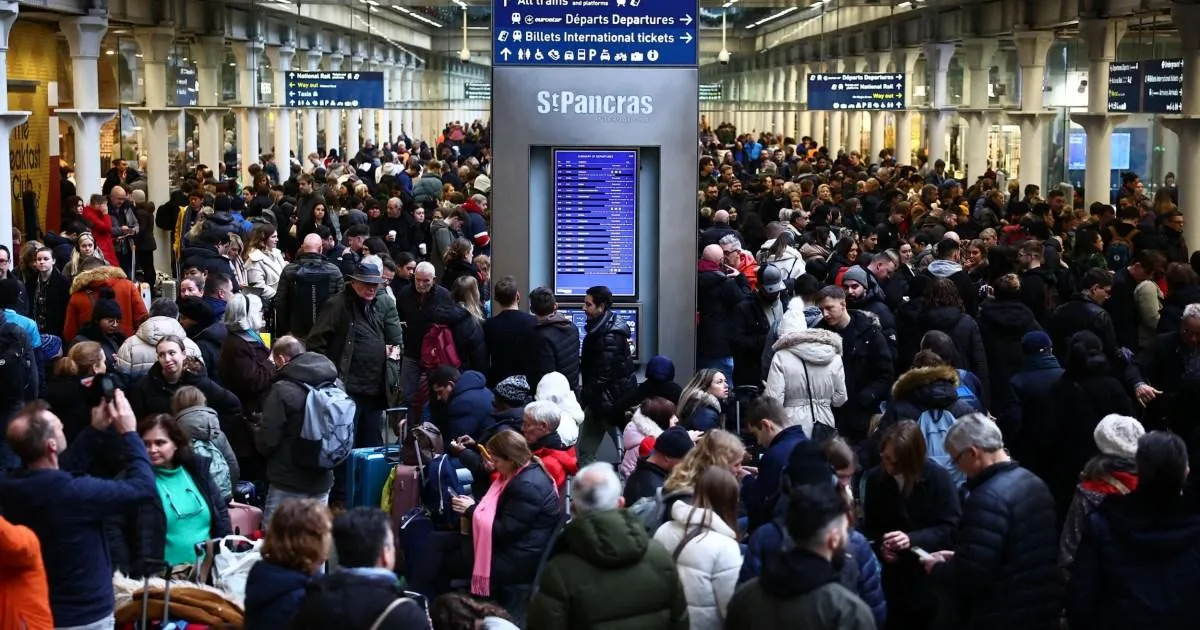
As the afternoon wore on and the disruption stretched toward the evening rush hour, the scene at St Pancras became a strange mixture of quiet resilience and quiet sorrow. Commuters huddled in groups, phones in hand, recalculating their routes and checking the latest updates, while others sat silently on benches, watching the boards for any sign of hope. The railway’s warning to expect delays of up to an hour, cancellations and dramatically revised schedules became the backdrop for countless small decisions—calls home to explain late arrivals, hurried messages to colleagues about missed meetings, the resigned shrug of travelers who understood that some days the railway simply doesn’t cooperate. And through it all, the staff on the ground kept working: station personnel guiding bewildered passengers toward alternative services, customer service teams fielding endless queries, train crews adjusting to temporary schedules, and across the network, a shared understanding that even on the worst days, the rails would eventually run again. For those caught up in the chaos, the advice was simple, practical, and tinged with compassion: delay your journey if you can, explore every alternative route if you can’t, and above all, be patient—because sometimes a single, heartbreaking moment on the tracks is enough to stop an entire city in its tracks.