



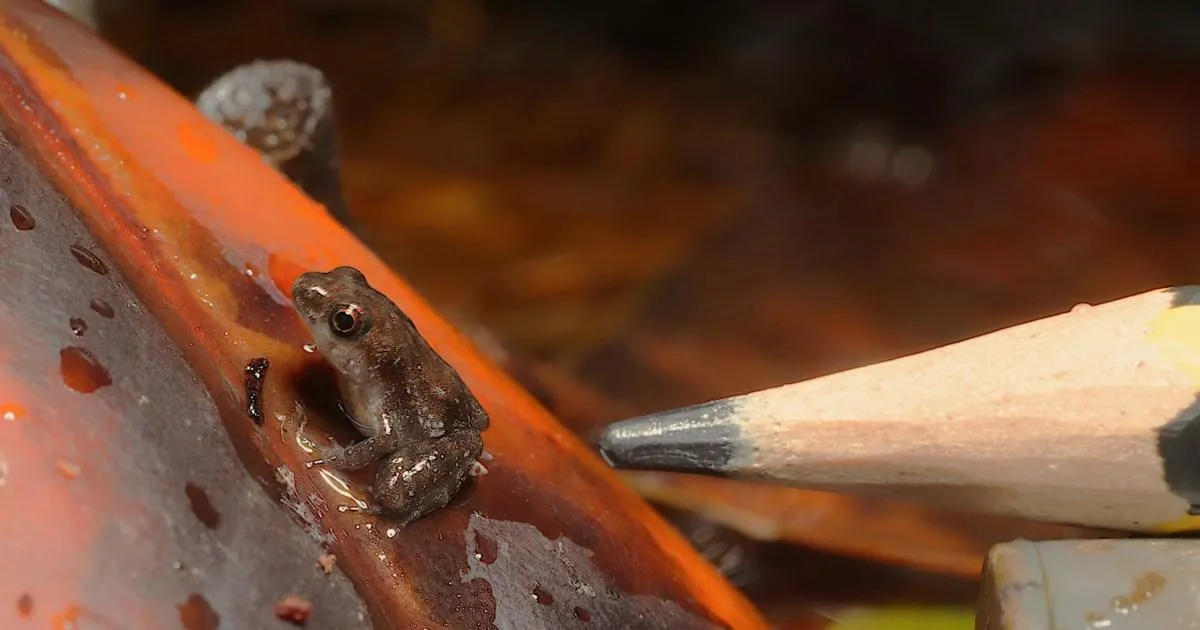
At first glance, the announcement might seem easy to overlook, much like the creatures themselves. The 15 newborn froglets at London Zoo are so small that five of them could line up across a fingernail. Yet their arrival is being hailed as a world first and a landmark moment for amphibian conservation. For the first time ever, Afia Birago’s puddle frogs (Phrynobatrachus afiabirago) have been bred successfully in human care, anywhere in the world. The froglets are currently just 5mm long—smaller than a grain of rice—but their existence is monumental for a species clinging to survival. Imagine holding one in the palm of your hand: you would feel almost nothing, a delicate speck of life no heavier than a few drops of water. Yet each of those specks carries the genetic future of an entire species. The froglets are the offspring of 20 adult frogs that were brought to London from Ghana the previous year as part of an emergency rescue mission. The mission was mounted by the Zoological Society of London (ZSL), Herp Conservation Ghana and the CSIR-Forestry Research Institute of Ghana, after it became clear that these frogs, found nowhere else on Earth, were in imminent danger of vanishing forever. No other zoo or institution has managed to breed this species, which makes the London births a crucial breakthrough. It is a breakthrough born of patience, expertise and no small amount of hope. “They may be tiny enough to sit on your fingertip, but their arrival represents a huge step forward for an amphibian facing an uncertain future,” said Ben Tapley, ZSL’s curator of reptiles and amphibians. For the keepers who have spent months learning the species’ secrets, the froglets are proof that dedication can pay off in the strangest, smallest ways. Behind the glass, in carefully controlled humidity and warmth, these miniature pioneers are beginning to explore their world—hopping distances that seem vast to them, though a human could cover the same ground in one stride. Their birth is not simply a zoo attraction; it is a vital insurance policy against extinction. For now, these tiny survivors are a reminder that even the smallest creatures deserve a future.
To understand why these births matter so much, you have to know how precarious the frog’s existence had become. Afia Birago’s puddle frog was only identified as a new species eight years ago. In the short time since, scientists have discovered that it survives in just two permanent pools in Ghana’s Atewa Hills Forest Reserve. That is the entire known range of the species—a tiny, fragile footprint on the map. The pools lie within a forest that is being steadily damaged by mining, and the pollution and habitat destruction have pushed the frogs to the edge. Because the species is so newly described, conservationists are still racing to understand its basic needs; there is a real fear it could disappear before we even learn what it requires to thrive. It is found nowhere else in the world, so losing it would not just be a local tragedy but a global loss of evolutionary history. The species was given its name by award-winning Ghanaian conservationist Caleb Ofori-Boateng, who helped describe it and named it after his mother, Afia Birago, so that her legacy would live on. That personal connection gives the rescue an extra emotional weight. This is not just a scientific case number; it is a creature carrying the name of a human mother, and a future that depends on human care. Afia Birago’s puddle frogs are not colourful or charismatic in the way of giant pandas. They are small, brown, unassuming amphibians that spend much of their lives hidden among leaf litter and shallow water. But their ecological role is important, and their disappearance would ripple through the forest’s delicate web of life. They are also a bellwether for the health of the Atewa Hills ecosystem, a biodiversity hotspot that shelters countless other species found only there. The fact that these frogs have survived in just two pools makes them extraordinarily vulnerable: one bad storm, one chemical spill, one mining accident could wipe out the entire wild population. In September 2025, with the threat of extinction imminent, an emergency action plan was established. The situation was so dire that waiting to gather more data was not an option. Conservationists made the difficult decision to bring some of the frogs into human care, not as a surrender, but as a lifeline.
Moving the frogs was no simple task. With limited experience caring for the species in captivity and difficulties sourcing equipment locally, the team knew they needed a safe haven where specialists could learn on the job. They decided to transfer 20 adult frogs to London Zoo, where decades of amphibian expertise could be put to work. But before the frogs ever boarded their flight to the UK, ZSL amphibian keeper Unnar Aevarsson travelled to Ghana. He helped establish a conservation breeding facility in Kumasi—the first dedicated amphibian conservation facility in West Africa, according to ZSL. He also spent time in the Atewa Hills, studying the frogs’ natural environment, measuring the temperature and humidity of their pools, observing the plants and water chemistry, and gathering every scrap of information that might help recreate a suitable home in London. It was painstaking work. The frogs are secretive and tiny, and almost nothing was known about their captive care. But the team drew on experience caring for other amphibian species, adapting techniques and improvising solutions. The transfer itself was delicate; the frogs had to travel in specially prepared containers, with conditions carefully maintained to reduce stress. For the keepers, it was a leap of faith. They were bringing animals to a strange new continent, hoping they could learn what the frogs needed before it was too late. The first months were a period of intense observation, trial and error, and quiet hope. Meanwhile, colleagues in Ghana continued to monitor the two wild pools, tracking threats and gathering data. The collaboration meant that even as the frogs adapted to London, their story was never forgotten at home. Every success in captivity was shared, every setback examined together. Every small change in the frogs’ behaviour was noted, every feeding response celebrated. The goal was not simply to keep the frogs alive, but to create an environment where they would feel secure enough to breed. It was a slow, meticulous process, and there were moments when the team must have wondered whether they would ever succeed. But they kept going, driven by the knowledge that these 20 frogs were among the last of their kind.
Once the adults arrived in London, the real detective work began. “When the adult frogs arrived in London last year, almost nothing was known about them,” Aevarsson said. “Using our extensive experience caring for amphibians, our team have since learned so much more about these incredible frogs—developing the knowledge, techniques and breeding protocols needed to give them the best chance of survival.” The keepers studied the frogs’ every move. They experimented with different diets, lighting cycles, water depths and hiding places. They mimicked the seasonal changes of the Ghanaian forest, creating micro-climates that encouraged natural behaviours. Slowly, the frogs began to settle. Breeding amphibians in captivity is notoriously difficult; many species require exact triggers—changes in rainfall, temperature, day length—to reproduce. The team had to learn these triggers by watching and listening, creating a rhythm of misting and drying that mimicked Ghana’s wet and dry seasons. When the first clutch of eggs appeared, it was a moment of electric excitement, followed by the anxious wait to see if they would hatch. The tadpoles were delicate, and raising them required constant attention and careful feeding. Each stage brought new challenges, but also new joy. The 15 froglets that have now emerged are the result of countless small decisions made by dedicated people. The fact that they have survived to this stage is a testament to the keepers’ patience and skill. Each froglet is a tiny, living lesson in what can be achieved when people refuse to give up on a species. The births are a cause for celebration, but Aevarsson is careful to frame them as a beginning, not an end. “These 5mm long froglets are cause for celebration, but our work to save Afia Birago’s puddle frog has only just begun,” he said. The wider goal is for ZSL’s partners in Ghana to establish sustainable conservation populations that can support the frogs’ recovery in the wild. The London births make that goal a real possibility. It is a sentiment echoed by the entire team: the froglets are not the finish line, but a bridge between despair and hope. With each new generation born in captivity, the species gains a buffer against extinction. With each new technique refined in London, the team learns how to care for the frogs better tomorrow than they did today. And with each tiny frog that opens its eyes and takes its first hop, the story of Afia Birago’s puddle frog becomes a little less about loss and a little more about survival.
The success in London is only one piece of a much larger puzzle. The ultimate aim is to ensure that Afia Birago’s puddle frogs can one day thrive again in their natural home in Ghana. That means building local capacity, training local conservationists, and creating breeding facilities in the country where the frogs belong. The new facility in Kumasi is central to that vision. By developing techniques in London, the team can transfer that knowledge back to Ghana, where conservationists can rear frogs in conditions closer to their wild habitat. Caleb Ofori-Boateng, the award-winning Ghanaian conservationist who named the species after his mother, spoke movingly about what the breeding programme means. “I named this frog after my mother so that her legacy would live on,” he said. “Thanks to this breeding programme, it will. Her name will be linked to a species we saved, not one we lost.” His words capture the emotional heart of conservation. Dr Kwame Antwi Oduro, director of the CSIR-Forestry Research Institute of Ghana, also emphasised the importance of the collaboration. “Protecting the species that live in Ghana’s forests is central to our mandate,” he said. “This collaboration with ZSL shows what science and partnership can achieve together, and it is building the skills and facilities Ghana needs to safeguard its own threatened wildlife.” For the local communities and researchers, the project is about more than one tiny frog. It is about pride, capacity and a future where Ghana’s natural heritage is protected by Ghanaian experts. The knowledge gained in London does not stay in London; it flows back to the country where the frogs were born, empowering a new generation of conservationists. It is a model that could be applied to other endangered species across Africa, turning a single rescue into a lasting legacy. The facility in Kumasi is not just a room with tanks; it is a symbol of what can happen when different countries, organisations and individuals come together around a shared purpose. It shows that conservation is not a luxury, but a necessity—and that even the smallest, most overlooked creatures are worth fighting for.
For now, visitors to London Zoo can glimpse the conservation programme at the Secret Life of Reptiles and Amphibians exhibit, where the frogs are being cared for by specialist keepers. The froglets may be difficult to spot among the foliage, but knowing they are there—that they exist at all—is a small miracle. Every time someone stops to look, they become part of the story. ZSL hopes that visitors will leave not just with a sense of wonder, but with a commitment to protecting the places where these animals live. Simple actions—supporting conservation organisations, choosing sustainable products, spreading the word—can make a difference. It is easy to feel helpless in the face of extinction, but the story of these 15 froglets is proof that dedicated people can turn the tide. The frogs’ survival is still far from guaranteed. The wild population remains critically endangered, and the mining threats to their habitat have not disappeared. But the births at London Zoo have changed the equation. They have given conservationists a fighting chance, a source of frogs for future reintroduction, and a powerful symbol of hope. As Ben Tapley said, the arrival of these tiny froglets is a huge step forward. It is also a reminder that conservation often works in small, quiet increments—behind the scenes, in carefully controlled tanks, with creatures so small they might be overlooked. But those small steps can add up to something extraordinary. For a species that nearly slipped away in silence, the sound of 15 tiny frogs hopping in London is actually a chorus of hope. The next chapter will be written in Ghana, where the real goal is to see Afia Birago’s puddle frogs living safely in their forest pools, their mother’s name carried into the future by a species that refused to disappear. And when that day comes, the 15 tiny froglets born in a London zoo will be remembered not just as a first, but as a turning point—the moment a species began its long journey back from the edge.