


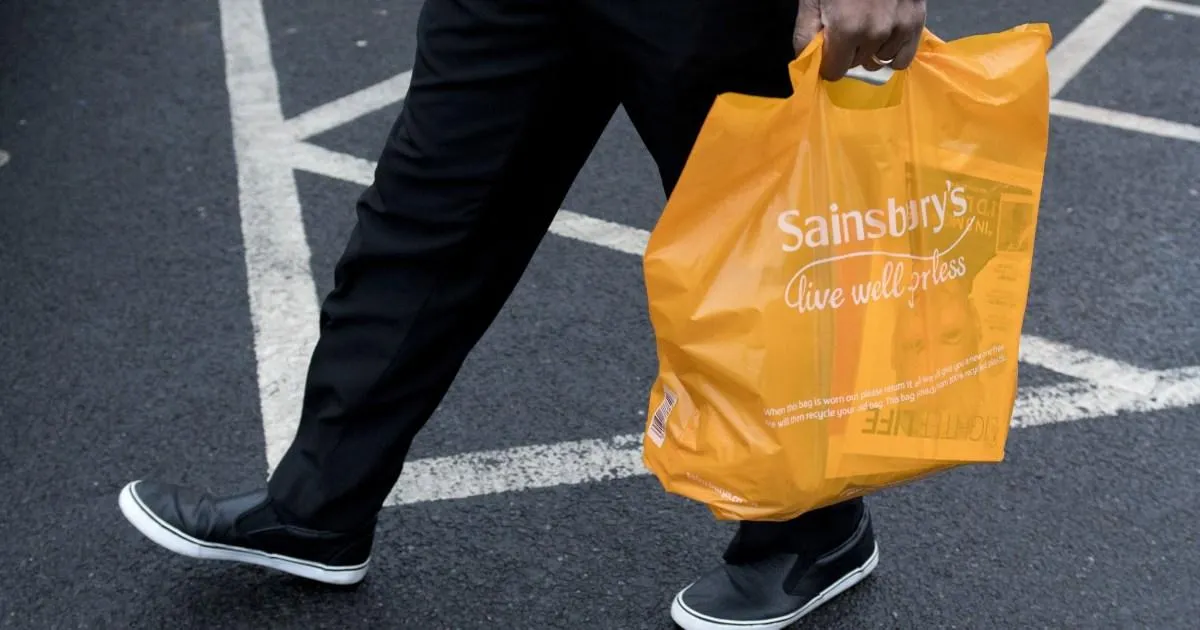
1. The story begins in the most ordinary way possible: a trip to the supermarket, a handful of items, and the quiet decision at the self-checkout not to pay for a carrier bag. It is the kind of moment that millions of people experience every week, often without a second thought. But for Luke Hodgson, that moment—repeated three times over the course of just twelve days—would come to define the end of his career before it truly began. Hodgson was a special constable, a volunteer police officer who gave his time to serve the public. He was also an employee of Sainsbury’s. And according to a formal misconduct ruling, he deliberately chose not to pay for carrier bags on three separate occasions, with the total value of what he failed to pay amounting to just £1.20. It is a staggeringly small sum, the kind of money that might be found between sofa cushions or dismissed as spare change. Yet the consequences were enormous. Sainsbury’s sacked him from his job. West Mercia Police dismissed him from his volunteer role. And the College of Policing placed his name on the barred list, meaning he will never be able to serve as a police officer in the future. All because of a handful of plastic bags, and the choices made around them.
2. The details of the case were laid out by West Mercia’s chief constable, Richard Cooper, in a formal misconduct ruling that left little room for ambiguity. Cooper stated plainly that Hodgson “did know that payment was required for the bags and chose not to offer such payment.” That single sentence captures the essence of why this case mattered. It was not an accident. It was not forgetfulness. It was not a faulty self-checkout machine or a moment of confusion. It was, in the eyes of the ruling, a deliberate act. And because it was deliberate, it carried weight far beyond the monetary value involved. The chief constable went on to say that the public expect nothing more from the police service than for them to be trustworthy. He acknowledged that this was not “operational dishonesty” in the sense of corruption or abuse of power in the line of duty. But he framed it as an abuse of trust nonetheless, because Hodgson was not just a police officer in his spare time; he was also an employee of the store where the thefts occurred. That dual role made the betrayal more personal. He was, in effect, stealing from his own employer while wearing the same uniform of trustworthiness that he had voluntarily taken on as a special constable. There were mitigating factors, Cooper noted. Hodgson eventually repaid the £1.20. But repayment, while welcome, could not undo the intent behind the original actions. The ruling concluded that Hodgson had acted dishonestly and had committed theft. And theft, however small, was fundamentally incompatible with the high standards of integrity required of anyone who wears a police badge. He was dismissed without notice, and the door to a future policing career was closed.
3. It is easy to look at a case like this and wonder whether the punishment fits the crime. After all, £1.20 is less than the price of a cup of coffee in most places. It is the kind of thing that could be forgiven with a shrug and a quick apology in many areas of life. But the police are not most places. The police hold a unique position in society, one built entirely on public trust. When someone becomes an officer—whether paid or volunteer—they are not just accepting a job; they are accepting a standard of behavior that applies to every corner of their life. The law does not care whether a theft is committed in a back alley or at a self-checkout in a bright supermarket. A police officer who steals is no longer a credible witness in court. A special constable who takes something without paying is no longer someone the public can look to as a guardian of the rules. The fact that Hodgson was a volunteer makes the story more complicated in some ways. He was not doing this for money. He was doing it, presumably, out of a sense of duty and service. That makes it all the more tragic that he would throw it away over such a trivial amount. But it also makes the decision to dismiss him more understandable. If integrity is not maintained in the small things, how can it be trusted in the big ones? This is the logic that underpins the ruling. It is not about the bags. It is about the character revealed by the act of not paying for them. And once that character is revealed, it cannot be unseen.
4. The story of Luke Hodgson echoes a strikingly similar case from 2024, one that adds another layer of context to this debate about honesty, trust, and proportionality. In that case, a Sainsbury’s worker named Niamke Doffou was dismissed after nearly twenty years of service because he selected the “zero bags used” option on a self-service checkout while packing up a £30 shop. Doffou, a native French speaker who had lived and worked in the UK for almost two decades, did not pay for the carrier bags he used. The bags themselves were worth either 30p or 65p each, depending on the type. After watching CCTV footage of the incident, Sainsbury’s bosses concluded that Doffou could no longer be trusted and fired him. Doffou later claimed that he was “tired and unaware of what he was doing” at the time. But his claim of unfair dismissal was thrown out by an employment judge, who said it was “very hard to argue” with the decision to dismiss him. The judge’s reasoning was similar to the logic used in Hodgson’s case: the act itself, however small, was a breach of trust. Doffou had worked for Sainsbury’s for nearly two decades. He had presumably scanned countless items over the years and understood the system well. To select the option that said no bags were used, when in fact they were used, was not a mistake. It was a conscious choice. And in the eyes of the employer, that choice negated all the years of good service that had come before it. It is a harsh outcome, especially for someone who may have genuinely been exhausted after a long shift. But it reflects a broader truth about how trust works: once broken, it is not easily repaired, regardless of the value of what was taken.
5. These two cases, taken together, offer a powerful reminder that integrity is not measured in pounds and pence. It is measured in the small decisions we make every day, especially when no one is watching. The self-checkout is an interesting frontier in this regard. It is a system that relies almost entirely on the honor of the customer. There is no cashier standing there, no one to look you in the eye while you scan your items. The machine simply asks you to be honest. And in that moment, the only person you are really answering to is yourself. For most people, the decision to pay for a carrier bag is automatic. It is not a moral struggle; it is just what you do. But for others, the self-checkout becomes a kind of test, and failing that test—even in the smallest way—can reveal something uncomfortable about a person’s relationship with honesty. The police understand this better than most. That is why they do not treat theft as a matter of the amount involved. The law distinguishes between petty theft and grand theft in terms of sentencing, but in terms of character, the distinction is meaningless. A person who steals a £5 note is just as capable of stealing £5,000. A person who lies about a carrier bag is just as capable of lying under oath. This is not to say that people cannot change or that one mistake should define a life. But for those who choose careers in law enforcement, the standard is intentionally unforgiving. The public does not want to think of police officers as people who have to be watched. They want to believe that the people in uniform are beyond reproach. And when that belief is broken, even by a small act, it damages the institution as a whole.
6. In the end, the most human part of this story is the sense of loss. Luke Hodgson did not set out to destroy his life. He was a volunteer, a person who gave up his free time to help keep his community safe. He had a job at Sainsbury’s and presumably a future that he hoped would include a career in policing. In a matter of days, all of that was taken away from him—or perhaps more accurately, he gave it away himself, one bag at a time. The same could be said of Niamke Doffou, whose twenty years of loyal service were erased by a single decision at a self-checkout. It is tempting to feel sympathy for them, to wonder if the punishment was too severe, to think about all the genuinely bad people in the world who seem to escape consequences while others are caught over 30p bags. But the law and the employers who enforced these decisions have a different perspective. They see trust as the most valuable currency there is, and they believe that it must be protected even when the cost of doing so seems harsh. For the rest of us, these cases are a reminder that our actions have weight, even the ones that seem insignificant. A carrier bag is just a carrier bag. But the choice to pay for it, or not to pay for it, says something about who we are. And for those who hold positions of trust, that something can be enough to end a career. In the quiet aisles of a supermarket, with a barcode scanner in hand and no one watching, the real character of a person is often revealed. Luke Hodgson discovered that truth the hard way. So did Niamke Doffou. And their stories leave us with an uncomfortable but important lesson: integrity is not about the size of the thing you do wrong. It is about the fact that you did it at all.