

Here is a summary and humanization of the content, structured into six paragraphs as requested.
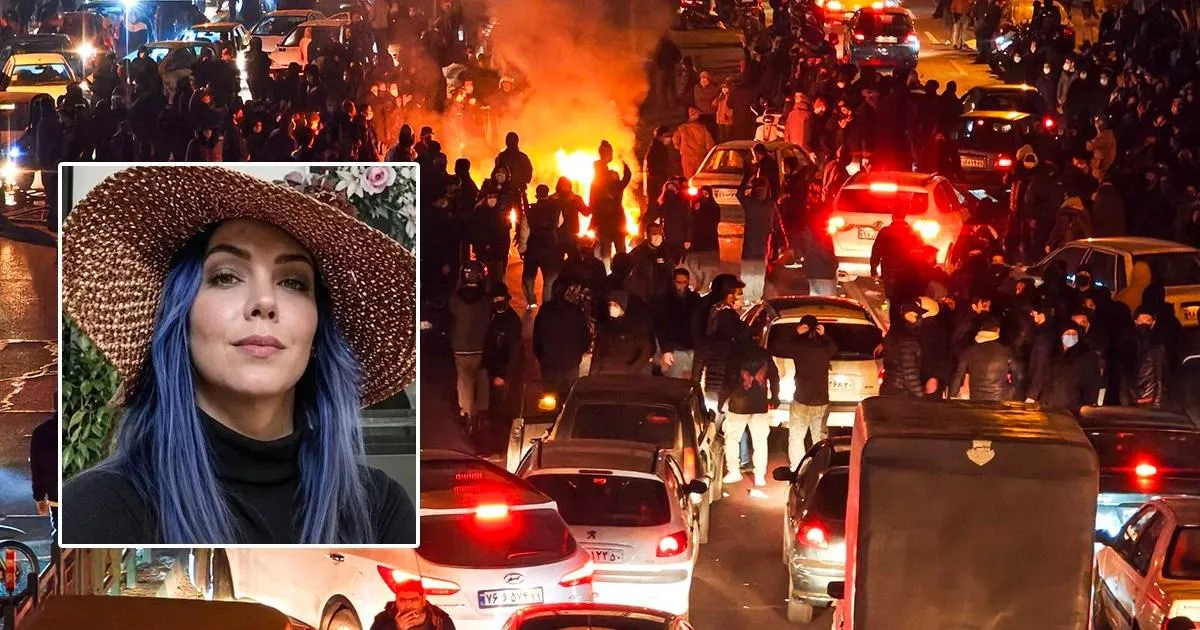
In the cold, gray dawn of a January morning in the city of Shahinshahr, Iran, a woman’s life was about to be irrevocably shattered by a single, instinctive act. Leila Abolhasani, a mother of two in her early forties, happened upon a scene of chaos: the local Ofogh Koorosh supermarket, a familiar landmark of daily commerce, was engulfed in flames. This was not an isolated accident but a flashpoint within the nationwide protests that had gripped the country. Reacting as any citizen with a smartphone might, she raised her phone and took a photograph of the burning store—a simple documentation of an extraordinary moment. She could not have imagined that this impulsive gesture would be interpreted as an act of war against the state itself, setting her on a collision course with the Iranian judiciary that would end, months later, with her being sentenced to death. Her arrest on January 8th for this photograph marked the beginning of a harrowing journey through a legal system that had already decided her fate.
The charge leveled against Leila Abolhasani is one of the most severe in the Iranian penal code: Moharebeh, which translates to “waging war against God.” This charge, historically reserved for armed insurgents and violent enemies of the state, carries the ultimate penalty. In her case, the act of “warfare” was defined as arson, an accusation that she and her supporters adamantly deny. For over seven months, she has been held in Tehran’s notorious Dowlatabad Prison, separated from her children and family, awaiting a verdict that was delivered with chilling swiftness in late May. The presiding judge at the Isfahan Revolutionary Court, Vahid Hemmatnejad, pronounced the death sentence, a decision that now languishes in a review by Iran’s Supreme Court. The legal process, opaque and driven by political imperatives, reveals that her “crime” was not the act of setting a fire, but the act of witnessing it and seeking to share that evidence with the world. Her photograph, an inconvenient truth, was transformed by the state into a weaponized memory used to justify her destruction.
But to truly understand Leila’s story, we must look beyond the legal jargon and see the human being at its center. She is a mother, thrust into a nightmare where the love for her children is now a source of profound pain. An anonymous refugee who knows her told news outlets that her footage could have exposed “how brutal and savage” the regime is, and that her case is being used as a terrifying example. The same source chillingly explained the regime’s intent: “They want to create fear among the people so that anyone who might consider revealing the truth will be too afraid to do so, especially after seeing what has happened to her and her two children.” This is not justice; it is a public spectacle of terror designed to silence dissent. Her children are not merely collateral damage in this case—they are hostages to the state’s desire for control, their mother’s life used as a bargaining chip to intimidate a population that has dared to ask for more.
Leila is far from alone in this tragic narrativeasi. Her case is a microcosm of a larger, brutal crackdown that followed the protests which erupted across Iran earlier this year. Sparked by the death of a young woman in police custody, the demonstrations quickly became a widespread uprising against the regime’s iron fist. Human rights organizations have estimated that as many as thirty thousand people, including several hundred children, were killed by security forces during these protests. The revolutionary courts, which operate with a presumption of guilt, have become assembly lines for death sentences, churning out verdicts for political prisoners and activists with alarming speed. The statistics are staggering: Iran is one of the world’s most prolific executioners, with over 1,600 people put to death in 2025 alone, the highest number since 1985. This industrial scale of violence, often conducted in secret and without due process, underscores the regime’s fundamental reliance on fear as its primary tool of governance.
Leila’s current existence is a limbo between life and death. She sits in a prison cell, her future hanging on the decision of a Supreme Court that is an arm of the very system that condemned her. Her only hope lies in the unlikely possibility that her appeal will be successful, but given the political nature of her case, the odds seem insurmountable. Meanwhile, her lawyers, acting in a legal framework that offers little genuine recourse, are fighting a desperate battle to save her life. The story of Leila Abolhasani is not just about a death sentence; it’s about the death of justice itself. It is the story of a woman punished for bearing witness to the truth, for choosing to document a moment of turmoil instead of turning a blind eye. The image of a mother, separated from her childrenhol, with the shadow of the gallows looming over her, serves as the ultimate indictment of a regime that preemptively crushes any voice that might speak a truth it does not control.
Ultimately, Leila Abolhasani’s fate is a somber reflection on the very nature of justice in contemporary Iran. Her punishment is not a verdict for a crime she committed, but a message for the world—a chilling declaration that the state will not tolerate being seen in an unflattering light. The disturbing similarity to the execution of Erfan Kiani, a man hanged for vandalism during the same protests, confirms that this is a system designed for swift and brutal suppression. The international community, through bodies like the United Nations, has condemned these executions, but words have done little to stay the hangman’s hand. As the Supreme Court deliberates, her life hangs in the balance, a fragile human thread caught in the gears of a merciless political machineterate. Her story is a stark reminder that in a climate of absolute state power, a single photograph can be deemed a capital offense, and the simple truth of a mother’s gaze can be treated as an act of war. Her family, her children, and all who know her can only wait, trapped within the terrifying silence of a court where the outcome has likely already been decided.