

The morning light did not bring hope to the villages of Nuwakot and Rasuwa; it brought only clarity to the scale of the catastrophe. As the muddy waters receded, leaving behind a thick, suffocating paste of silt and debris, the residents who had fled for their lives began to pick their way back through the wreckage of their homes. The air, thick with the stench of damp earth and spilled fuel, was punctuated by the sharp cries of those who discovered that their houses—and their loved ones—were gone. They climbed over twisted metal roofs, shattered wooden beams, and boulders that had rolled down from the Himalayan foothills like monstrous marbles. Each step was a negotiation with grief. Some merely stood in silence, staring at the empty spaces where their kitchens, their fields, and their family photographs used to be. The flash floods, triggered by relentless monsoon rains, had swept through the narrow valleys with the force of a thousand locomotives, leaving a trail of desolation that measured not just in wreckage, but in the stark, unforgiving arithmetic of the missing. As of this morning, the official count stood at 626 confirmed dead, with a staggering 2,426 people still unaccounted for. For the families sifting through the sludge with their bare hands, these are not just numbers; they are the faces of mothers, fathers, children, and grandparents who vanished in the blink of an eye.
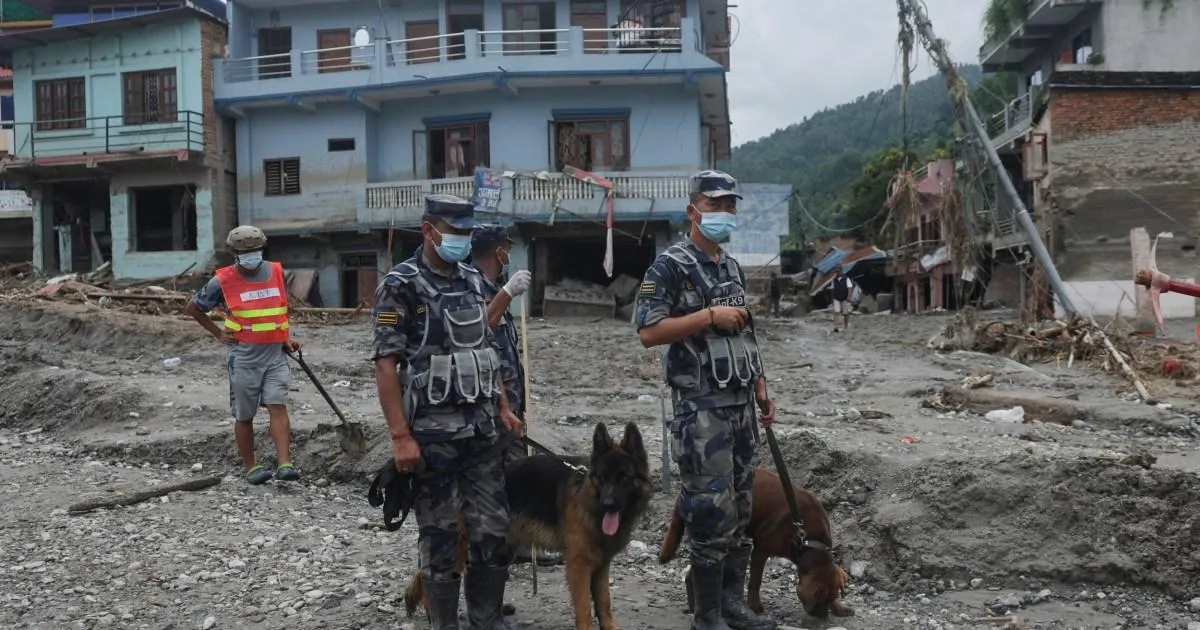
The search for the missing has become a desperate, grueling campaign against both time and the elements. Across the ravaged landscape, crews of soldiers, police officers, and volunteers are toiling through the debris, often with little more than shovels and sheer determination. In the Rasuwa district, which borders Tibet, the rescue effort is being compounded by the treacherous terrain and the ominous grey skies that continue to threaten more rain. Armed police officers have been deployed with sniffer dogs, their handlers moving methodically through the rubble, hoping to catch a scent of life beneath the wreckage, though the grim reality is that they are more often finding the scent of death. The rescue teams are working around the clock, though the intermittent downpours have repeatedly forced them to suspend operations, transforming the already treacherous paths into slick mudslides that endanger the rescuers themselves. The area is a magnet for a diverse group of people—foreign pilgrims journeying to sacred sites, laborers working on infrastructure projects, and trekkers seeking the majestic views of the world’s highest peaks. The hundreds of foreigners reported missing highlight the international scope of this tragedy, turning a local disaster into a global reckoning. For the local residents in Nuwakot, where a list of the missing has been painstakingly pinned to the wall of a relief center, the search is deeply personal. They scan the names on the paper list, hoping to cross out a loved one who has been found alive, only to see the ink of new names added as the reality of the flood’s destruction extends further into the hinterlands.
Across the world, in living rooms and offices in the United Kingdom, the anxiety is palpable and excruciating. Among the thousands missing, at least fourteen British nationals are currently unaccounted for, a figure that has sent a shudder through the nation. The missing include a 13-year-old girl and a 14-year-old boy, children whose ages seem impossibly young to be caught in such a catastrophic geological event. They were part of a trekking group organized by The Trekkers’ Society, a specialized expedition company that leads tourists through the dramatic Himalayan passes. The group consists of four British men, aged 14, 50, 50, and 54, and five British women, aged 40, 46, 50, 50, and 53. Another operator, Kailash Journeys, has also reported that seven of its British clients—two men and five women aged between 18 and 55—remain missing. For the families at home, the wait is a special kind of purgatory. They refresh news websites obsessively, their phones clutched in their hands, waiting for a call that won’t come. They imagine their loved ones huddled in a tea house, waiting for the floodwaters to recede, or perhaps injured in a hospital that has lost its phone lines. The Foreign, Commonwealth and Development Office (FCDO) has issued a generic statement, advising all British nationals in Nepal to follow local authority advice and exercise caution while travelling, accompanied by consular assistance numbers. But for a mother in Manchester or a father in Cambridge, those official words feel hollow, incapable of bridging the 4,000 miles of distance that separates them from their missing family members. They are left clinging to the only hope they have: that their loved ones are among the survivors waiting to be discovered.
As the world watches with bated breath, the international community has mobilized to provide relief to the stricken nation. The United Kingdom has been at the forefront of this response, pledging £5 million in humanitarian aid and deploying a specialized crisis response team to the region. This team, composed of rapid deployment experts in search and rescue, logistics, and disaster response, is arriving in Nepal to assist the overstretched local authorities. Alongside the UK, helicopters from various countries are churning through the thin mountain air, their rotor blades slicing the oppressive clouds, ferrying essential supplies—food, medicine, and warm clothing—to the isolated villages that have been completely cut off from the outside world. Soldiers load massive sacks of rice, crates of instant noodles, and bundles of clothing onto these aircraft, desperately trying to reach the survivors who have been stranded for days without shelter or sustenance. Despite the devastation, there are stories of miraculous survival. Rescue crews have managed to pull over 3,700 people from the wreckage, including several young babies who were carried to safety in the arms of soldiers, their tiny faces swaddled against the cold. Survivors stagger out of the mud, often clutching nothing more than a small plastic bag containing a few precious belongings—a ration card, a pair of shoes, a photograph tucked inside a jacket. The evacuation of these thousands is a testament to human resilience, but it also serves as a stark reminder of those who didn’t make it out with them, their names still echoing unanswered in the hills.
Amidst the physical wreckage, the emotional toll is beginning to manifest in heartbreaking ways. In the community of Nuwakot, the relief center where the list of missing is pinned has become a focal point for the grieving. A man methodically pastes photographs of his missing relatives onto the wall of a university building that has been converted into a shelter, the images of smiling faces a stark, silent contrast to the gray misery surrounding them. These are the faces of people who, just a week ago, were tending to their livestock or sowing their fields, their lives upended by a wall of water that gave no warning. The grief has transcended borders, touching the Nepali diaspora across the globe. Rajendra Pudasaini, an Essex-based nurse who serves as the president of the Non-Resident Nepali Association UK, recounts his own family’s tragedy with a heavy heart. His relatives were caught in the flash flood and swept away. “They are gone,” he says, his voice breaking, “They were my family, these people are not just news. The country is paying the price for global warming.” His words resonate with a bitter truth that many environmental scientists are now stating with urgency. The Himalayas, a fragile ecosystem, are warming at an alarming rate, causing glaciers to melt and glacial lakes to form, often brimming with unstable moraine dams that can burst at any time. These Glacial Lake Outburst Floods (GLOFs) are the terrifying mechanism behind this week’s destruction. The floods have wreaked an irreplaceable loss not just on the physical landscape, but on the cultural and social fabric of the communities, exposing deep vulnerabilities that were already frayed by decades of unregulated development and climate instability.
The threat, however, is not yet over. High in the Himalayas, the authorities are watching another potential disaster unfold with grave concern. A new lake has formed at high altitude, its waters pooling dangerously behind a fragile glacier. Satellite imagery and drone surveillance have shown the lake expanding, and there were grave fears that the accumulating pressure would cause it to burst, unleashing yet another catastrophic deluge downstream on the already battered survivors. In a race against the clock, engineers and disaster management teams have been working to mitigate the risk. According to Chinese state broadcaster CCTV, the lake has recently reduced in depth by ten meters from its peak level, a small but crucial victory suggesting that the immediate threat of a secondary flood may be receding. However, the reprieve is only temporary; the underlying geological instability remains, a ticking time bomb in a warming world. As the rescue crews continue to dig through the mountains of debris, bearing the brunt of the monsoon weather, the fate of the 2,426 missing persons hangs in the balance. For every day that passes, the window of survival narrows, and the hope for a miracle fades. Yet, the people of Nepal, and the international responders alongside them, refuse to yield to despair. They continue to dig, to search, and to wait. On a ridge overlooking the valley, a man stands alone, silhouetted against the grey sky, staring at the distant peaks where the clouds refuse to part. He is waiting for a helicopter to bring back his brother, his cousin, or even just a piece of clothing to bury. He does not know that tonight, in an apartment in London, an elderly woman will light a candle for him and his family, her own nephew’s name still printed on the FCDO’s advisory list. The floodwaters have receded, but in the hearts of those who love the missing, the storm rages on, an unanswered, agonizing wait amplified by the chilling silence of the mountains.