


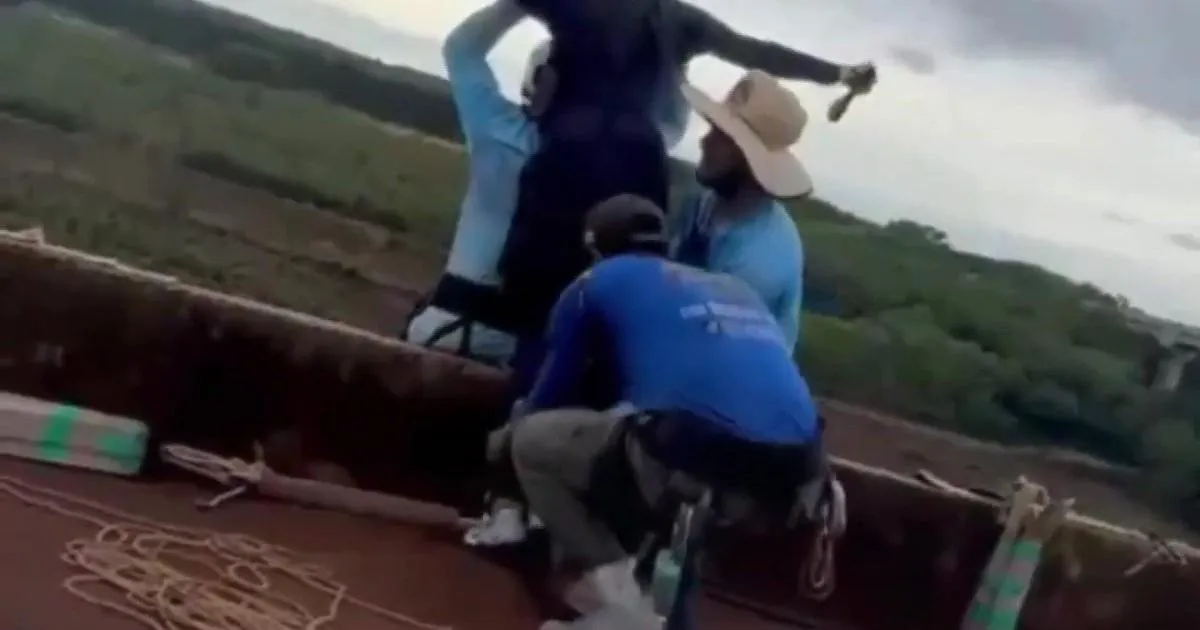
The tragic death of 21-year-old model Maria Eduarda Rodrigues de Freitas in Limeira, São Paulo, serves as a haunting reminder of the fragility of life. What was supposed to be an exhilarating adventure at the abandoned Ponte do Esqueleto railway bridge turned into a nightmare when a fundamental safety protocol was ignored. Witnesses and onlookers watched in horror as Maria was carried to the edge in a “Superman” pose, only to be plummeted 130 feet to the ground without a bungee cord attached. The chilling footage captured not only her fall but the immediate, panicked reaction of the instructors, who stood on the platform looking down at the very safety line that had failed to secure her journey.
The moments following the impact were marked by a desperate, uphill battle for survival. Rayza Dias, a nurse who happened to be nearby, showed immense courage by scrambling down a treacherous, steep slope to reach the victim. Her account highlights the raw humanity of the situation: Maria was indeed alive when she reached the landing zone, breathing heavily and holding onto a faint pulse. Despite the nurse’s best efforts and the urgency of the moment, the trauma was too severe for Maria to overcome. She passed away shortly after, leaving behind a community in shock and a family devastated by the preventable nature of her death.
In the aftermath, the profound grief felt by Maria’s family has reverberated across social media and the public sphere. Her mother’s words following the funeral were filled with the kind of primal anguish that only a parent who has lost a child could understand. “That damned rope took you away from me forever,” she lamented, pinning the heartbreak on the gross negligence that stole her daughter’s future. It is a sentiment that captures the senselessness of the tragedy; Maria had been sharing her excitement for the jump on social media just hours before, completely unaware that the “extraordinary” experience she sought would be her last.
As the legal proceedings begin, the actions of the operators have come under intense scrutiny. The jump was facilitated by Entre Cordas and its affiliated instructor branch, Ih Voei, organizations that marketed their services as thrilling leaps into the extraordinary. However, when the reality of their mistake set in, the individuals responsible—Maicon Fernandes Cintra, Luis Felipe Feliciano Egoroff, and Vitor de Freitas Goncalves—fled the scene and attempted to hide in nearby woods. Their subsequent claim that they “can’t remember” who was responsible for the safety attachment is a chilling admission of negligence that has rightfully led to homicide charges against them.
Beyond the immediate arrests, this catastrophe has sparked a broader conversation about accountability and the regulation of extreme sports. The city of Limeira has signaled its intent to pursue legal action against the Brazilian government, pointing to a critical failure in monitoring access to the abandoned bridge. For too long, the site had reportedly served as a venue for unauthorized or improperly regulated bungee operations. The tragedy has forced a focus on how such dangerous activities are allowed to persist in abandoned locations without strict oversight, raising questions about whether Maria’s death could have been prevented through better infrastructure management and stricter licensing.
Ultimately, the story of Maria Eduarda Rodrigues de Freitas is a sobering call for safety, responsibility, and remembrance. It is the story of a young woman who possessed a zest for life, cut short by the staggering inefficiency and carelessness of those sworn to protect her. As the legal system works to hold the organizers accountable, the public is left to mourn a life that should still be in full bloom. It serves as a reminder to cherish every moment and to never take the safety of our loved ones for granted, as the difference between a thrilling memory and an eternal loss often comes down to the simple, diligent practice of the rules.