


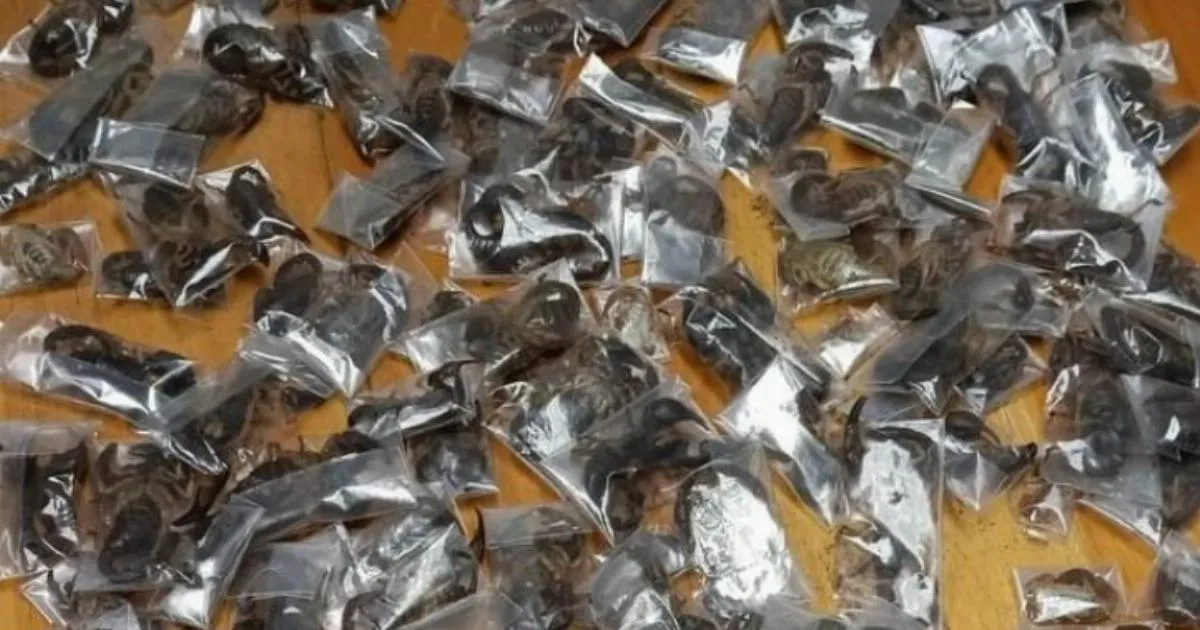
It sounds like the plot of a thriller movie, but authorities at Cape Town International Airport recently dealt with a bizarre and dangerous reality. A 28-year-old traveler was intercepted by police following an intelligence operation that had flagged him as a person of interest. When officers searched his luggage, they didn’t find the usual holiday souvenirs; instead, they discovered 150 live, venomous scorpions carefully tucked away among his folded clothing. Each creature had been individually wrapped, a chilling level of preparation that highlights the disturbing lengths to which wildlife smugglers will go to move living cargo across borders.
The suspect was promptly taken into custody under the Nature and Environmental Ordinance Act, charged with the illegal possession of wild animals. While the police are still working to determine the exact financial value of this illicit shipment, the scorpions themselves have been moved to a safe haven to recover from their ordeal. It is a stark reminder of the massive, hidden threat of wildlife trafficking that persists in South Africa. As a nation boasting incredible biodiversity, it often becomes a primary target for criminal syndicates who view exotic animals—from iconic rhinos to the smallest reptiles—as nothing more than commodities to be exploited for profit on the global black market.
This arrest serves as a timely reminder of how volatile the illicit trade in exotic creatures really is. Just recently, a passenger at Logan Airport in Boston found herself on the wrong end of a stray scorpion that had escaped during the baggage claim process—a terrifying experience that underscores the danger these creatures pose to public safety. When humans treat venomous wildlife like contraband in a suitcase, they aren’t just endangering the animals; they are creating high-risk scenarios for airport staff, fellow travelers, and anyone else who might inadvertently come into contact with these hitchhikers. The suspect in Cape Town is expected to face a judge this Monday, where the legal system will begin to address the consequences of his actions.
Interestingly, while modern scorpions are creating chaos in airports, the history of these arachnids is just as fascinating—and significantly more intimidating. Scientists from the Natural History Museum and the University of Manchester recently made a groundbreaking discovery involving fossils that have been sitting in museum archives for over 150 years. By applying modern analytical techniques to these ancient specimens, they identified Praearcturus gigas, a prehistoric scorpion that once roamed the UK roughly 415 million years ago. This wasn’t a creature you could tuck into a suitcase; it measured a meter in length and brandished pincers over 16 centimeters long.
The Lead Curator of Fossil Arthropods, Dr. Richard J. Howard, noted that this finding completely shifts our perspective on the evolution of life on Earth. Most people imagine giant insects or millipedes as the monsters of the distant past, but Praearcturus existed long before trees even evolved. At a time when life on land was still in its earliest, most experimental stages, these massive, armored predators were already dominating their environment. Confirming the nature of this ancient species has provided researchers with a much clearer picture of how and when these complex creatures reached such extraordinary sizes, proving that scorpions have been a formidable force long before humans ever walked the planet.
Ultimately, these two stories—one of a modern-day crime and one of a prehistoric mystery—offer a strange look at our relationship with the natural world. Whether through the lens of illegal smuggling efforts that threaten our current ecosystems or through scientific research that uncovers the giants of our deep past, we are reminded that wildlife has always been a complex and sometimes dangerous part of our shared history. Conservationists and scientists continue to fight to protect the delicate balance of our modern biodiversity, hoping to prevent today’s criminals from stripping the earth of its most unique creatures. As this latest smuggling attempt shows, the work to stop those who trade in these living treasures is as urgent as it has ever been.