


The tragic death of 21-year-old Maria Eduarda Rodrigues de Freitas at an abandoned railway bridge in Limeira, São Paulo, has sent shockwaves through Brazil and beyond. A vibrant young woman, Maria Eduarda was a teacher and fitness enthusiast who had looked forward to her bungee jumping experience as an exciting, “extraordinary” adventure. Instead of the thrill she signed up for, she was met with a horrific, preventable accident when the safety equipment meant to secure her life remained detached on the platform. Witnesses at the scene were left traumatized, their shouts of “the rope, the rope” echoing in the moments before she plummeted 130 feet to the ground. For her family, particularly her mother, Valdenia, the loss is an unbearable agony—a life full of promise extinguished by what appears to be a staggering, inexcusable failure of professional responsibility.
The investigation into the incident has recently moved into the courtroom, where three men involved in the operation—42-year-old Maicon Fernandes Cintra, 32-year-old Luis Felipe Feliciano Egoroff, and 27-year-old Vitor de Freitas Gonçalves—have appeared to face charges of homicide with eventual intent. Photographed being led into court in handcuffs, the three men offered a defense that has done little to soothe the outrage of the public or the grieving family: they claimed to have experienced a “blackout” regarding the setup process. Despite having operated these jumps for years, the men insisted they could not recall who was responsible for securing the safety cord, shifting the blame to a collective lack of defined roles and arguing that equipment checks were handled “jointly” rather than through a rigorous, individual protocol.
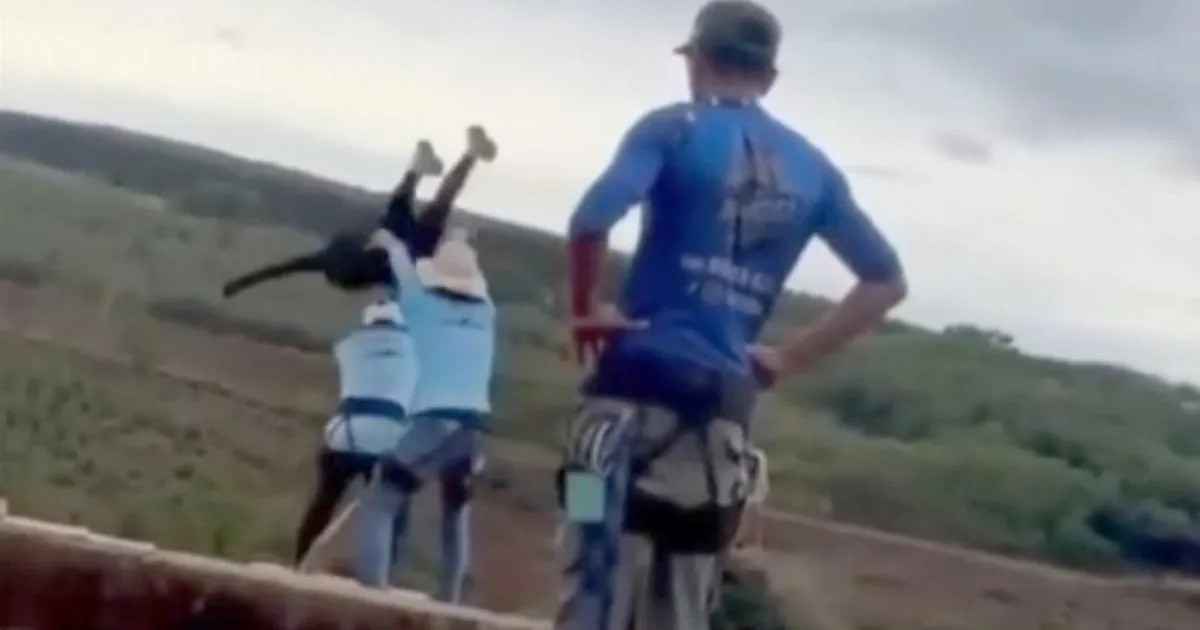
The details emerging from the police reports paint a picture of an alarmingly disorganized operation. Luis Felipe, for instance, admitted to authorities that the team lacked set responsibilities, a revelation that calls into question the safety culture of the companies involved, Entre Cordas and the affiliated brand Ih Voei. Their lawyer has attempted to characterize the defendants as being in a state of “shock,” claiming they are incapable of explaining how such a catastrophic oversight occurred. Yet, for those observing the proceedings, the “shock” of the workers pales in comparison to the reality of the footage capturing the event, which shows Maria Eduarda being carried in a “Superman” pose toward the edge of the bridge while the safety line lies completely ignored on the platform behind her.
Social media archives have made the tragedy feel even more personal and immediate. In the hours leading up to her death, Maria Eduarda had shared her excitement with friends and family, posting photos of the bridge and images of the company’s representatives. One post in particular—a playful, rhetorical question asking who the “crazy person” was who allowed her to jump—now stands as a harrowing, unintentional irony. Those final digital traces of a young person preparing for what should have been an exhilarating weekend have become a haunting testament to how quickly a moment of joy can turn into a nightmare defined by professional negligence and a complete breakdown of safety standards.
For Maria Eduarda’s mother, Valdenia, the aftermath has been defined by a raw, public outpouring of grief. Shortly after her daughter’s funeral, she took to social media to express the depth of her despair, mourning the girl who was taken away forever by the very equipment that promised safety. Her words—describing a remaining existence framed only by “pain and longing”—underscore the devastating impact of this fatality. The company’s subsequent actions, such as the reported deletion of their social media pages that once touted the “extraordinary” nature of their jumps, have been interpreted by many as an attempt to erase their connection to the tragedy rather than take ownership of the wreckage they left behind in a family’s life.
Ultimately, this case serves as a grim indictment of environments where high-adrenaline activities are managed without stringent safety oversight. As the legal process continues in São Paulo, the focus remains on whether the “blackout” defense will hold any weight against the clear evidence of human error and operational failure. The death of Maria Eduarda Rodrigues de Freitas was not a freak accident or an act of nature; it was a clear departure from the foundational duty of care owed to anyone who places their life in the hands of an operator. As the community continues to mourn a teacher whose life was cut short in such a preventable way, the hope remains that this tragedy will force a reckoning within the industry to ensure that never again is a safety check ignored in the name of a “thrilling” experience.