


The recent wave of missile attacks launched by Vladimir Putin’s forces has left a deep scar across the landscape of Ukraine, not only claiming precious lives but also devastating the cultural and spiritual heart of the nation. In a coordinated aerial assault that officials describe as one of the most significant since early June, residential areas and historic landmarks were relentlessly targeted. The tragic toll of this escalation continues to rise, with four civilians losing their lives in Kyiv alone. Beyond the immediate loss of life, the psychological impact of seeing centuries-old shelters of peace and history transformed into targets is rippling through a grieving nation that now stares down the barrel of an increasingly nihilistic offensive.
The human cost of this assault was particularly agonizing for those on the front lines of emergency response. In Kharkiv, a harrowing scenario unfolded when a second strike hit a site where rescue workers were already battling flames ignited by an initial wave of missiles. This deliberate strategy—targeting those performing acts of mercy—resulted in the deaths of five heroic rescuers and left twenty others injured. It is a grim testament to the intensity of the bombardment that even those tasked with saving others have become victims of a conflict that seems to abandon any semblance of military code or international humanitarian protection. The bravery of these individuals, cut down while shielding their neighbors from disaster, has left the country in a state of profound mourning and righteous indignation.
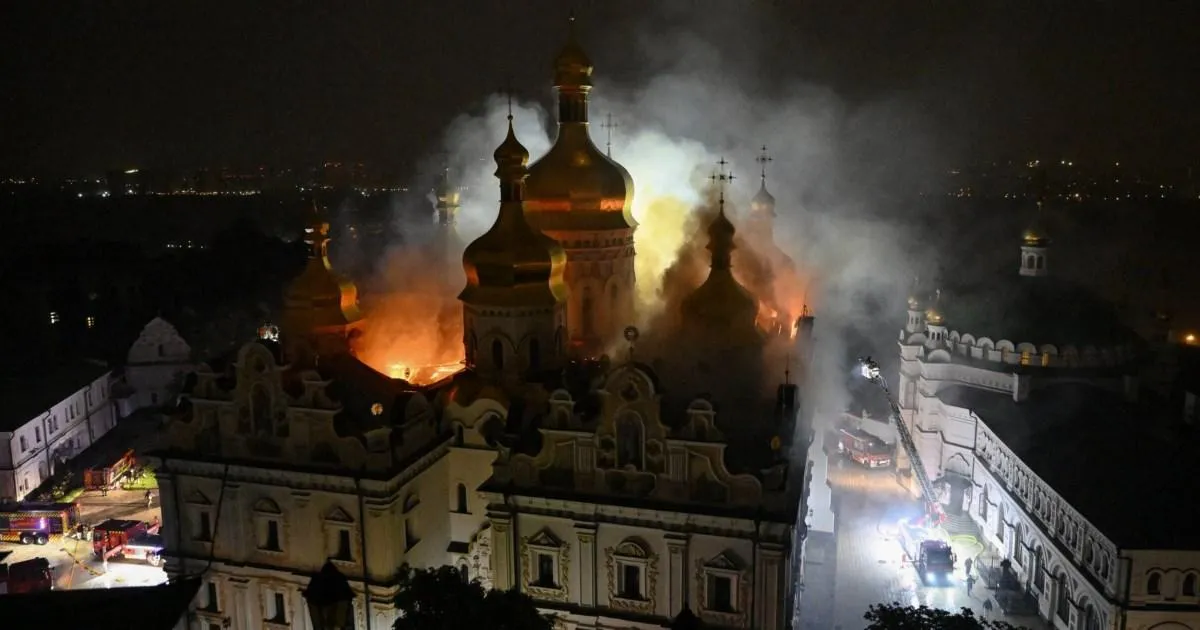
Perhaps most emblematic of the cultural annihilation occurring in this conflict is the assault on the Kyiv-Pechersk Lavra. Founded in 1051, this monastery is more than just a World Heritage site; it is a golden-domed pillar of history that has survived centuries of strife, including the destruction witnessed during the German occupation of World War Two. When the missiles struck, causing a massive, destructive fire, it served as a painful reminder that for modern Russian forces, no sanctuary is sacred, and no heritage is too precious to be spared. Officials in Kyiv have been quick to condemn the act, pointing out the hypocrisy of a leadership that often invokes “Orthodox values” while simultaneously raining fire down upon one of the holiest Christian shrines in Eastern Europe.
The scope of this latest barrage extended far beyond religious centers, reaching deep into the soul of Ukrainian artistry and expression. The Oleksandr Dovzhenko National Film Studio, which houses a priceless collection of the country’s cinematic heritage and historical costumes, was among the primary targets. Similarly, the Kharkiv Art Museum, the city’s historic opera theatre, and the House of Organ and Chamber Music in Dnipro were all struck. By attacking these institutions, the aggressors are not just damaging infrastructure; they are attempting to dismantle the collective identity of the Ukrainian people. Every museum hit and every theatre burned serves as a deliberate attempt to erase the cultural narrative of a sovereign nation, leaving behind the soot and ash of a targeted erasure.
For many Ukrainians, the emotional resonance of these attacks is best captured by the raw, unfiltered grief of survivors like Olena Kurylo. Witnessing the destruction of the city’s theaters and churches, she voiced a sentiment shared by many: a visceral, stinging anger toward an enemy that hides behind pseudo-religious justifications while perpetrating horrific violence. Her words—challenging the moral standing of those who turn their weapons on places of worship—reflect a collective shift in consciousness, where the shock of war has hardened into a fierce, unshakable resolve. The realization that there is no “safe” place under the current bombardment has forced the Ukrainian people to reckon with an opponent they describe as having abandoned humanity entirely, seeking only to destroy what they cannot own or occupy.
As the smoke begins to clear, the Ukrainian government is turning toward the international community, specifically UNESCO, to demand an urgent and robust response to what they label as state-sponsored barbarism. The scale of the destruction is being documented, and the files are being compiled for a future where accountability must eventually replace the silence of the international status quo. Even as the fires are extinguished and the rubble is cleared from the streets of Kharkiv and Kyiv, the shadow of these attacks remains long. The world is watching a nation struggle to defend not only its borders and its children but also the stones and stories that anchor its existence in history, proving that even in the darkest hours of conflict, the spirit of a culture is harder to kill than the buildings that symbolize it.