


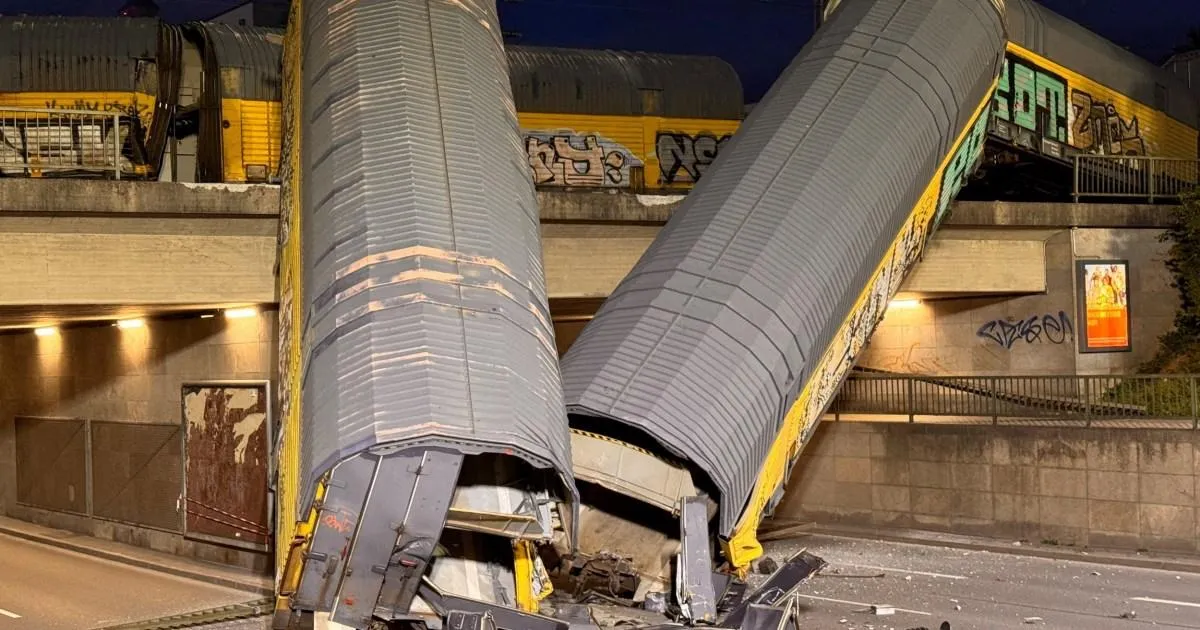
The quietude of a Munich Monday morning was shattered in the early hours today when a catastrophic freight train collision occurred on a bridge in the Milbertshofen district. At approximately 1:40 a.m., during standard shunting operations—a routine process where trains are rearranged and sorted within a depot—two freight trains collided with enough force to send two carriages plummeting five metres onto the Schleißheimer Straße below. The sight was surreal and devastating; as one responding firefighter remarked to the German news agency dpa, the visual of two massive trains crashing and spilling over the side of a bridge was simply “unbelievable.”
The wreckage left behind painted a harrowing picture of the accident’s intensity. Photographs taken at the scene show the mangled metal of the derailed wagons locked in a jagged “V” shape, dangling precariously from the bridge between Frankfurter Ring and Max-Diamand-Straße. Beneath the structure, the road was littered with debris and twisted steel salvaged from the carriages. While the railway operator, Deutsche Bahn, confirmed that the specific wagons that toppled during the collision were luckily empty, the human cost was not avoided entirely. Tragically, one person lost their life in the incident, a victim who has yet to be publicly identified by the authorities.
In the immediate aftermath of the crash, questions naturally surfaced regarding the nature of the freight and the safety of the surrounding area. Officials worked quickly to quell concerns, confirming that while the full inventory of the trains has not been publicly detailed, the cargo involved was not hazardous. Furthermore, the transit authority provided some relief to local commuters, noting that the incident—while localized and severe—has fortunately not disrupted regional or long-distance passenger services. The impact remains contained to the immediate site of the collision and the stretch of road beneath the tracks.
The logistics of cleaning up such a massive accident are extensive and physically demanding. Today, police released footage showing heavy-duty cranes laboring to lift the mangled debris from the bridge, a process that is as delicate as it is complex. Because of the size of the trains and the precarious position of the wreckage, civil authorities have shuttered Schleißheimer Straße in both directions between Moosacher Straße and Max-Diamand-Straße. This closure is expected to remain in effect for the duration of the removal process, which officials have warned could stretch through the entire weekend, potentially lingering into Sunday.
Behind the logistical updates and the official statements, a investigation is now underway to determine exactly how such a collision could have occurred. At this stage, the cause of the crash remains a mystery, leaving both the public and investigators searching for answers as to how standard shunting procedures went so tragically wrong. While police have promised to keep the community updated on the status of the road closures and the progress of the recovery, the focus for the moment remains on the somber task of clearing the site and respecting the privacy of those affected by the loss of life.
As the recovery crews continue their arduous work under the watchful eyes of the Munich police, the bridge stands as a stark reminder of the inherent risks present in industrial and transport infrastructure. For the residents of Milbertshofen, the sight of the dangling carriages will likely leave a lasting impression of a night when the routine rhythm of the city’s railway was interrupted by tragedy. As authorities work to clear the wreckage and restore normalcy, the city waits for the investigation to shed light on how this accident transpired, holding space for the victim and the necessary restoration of safety protocols along this vital transit corridor.