

The political landscape in Westminster has shifted with seismic force following the Makerfield by-election, leaving Prime Minister Sir Keir Starmer at a crossroads that could define the remainder of his career. After Andy Burnham’s commanding victory, which saw him secure 55% of the vote and surge 20 points ahead of the Reform candidate, the once-stable foundations of the Labour government have begun to crack. Reports suggest that Starmer, who spent the weekend at Chequers with his wife, Victoria, is facing internal pressure so profound that an announcement regarding his future could arrive as early as tomorrow. While he initially vowed to fight for his position, the mood within his own Cabinet suggests that the tide of opinion has turned irrevocably against him.
The pressure inside Downing Street is not coming solely from political opponents, but from the inner circle of Starmer’s own government. High-profile figures, including Foreign Secretary Yvette Cooper and Transport Secretary Heidi Alexander, have reportedly urged the Prime Minister to establish a clear timeline for his departure. This internal revolt, coupled with the defection of previously loyal MPs like Southport’s Patrick Hurley, paints a picture of a leader losing his grip on the Parliamentary Labour Party. The consensus among many is that the party, having suffered through disastrous local elections and a decline in Welsh support, requires a fundamental reset to avoid total electoral annihilation at the hands of a surging Reform UK.
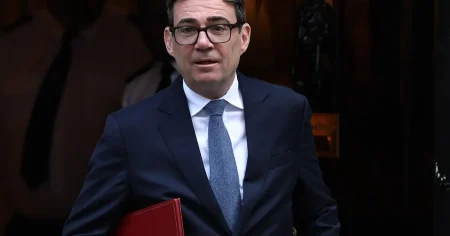
For his part, Andy Burnham has emerged not just as a victor, but as a political juggernaut. Known as the “King of the North,” his ability to dismantle the Reform threat in Makerfield has positioned him as the clear heir-apparent to the premiership. As he prepares to be sworn into Parliament tomorrow, he is expected to meet with Starmer to discuss the future of the party. The strategy from the Burnham camp appears to be one of overwhelming momentum; reports suggest they are actively seeking the support of half the Parliamentary Labour Party, aiming for 200 backers to solidify his status as the inevitable successor and prevent any prolonged instability.
The prospect of a resignation is particularly poignant when reflecting on how rapidly the political climate has deteriorated for the current administration. Less than two years ago, Sir Keir Starmer stood at the helm of a party with a commanding majority, ushered in by a public eager for change. Today, however, that overwhelming support has evaporated, replaced by a consistent ten-point lead for Reform UK in national polling and deep anxiety among Labour MPs. The “staggering fall from grace” described by political observers is rooted in a fundamental disconnect between the government’s trajectory and the voters, a gap that many in the party now believe can only be bridged by a change in leadership.
Despite the clamor for a quick exit, not everyone in the party is eager for a seamless or “coronated” transition to a Burnham-led government. Some influential figures, including former Health Secretary Wes Streeting, are pushing back against the idea of a simple handover. Instead, they are advocating for a robust “battle of ideas” to ensure that whoever replaces Starmer is properly vetted and publicly tested. There is a palpable fear that simply swapping faces without a deep, intellectual reckoning regarding the party’s direction would be a superficial fix for the deeper, systemic issues that have brought the Labour Party to this precarious point of exhaustion.
As the week begins, the nation watches to see if Sir Keir Starmer will choose a “deliberate slow march” toward his exit or attempt one final, defiant stand. While he claimed on Friday that he would not walk away from a contest, the reality of his Cabinet’s shift makes that promise look increasingly fragile. Whether he stays to fight or bows to the inevitability of Burnham’s rise, one thing is certain: the era of Starmer’s leadership is effectively under a final, grueling audit. Westminster is braced for the kind of turbulence that fundamentally alters the course of history, as a government that once seemed unshakable now appears to be waiting for the hammer of history to fall.