

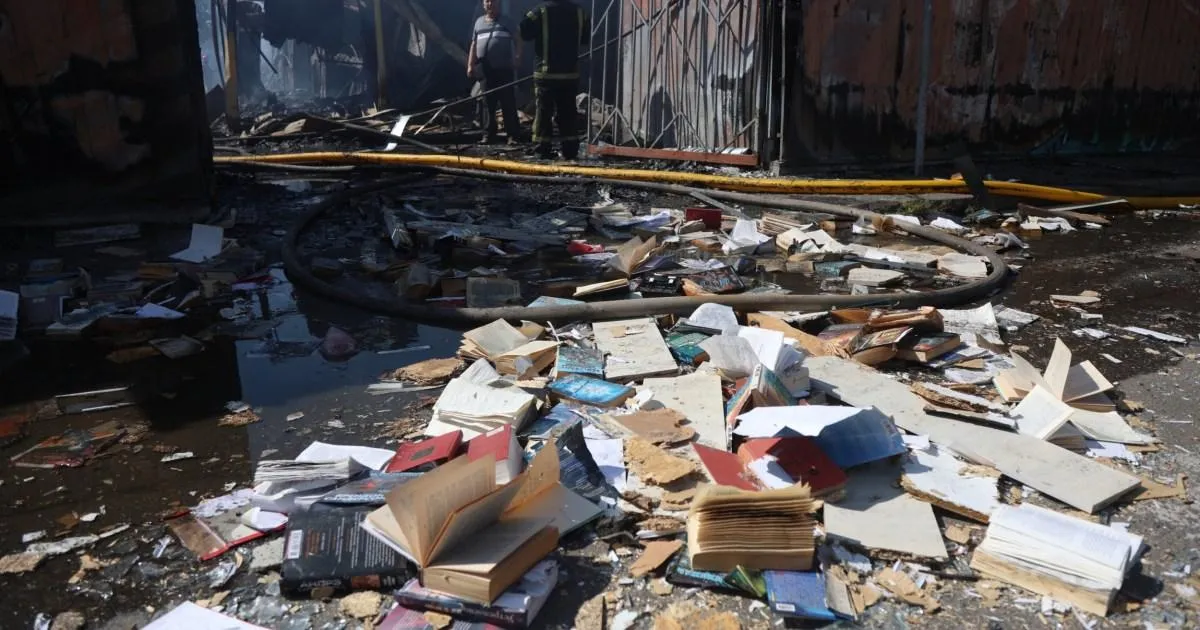
On a warm August morning, the Pochaina book market in Kyiv should have been alive with the quiet music of turning pages—readers leaning over tables, fingers brushing spines, children tugging parents toward bright covers. Instead, after a Russian strike, the air smelled of smoke and scorched paper. A pile of books lay damaged in the ruins, their pages curled and blackened, words half erased. For decades, this market had been one of the largest and most beloved literary gathering places in Ukraine, a place where a student could find a used novel, a grandmother could buy a book of poems for her grandson, and a young writer could discover the courage to keep going. Now it became another wound in a war that has increasingly targeted not only soldiers and cities, but the very culture that makes Ukraine Ukraine. Across the country, millions of books have been destroyed in recent months. School textbooks and children’s stories are among the casualties. Warehouses and printing houses have burned. According to local media, roughly a third of Ukraine’s annual book output—around 12 million books—has been destroyed by Russian strikes in just two months. But the true weight of this loss cannot be measured in copies. Books are how a nation tells itself who it is, how it remembers its past and imagines its future. To burn them is to try to erase a people’s memory. And yet, even in the ashes, there is a stubborn truth: a book can be destroyed, but a story cannot.
Perhaps nowhere is the cruelty of this campaign more visible than in the attack on a printing press on the edge of Kyiv, a facility that was due to supply 10 percent of Ukraine’s schoolbooks for the coming academic year. The strike turned months of work into smoke in a single night. Thousands of textbooks—algebra, history, literature, biology—were meant to be in children’s backpacks by September. Instead, they are gone. Viktoria Haidai, the publishing commercial director, said she believes the attack was deliberate. “The Russians are also destroying printing houses in an attempt to erase Ukraine as a nation,” she said. “But frankly they will not succeed.” Her words carry both grief and defiance, but the practical reality is devastating. Serhii Babak, a Ukrainian politician who chairs the education committee in parliament, said Russia had destroyed entire print runs of textbooks in certain subjects for the coming school year. Imagine a teacher standing in an empty classroom, holding a list of students, knowing that there are no books for them. Imagine a child who loves reading, opening a backpack only to find nothing new. A textbook is not just paper; it is a promise of knowledge, a bridge to opportunity, a shared foundation for a generation. When those books are burned, the loss is not only material. It is a deliberate attempt to disrupt the future of a nation’s children. And yet, even as the smoke cleared, teachers and parents began to plan. They would share copies, print lessons, find another way. Because that is what a country that refuses to be erased does.
The human cost of these attacks is also being felt deeply by Ukraine’s publishers, who have become all too familiar with grief. Yuliya Orlova, co-founder of the Vivat publishing house, wrote on Facebook that her company had “lost in this lottery.” It was not a casual phrase. Despite efforts to move books to the safer western city of Lviv, a large number of new releases by Ukrainian authors were lost when one of Vivat’s warehouses and two belonging to partners burned down. These were books that had been written, edited, designed, printed, and lovingly prepared for readers. They were novels and poems and memoirs, stories that had waited years to be told. And in one night, they were gone. Orlova’s plea was heartbreakingly honest: “I don’t have the strength for any rallying call. Let’s just survive.” Her words remind us that behind every publisher is a human being, someone who has poured their life into bringing stories into the world. On the same day, the poet Ivan Malkovych also received terrible news. A warehouse containing children’s books set to be shipped from his publishing house, A-Ba-Ba-Ga-La-Ma-Ga, had been destroyed. This was not the first attack on the company’s main warehouse. In recent months, Malkovych said, Russians had “destroyed our books and blew out the windows and doors.” The publisher, beloved for its children’s literature, expressed sincere sympathy for colleagues whose books were also burned by what he called degenerates. Then he offered a simple, powerful response: “Order Ukrainian books. Thank you to everyone who is with us.” It is a reminder that in this war, buying a book is not just a purchase. It is an act of solidarity, a vote for survival, a way of saying that Ukrainian voices will not be silenced.
PEN Ukraine, a free speech advocacy group, has tried to quantify what cannot truly be quantified. The August 28 strike on a Kyiv warehouse, they said, burned more than 60,000 books, with damage estimated at over 23 million hryvnia, about £380,000. But the group also reminded the world what a book contains before it ever reaches a shelf. “Behind every book is the work of authors, editors, translators, designers, publishers, printers, logistics specialists, and booksellers,” they wrote. “All of them work under wartime conditions, when a single Russian attack can destroy the result of months of work and large volumes of books in one night.” The group listed seven other publishing houses that had completely or partially lost their products, along with the online retailer Book.ua. The numbers are staggering. Twelve million books destroyed in two months. Entire print runs gone. Warehouses reduced to rubble. But numbers can numb. Each of those books was a world. A children’s picture book with a story about a hedgehog, read aloud at bedtime. A novel that kept a soldier company in a trench. A collection of poetry that made a young person feel less alone. A textbook with a student’s name written neatly on the first page. These are not just products. They are small, tangible pieces of humanity. And they are being deliberately destroyed, not as collateral damage, but as part of a broader strategy to erase Ukrainian culture, memory, and identity. Yet by naming the loss, by counting the books, PEN Ukraine and the publishers are doing more than mourning. They are documenting a crime. They are bearing witness.
These attacks on books are not isolated. They are part of a wider war on Ukrainian culture and heritage that has intensified this summer. The Pochaina Book Market, a favorite of Kyiv’s book lovers, was seriously damaged by fire after a Russian strike earlier this month. And perhaps most symbolic of all, an 11th-century cathedral in Kyiv was set ablaze by a strike, a site of immense spiritual and historical significance. President Volodymyr Zelensky responded with outrage, saying: “This is one of Russia’s most serious crimes against Christian culture to date.” Cathedrals and books are not random targets. They are repositories of language, memory, faith, and identity. A nation survives not only through its army and its borders, but through its stories, its songs, its architecture, its written words. To burn a cathedral is to try to sever a people from its spiritual roots. To burn a warehouse full of textbooks is to try to dim the light of a nation’s future. This is why the attacks feel so personal, so intimate. Russia is not only trying to occupy territory; it is trying to convince the world that Ukraine does not exist as a distinct culture, that its language is a dialect, its history a footnote, its literature a curiosity. But the fires reveal the opposite. Why would anyone be so afraid of books? Because an educated, literate, and confident nation is dangerous to an empire built on lies. Ukraine’s words, printed on paper, carry the weight of truth. And truth, no matter how many times it is burned, has a way of rising again.
And so, after every attack, the response from Ukrainian writers, publishers, and readers has been the same: resist, rebuild, read. Malkovych’s plea was simple and direct: “Order Ukrainian books. Thank you to everyone who is with us.” Publishers are already planning reprints. Books will be printed in smaller runs, in safer cities, in basements and underground presses if necessary. Libraries will be rebuilt. Teachers will find a way. Viktoria Haidai’s conviction remains unshaken: “The Russians are also destroying printing houses in an attempt to erase Ukraine as a nation. But frankly they will not succeed.” She is right. Because a book can be burned, but a story cannot. Every time someone opens a Ukrainian book—in Kyiv, in Lviv, in London, in New York—the nation is present. Every translated poem, every shared quote, every bedtime story read in Ukrainian is an act of defiance. The war has turned reading into resistance. For every warehouse lost, new words will be written. For every child who goes without a textbook, a community will share what it has. This is what the Russians fail to understand. Books are not just paper and ink; they are persistence, memory, and love. Ukraine will continue to read, to write, and to remember. And no missile, no fire, no act of cruelty can erase that. Let’s just survive, Orlova said. But surviving is not enough. Ukrainians are doing something more. They are still telling their stories, and in doing so, they are proving that a nation built on words cannot be destroyed.