


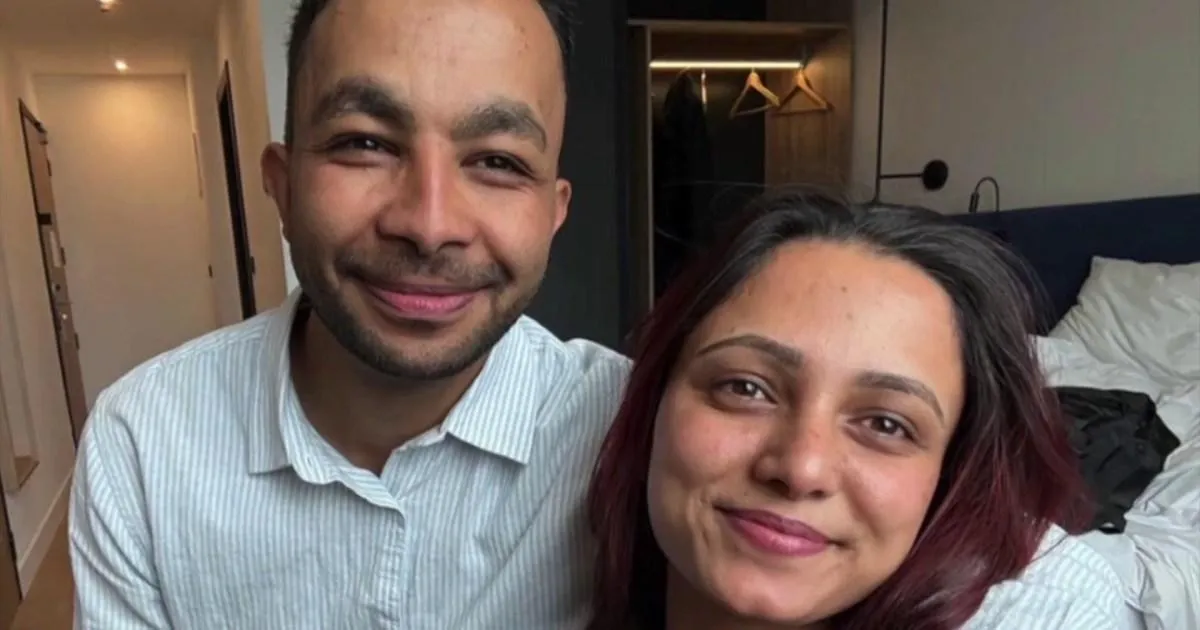
The last thing Pramod Poudel heard from his wife was her voice, warm and full of love, asking how he was and telling him she loved him so much. It was a simple phone call, the kind married couples make without thinking, but it became a haunting memory within hours. Pramod, a 34-year-old truck driver from East Sussex, had been thousands of miles away in England when he spoke to 25-year-old Samitra on Wednesday at 4.15pm. She was staying with his family in the village of Sole, near the remote border between Nepal and Tibet, a place he knew as home. Later that same night, a glacier collapsed high in the Himalayas, unleashing torrents of water, ice, and debris that tore through the valley below. Sole was in its path. Since that phone call, Pramod has heard nothing. Samitra, along with his mother Tulisa, 52, his brother Pardip, 31, and his uncle Madhav, 64, are all missing. He travelled to Nepal as soon as he could, leaving behind the safety of life in East Sussex to stand in the mud and wreckage of a village that no longer looks the way he remembers. He is not giving up. He told reporters he is very hopeful of finding them, and that he is praying to God, but he also acknowledged the devastating reality that around ninety percent of the people and homes in the area were washed away. Very little of the village is left. For a newly married man, the distance between those two truths is almost impossible to bear.
The disaster that took Samitra and so many others is not just a local tragedy but a catastrophe of national and international scale. The flash floods were triggered when a glacier collapsed near the border with China’s autonomous region of Tibet, sending enormous volumes of water surging down mountain rivers and valleys. In Nepal, the official death toll has risen above seven hundred, and more than two thousand four hundred people remain unaccounted for. Entire villages have been submerged or swept aside, roads destroyed, bridges collapsed, and lives scattered in a landscape of mud, stone, and broken timber. The impact was felt on both sides of the border. Chinese authorities confirmed that five hundred and forty-six people were missing in Tibet, and of those, two hundred and sixty-one were foreign nationals. The scale is staggering, especially for a region where communities are small, remote, and closely connected. Families like Pramod’s are not statistics; they are people with names, faces, and recent memories of ordinary conversations. The pain of not knowing, of waiting by a phone that never rings, of searching through lists of the missing, is a grief that too many are now carrying. Rescue teams are working around the clock, but the conditions are brutal. Waterlogged ground, damaged infrastructure, and the constant risk of further flooding make every effort dangerous and slow. For every person rescued, there are many more still hidden beneath the debris, and for every family that receives good news, countless others are left in agonizing uncertainty.
Among the missing are people with close ties to Britain, and their stories are a painful reminder that this tragedy reaches far beyond the Himalayas. At least thirty-three British nationals are missing across the region, including fifteen British citizens in Tibet specifically. Some are young, like a thirteen-year-old girl and a fourteen-year-old boy. Others are older, well known in their communities, or in the middle of ordinary lives. An NHS nurse, a mother of two, a Hindu priest from south London who had been leading a tour in the region, and an eighteen-year-old from Surrey who had just finished his A-Levels are all unaccounted for. Each of these people has a family waiting for news, and each family is living through its own version of the same nightmare. One of the most heartbreaking stories is that of Geetha Reddy, a mother of two whose husband remains in London with their daughters, aged twelve and fourteen. He has not heard from her since the flooding hit, and he is trying to hold everything together for their children. Their girls are due to start school next week, but they cannot think about that. He told reporters that the kids still do not believe their mother is gone. They think she is stuck somewhere, cut off by the flood, and that she will come back when the mobile network returns. It is a hope that feels fragile and unbearable at once. The family is not sure what to do. They are suspended between the ordinary demands of life, school, work, routine, and the extraordinary weight of grief and uncertainty. The husband spoke quietly about his daughters’ refusal to accept the worst, a tender and devastating detail that shows how children process disaster through the lens of love and faith.
Behind the personal stories, there is a massive humanitarian effort unfolding under extremely difficult conditions. The United Kingdom has contributed five million pounds in humanitarian relief and has sent teams to assist with rescue and recovery operations. These experts are working alongside Nepalese and international responders to search for survivors, clear debris, and provide medical care to the injured. Emergency workers have been evacuating residents from the banks of the Trishuli River after fresh rainfall caused water levels to rise again, forcing rescuers themselves to seek higher ground. The danger is not over. A lake that formed on Thursday prompted fears of further flooding, though it has since drained, but drones have detected another pool of water in the Himalayas, according to China’s state broadcaster CCTV. Each new body of water could become a threat, especially if it breaks its natural barriers and sends more water rushing downstream. Foreign experts are now working to open tunnels blocked by the flooding, hoping to release pressure and prevent another surge. The Red Cross has estimated that some ninety thousand people have likely been affected by the disaster, a number that includes not only those who lost homes and loved ones but also those who have been displaced, injured, or cut off from food, water, and electricity. The rescue operation is a race against time and weather. Every hour increases the risk that survivors still trapped beneath rubble will not be found in time. Yet the rescuers continue, driven by the knowledge that every life saved matters and that somewhere in the wreckage, there may still be miracles waiting to happen.
Those miracles are possible, and sometimes they come in the most unexpected forms. Among the stories of loss and despair, one image has brought a small measure of hope: a ninety-seven-year-old woman named Guna Maya Bohara, pulled from the rubble of her care home after it was destroyed by the flood. She was carried to safety by emergency workers, covered in mud and exhaustion, but alive. Her great-nephew Dipak described her as looking like a warrior who had returned home from battle. The phrase captures something profound about the human spirit, the refusal to surrender even in the face of overwhelming forces. For a woman of her age to survive such a disaster is remarkable. It is also a reminder that the victims of this catastrophe are not just buildings or villages, but people of every age, from a thirteen-year-old girl to a ninety-seven-year-old grandmother. Every rescue story matters, not only because it saves a life, but because it gives hope to others who are still searching. It tells families like Pramod’s that the impossible can happen, that a voice can be found again, that a loved one can emerge from the mud and rubble. At the same time, it deepens the grief for those who have not received such news. Why one person and not another? There is no answer to that question, only the relentless uncertainty of disaster. Yet the image of an elderly woman being carried to safety, her family weeping with relief, is a powerful testament to the courage of both the survivors and the rescuers who refused to give up on her.
As the days pass, the world is beginning to understand the full human cost of this tragedy, but for the families still waiting, the numbers mean little. What matters is the face of a mother, a wife, a brother, a neighbour. What matters is the last phone call, the memory of a voice saying “I love you so much,” and the desperate hope that those words were not the final ones. The international response has been generous, with aid money and rescue teams arriving from many countries, but this is not only a moment for governments and relief agencies. It is a moment for the rest of us to hold space for the grief of people who have lost everything, and to recognize that behind every missing person is a story of ordinary life interrupted by extraordinary violence. For Pramod, standing in what is left of his village, the future is impossible to imagine without his wife and his family. For Geetha’s daughters, the beginning of school will be shadowed by the absence of their mother. For the families of the British teenagers, the NHS nurse, the Hindu priest, and the young man from Surrey, no amount of news will be enough until they know what happened to the people they love. The floods may eventually recede, and the waters may calm, but the emotional aftermath will last for years. The scars on the landscape will heal slowly, and the scars on the hearts of survivors will take even longer. What this disaster demands of us is not just sympathy, but solidarity, not just prayers, but presence. The world must not look away when the headlines fade. The families still searching deserve to know that their loved ones are not forgotten, that their stories are still being told, and that every possible effort is being made to bring them home or to bring them answers. In the face of such devastating loss, the only human response is hope, fragile and stubborn, the hope that the next update brings good news, the hope that somewhere, somehow, another miracle is waiting to be found.