

The simple pleasure of a quiet day spent fishing turned into a harrowing, life-altering ordeal for one 79-year-old man in Russia’s remote Far East. What began as a routine excursion into the dense, untamed woodlands near the village of Pilvo, on the rugged Sakhalin Island, quickly spiraled into a desperate battle for survival. For most, a fishing trip represents an escape from the daily grind and a moment of tranquility, but for this pensioner, the wilderness became an unforgiving maze. As his family and local authorities grew increasingly concerned, the quiet woods transformed into the setting of a major search-and-rescue mission that would stretch across nine grueling days, leaving the man physically broken and mentally pushed to his absolute limit.
For nine days, the man fought against an environment that was seemingly designed to hide him from the world. When his car was discovered abandoned near the village, it acted as a final clue in a vast landscape of forest and mountain, signaling that he had wandered into a labyrinth of thick, encroaching vegetation. Despite his age, his instinct for survival remained sharp, and rescuers later learned he had spent his time tirelessly attempting to hack his way through the dense undergrowth in a desperate bid to navigate back to civilization. It is a testament to the resilience of the human spirit that he remained alive for so long, battling the elements and the psychological toll of isolation without the support or resources one would naturally expect to need in such a perilous situation.
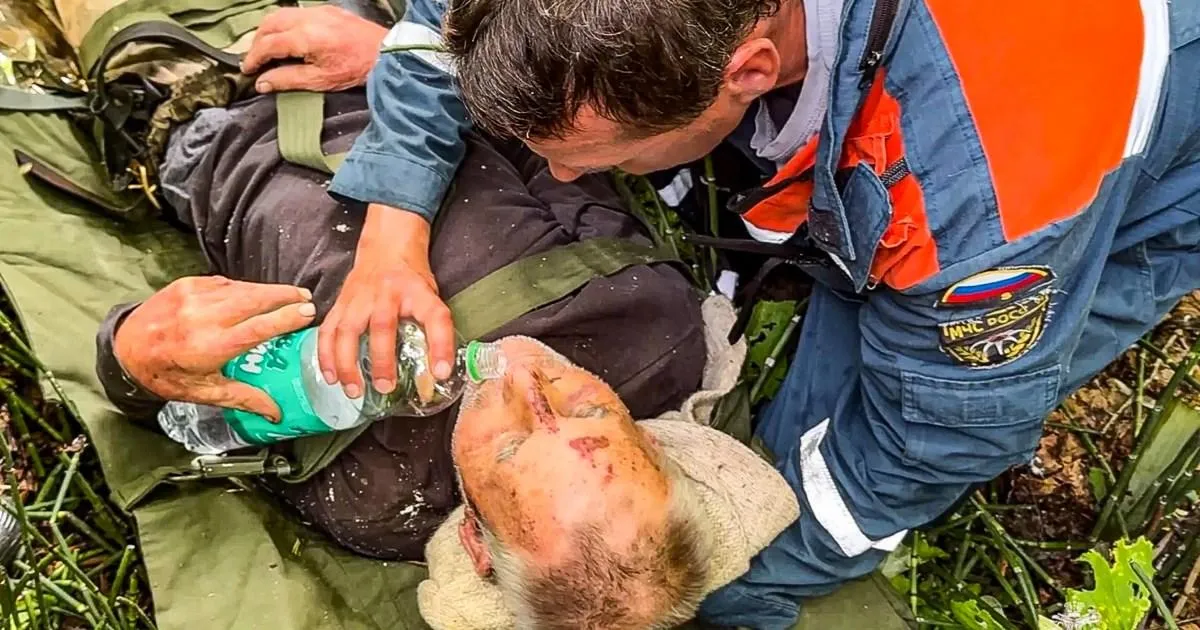
When volunteers finally located him on the banks of the Pilevka River, less than a mile from his start point, the scene they encountered was heart-wrenching. The man was found alive, a small victory against the odds, but he was completely depleted. He had exhausted every ounce of his strength in his attempt to return to the path, eventually finding himself unable to take another step. The sheer physical toll of navigating Sakhalin’s unforgiving terrain—characterized by its mountainous landscape and aggressively thick brush—had rendered him immobile. It was a moment of profound relief for search teams, who had been racing against time in an area where the wilderness often holds the upper hand.
The rescue itself proved to be a difficult undertaking, requiring emergency responders to traverse the very terrain that had proven so treacherous for the fisherman. Given his frailty and the severity of his condition after more than a week in the wild, the team had to carefully transport him over the uneven landscape, treating him with the tenderness required for someone who had endured so much. As they carried him to safety, the focus shifted from the suspense of the search to the necessity of immediate medical intervention. He was rushed to be treated for the exhaustion and exposure that had plagued him for the better part of those nine days; today, he remains under the watchful care of medical professionals, slowly recovering from the ordeal that nearly claimed his life.
The setting of this drama, Sakhalin Island, adds a layer of stark, isolated beauty to the story. Positioned precariously between the Russian mainland and Japan, the island is a massive, craggy expanse nearly 600 miles long and home to roughly half a million people. With its rich, often turbulent history of shifting borders and its untamed topography, Sakhalin is not a place for the unprepared. Its vast forests and mountainous peaks serve as a constant reminder of nature’s indifference to human activity. For this man, the vastness of the island was not just a backdrop for a quiet hobby, but an expansive, wild obstacle course that highlighted how quickly a peaceful afternoon can turn into a struggle for the most basic human need: survival.
Ultimately, the rescue serves as a sobering reminder of just how fragile our connection to safety truly is. It echoes stories of endurance from across the globe, such as the case of backpackers lost in the Australian Outback, proving that whether in the heat of a desert or the dense forests of the Russian north, humanity is capable of incredible endurance. While the details of his recovery are ongoing, the primary relief felt by his community is in the fact that he was found at all. Behind the headlines of military tensions and international politics associated with this region, this story stands as a profoundly human account of an older man’s will to keep fighting, even when the forest seemed determined to keep him hidden forever.