


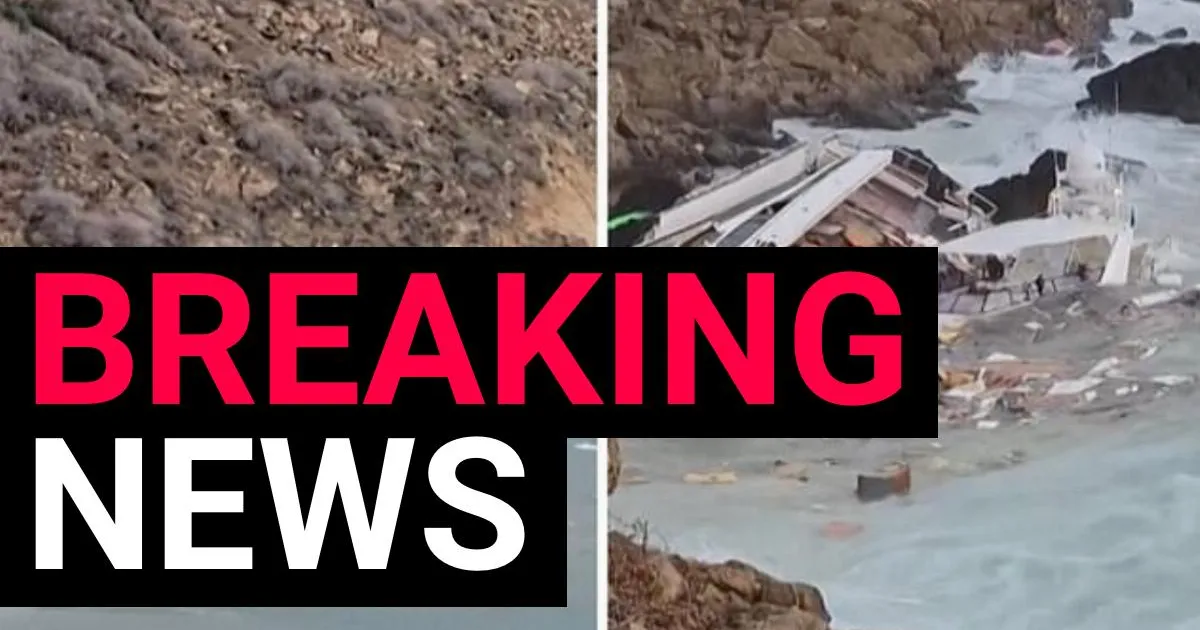
The sun-soaked coastline of Cape Greco, a place known for its dramatic sea caves and glittering turquoise water, became the scene of a nightmare on Saturday when a ferocious storm turned the Mediterranean into a churning trap. The idyllic southeastern corner of Cyprus, where holidaymakers and locals alike often come to watch the waves, suddenly offered a front-row seat to disaster. Several yachts that had been sailing the same waters hours earlier were caught by violent winds and shoved helplessly toward the jagged rocks. In the chaos that followed, a 77-year-old businessman named Dimis Mavropoulos lost his life. He was pulled unconscious from the rough sea by a rescue helicopter after his vessel slammed into the rocks, and despite the frantic efforts of emergency responders, he could not be saved. At least six other people were injured during the ordeal, and two survivors were taken to hospital for treatment. The news spread quickly through the small coastal communities, leaving residents stunned. This was not a distant headline from a faraway place; it happened on their coastline, in the waters many of them had swum in since childhood. The storm had arrived without mercy, and in a matter of minutes, it had taken everything from one family and left others clinging to life in a hospital ward, trying to understand how a beautiful Saturday could end in so much sorrow.
A witness, identified only as A Panikos, was standing on the shore with his camera when the tragedy unfolded before his eyes. He told Philenews that he had gone to the coast to capture the dramatic waves, but what he saw would stay with him forever. He described how the first boat he noticed was still intact, miraculously still avoiding the rocks for the moment. But then a huge wave rose out of the sea and smashed the vessel apart as if it were made of twigs. Panikos and the people around him did not hesitate. They tied a rope to a large rock and hurled it toward the man on the boat, desperately shouting at him to grab hold and pull himself to safety. According to Panikos, the man could not swim, which made the moment all the more terrifying. He was trapped on a sinking, breaking vessel, without the ability to escape by swimming, and the only hope was a rope thrown by strangers on the shore. Panikos recounted how the boat then broke up in the water as police arrived, their flashing lights and sirens adding to the pandemonium. Meanwhile, Mavropoulos’s boat had tipped sideways into the rocks, and two women aboard made the agonizingly brave choice to dive off the decks into the violent sea. It was a leap of pure survival, a split-second decision that likely saved their lives. Mavropoulos’s friends urged him to do the same, to abandon the yacht and jump with them. But he refused. He insisted on remaining aboard, determined to save his boat from being destroyed by the rocks. It was a decision that would seal his fate.
There is something profoundly human, and profoundly heartbreaking, about Mavropoulos’s final choice. To some, a yacht may seem just an expensive possession, a luxury item for a privileged few. But to a man who had built a life of business and ambition, that boat may have represented everything he had worked for, the reward for a lifetime of discipline, the place where he had created memories with friends and family. In that final moment, he was not acting out of greed or foolish pride, but out of a deep, almost instinctive desire to protect something he loved. The two women who leapt into the water chose life; they understood that no object was worth dying for. Mavropoulos could not let go. Perhaps he believed the storm would spare him, that he could somehow hold the boat steady until the worst passed. Perhaps he had survived other storms and thought this would be no different. But at 77, he was no longer young, and the sea was pitiless. The fact that he could not swim adds another layer of tragedy. He had spent his life around water, yet had never learned to swim, perhaps never felt the need, because he navigated the sea from a boat, not from the water itself. He could not have imagined that his survival would one day depend on his ability to float through a raging surf. The friends who escaped may have tried to drag him, but he held firm, and they were forced to watch as the next wave caught the yacht at the wrong angle, tipping it over and swallowing the man who had refused to leave. In the end, the rocks won, the sea won, and the yacht was reduced to nothing more than splintered wreckage floating in the surf.
The storm that killed Mavropoulos was not satisfied with just one tragedy. Across Cyprus, the heavy rain and strong winds that swept over the island caused widespread chaos and destruction. Streets flooded so quickly that cars were abandoned in the middle of the road, their drivers forced to wade to safety or climb onto rooftops, waiting for rescue. Landslides unleashed rivers of mud and stone onto mountain roads, cutting off villages and forcing residents to evacuate. Trees that had stood for decades were uprooted and thrown across gardens and homes, crushing roofs and blocking highways with their tangled branches. Emergency services were overwhelmed, responding to dozens of calls in a short space of time, and throughout the island, people were reminded of how fragile their ordinary routines really are. In the coastal towns, the sea became an enemy. Fishermen who had spent their lives reading the ocean’s moods later admitted they had never seen it turn so angry so quickly. Residents stood on the shore, helpless and horrified, as the boats they had moored and maintained with so much care were pummelled against the rocks. The wind howled, the rain lashed windows, and the lightning carved bright veins in a black sky. It was the kind of storm that makes people want to stay indoors, but for those who lived by the sea, there was no hiding. They had to watch, wait, and in some cases, risk everything to help their neighbours. The storm was a brutal reminder that nature cannot be controlled, and that for all of humanity’s achievements, the power of the elements remains something to be respected, not challenged.
As if the island had not suffered enough, tragedy struck again on the northern coast, where a high-speed ferry carrying around 260 people capsized near the town of Kyrenia in the same storm. The vessel, described by some reports as a catamaran, began taking on water while it was still about four miles from shore. For the passengers onboard, the journey that had probably begun as an ordinary crossing turned into a waking nightmare. The ferry listed violently, water pouring over the decks, and then it turned over, throwing men, women, and children into the cold, furious sea. Some passengers were trapped inside as the vessel rolled, while others managed to scramble out onto the upturned hull, only to be swept away by the next wave. Emergency services, including ambulances, rescue helicopters, and boats, were dispatched to the scene, but the conditions were horrendous. The wind and rain made visibility almost impossible, and the swollen seas tossed the rescue vessels around like toys. Mayor Murat Senkul of Kyrenia told CNN Turk that 159 of the 258 passengers onboard had been accounted for at first, and that number was later reported to have risen to more than 200. But the good news stopped there. It was confirmed that several people had died, and dozens remained missing. Families waited on the shore for hours, their faces etched with anguish, clutching photographs of loved ones and staring out at the dark water. Every time a rescue boat came into the harbour, people rushed forward, calling out names, hoping to recognise a survivor. The capsize of the ferry was a catastrophe that would leave the region in mourning for a long time, and it cast an even darker shadow over a day that had already seen far too much loss.
In the days that followed, the island of Cyprus was left to wrestle with the grief and unanswered questions. The immediate search efforts continued, with brave rescue teams combing the waters and the coastline, but the hope of finding more survivors faded with every hour. Families who had not heard word from their loved ones clung to every rumour, every rumour, every glimpse of a stretcher being carried into an ambulance. The survivors of the yacht crash, including the two women who had dived into the sea, were treated in hospital, their physical wounds on the way to healing but their emotional scars likely to remain. For the friends of Dimis Mavropoulos, the memory of that final farewell would haunt them for years. The storm had passed, the sun was beginning to return over the Mediterranean, and the waters around Cape Greco were slowly growing calm again. But no one who had witnessed what happened would be able to see that coastline the same way. The rocks, worn smooth by centuries of waves, would forever bear the marks of broken boats and a lost life. The community, too, would bear its own invisible marks. In the midst of the tragedy, there had been moments of remarkable humanity: strangers hurling ropes into the sea, neighbours wading into floodwater to help the elderly, rescue workers pushing their bodies to exhaustion in the hope of saving even one more person. Those acts of courage could not undo the pain, but they were a reminder that even in the darkest hours, people reach out to one another. The story of that day is not just a story of a storm and the destruction it leaves behind. It is a story of ordinary people faced with impossible choices, of survival and sacrifice, and of lives cut short too soon. For Mavropoulos, the choice he made was fatal. He died trying to save a boat, in waters he loved, in a storm he could not defeat. And in that final, tragic decision, he became a testament to the strange and powerful connection between humans and the things we build, own, and cherish. His family, his friends, and his community would remember him not as a fool who gambled with his life, but as a man who stayed behind when everyone else had gone, because he could not bear to let go of what mattered to him. The sea may have taken him, but it could not take the memory of the quiet, stubborn courage he showed to the end. And as the island slowly healed, the names of those lost in the storm would be spoken in whispers, in prayers, and in the hearts of the people who loved them — never forgotten, always mourned, and finally at rest.