
The atmosphere at the Washington National Cathedral was heavy with the weight of global politics and personal grief as world leaders gathered to honor the late Senator Lindsey Graham. Among the high-profile attendees were Ukrainian President Volodymyr Zelensky and Israeli Prime Minister Benjamin Netanyahu, two leaders currently navigating their own intense regional conflicts. While the primary purpose of the gathering was to pay respects to a man who had been a staunch ally to both their nations, the optics of these leaders sitting in proximity inevitably drew the attention of the public and the media, turning a solemn funeral into a site of intense diplomatic scrutiny.
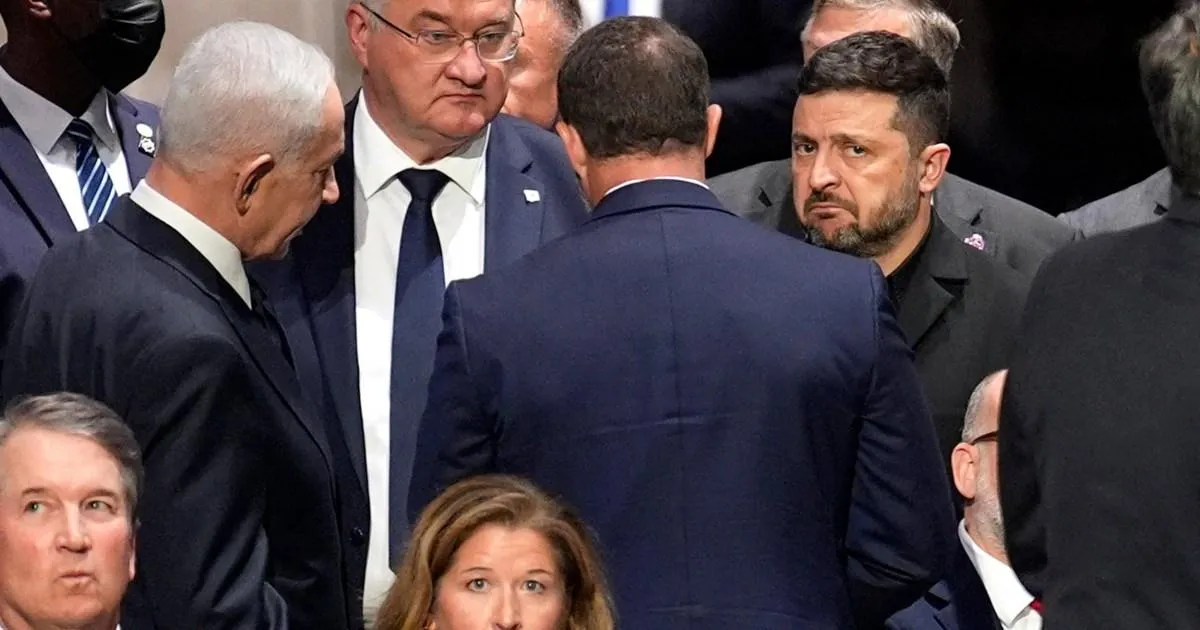
Beyond the formal proceedings, a moment of undeniable tension between the two leaders became a focal point for observers. A video recording of their interaction, analyzed by professional lipreader Nicola Hickling, suggests that the private conversation was far from a simple exchange of pleasantries. According to Hickling, the pair appeared to be locked in a firm, perhaps even contentious, disagreement regarding specific diplomatic conditions. The exchange captured a candid side of international relations, suggesting that even in moments of shared mourning, the burden of statecraft and the friction of clashing agendas remain unavoidable for figures leading nations in crisis.
The dialogue revealed in the footage paints a picture of two leaders asserting their respective positions with grit. Zelensky, according to the analysis, was heard emphasizing that certain conditions had not been met by an unnamed party, insisting that it was vital to “get them to agree.” When Netanyahu reportedly offered a rebuttal, the Ukrainian president was quick to dismiss it as “incorrect,” showing that despite the setting, he was not backing down from his narrative. The exchange culminated in a pragmatic “agree to disagree” statement from Zelensky, a phrase that highlights the profound difficulty of aligning the geopolitical priorities of two nations that are both fighting for their security on vastly different fronts.
As the conversation concluded, the masks of intense diplomacy slid back into place. Joining the duo were Ukrainian Foreign Minister Andrii Sybiha and US Secretary for Homeland Security Markwayne Mullin, seemingly acting as a buffer or an extension of the broader diplomatic circle. In a swift pivot, the irritation of the debate yielded to the practiced civility required of statesmen. Zelensky offered a nod and a definitive “good,” followed by a handshake and a polite smile. It was a fleeting, humanizing reminder that in the world of high-stakes politics, hostility and cordiality are often separated by nothing more than a camera lens and the social pressures of a public event.
The funeral itself was a tapestry of unconventional political theater, serving as a stark contrast to the gravity of the occasion. The proceedings were marked by notable moments, such as Donald Trump’s casual interaction with JD Vance, where the exchange of Tic Tacs became a viral sensation, distracting briefly from the eulogy. Perhaps most humanizing—and perhaps most awkward—was the sight of the former president struggling to stay awake in the front row. These intimate, raw, and at times surreal glimpses into the lives of the world’s most powerful people reminded onlookers that behind the headlines and the geopolitical maneuvering, these leaders are subject to the same fatigue and social discomfort as anyone else in a long, somber service.
Reflecting on the life of Senator Graham, President Trump’s eulogy offered a final layer of complexity to the day. By recounting the infamous anecdote of him leaking Graham’s phone number during their 2015 rivalry, only to highlight how they later became unlikely allies, he underscored the fluidity of political loyalty. The story of the phone being “blown up” by the public served as a bridge between the pettiness of past feuds and the eventual respect they found in one another. Ultimately, the day acted as a mirror for the current state of global affairs: a chaotic, occasionally tense, and deeply complicated mixture of personal history and professional necessity, all playing out in the shadow of a changing order.