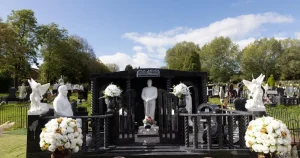

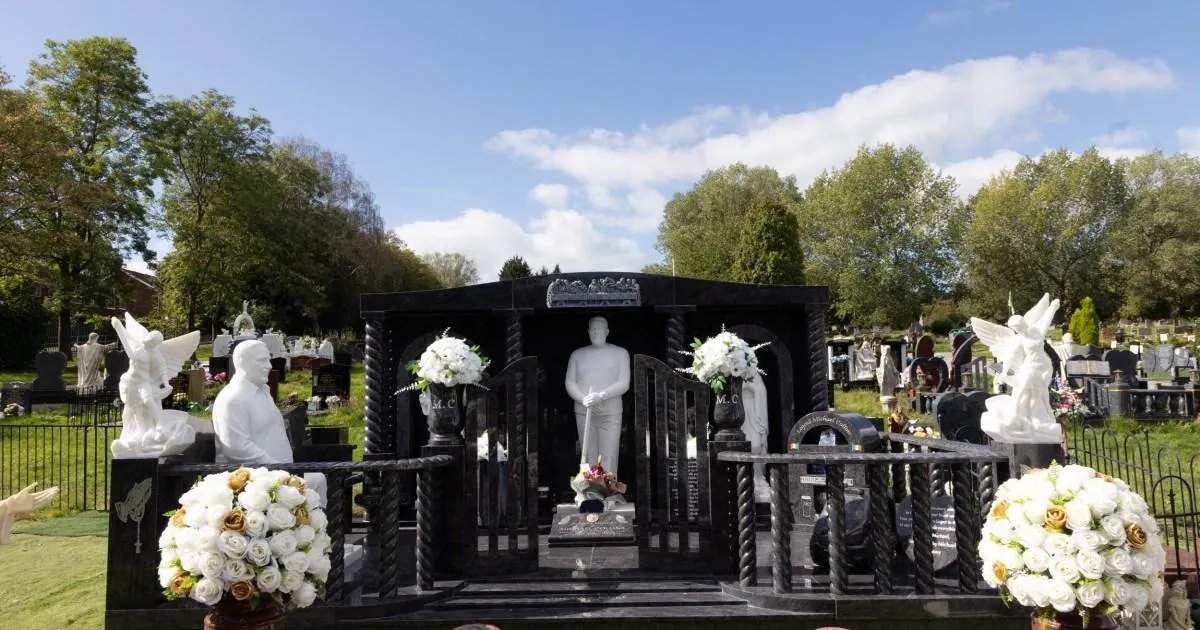
On a quiet stretch of Shiregreen Cemetery in Sheffield, the silence of the dead has been interrupted by something enormous. A new thirty-tonne memorial, carved from polished black marble, now towers over the surrounding graves like a strange, lavish monument to one family’s devotion. It marks the resting place of Michael Collins, a 51-year-old man from the city’s Traveller community, who died in December 2024. But Michael’s memorial is not the first of its kind, and it does not stand alone. Just metres away is the headstone of his older brother, Willy Collins, a bare-knuckle boxer and self-proclaimed King of Sheffield, who died suddenly in Majorca in 2020 at the age of forty-nine. That grave marker cost £200,000 and was once described as ‘Britain’s biggest’ headstone, a gaudy and unmissable tribute that made national headlines when it was erected in 2022. For years, Willy’s memorial has been at the centre of a bitter planning row, with Sheffield City Council insisting it should not have been built and Willy’s widow, Kathleen, promising ‘war’ if anyone dared to remove it. Now, with Michael’s monument rising only a few steps away, the Collins family have turned a quiet municipal cemetery into the most extraordinary, and controversial, family plot in Britain. The polished surfaces of the new memorial catch the grey Yorkshire light, and the sheer scale of it makes it impossible to approach without staring. It is the kind of sight that stops visitors in their tracks, forcing them to ask: who was this man, and why does his family feel the need to remember him so loudly? The answer, as with so many grand gestures of grief, is both simple and complicated. It is love, but it is also legacy, pride, and a refusal to let the world forget.
The details of Michael’s memorial read less like a headstone and more like a shrine designed to preserve a personality in stone. Standing nine and a half feet tall, the monument is built from heavy black marble, and around it the family has arranged a small gallery of tributes. There are two life-size white statues of Michael, each one depicting him with the kind of confident, alive presence that photographs can only hint at. Beside one of these statues are figures that appear to be Jesus Christ, standing as silent guardians over a man the family clearly revered. Behind him, a marble pint of Guinness and a marble can of the same drink are placed alongside a marble bottle of Budweiser, a tribute to the drinks Michael loved and the social world he inhabited. The second statue shows Michael sitting on a bench, looking out at an engraved image of the four Collins brothers, all of whom have now died. Underneath the image, the words ‘Sheffield Collins Brothers’ are written, a permanent caption for a bond that death itself could not break. To the right of the memorial stands a marble Bluetooth jukebox, engraved with the words ‘Legend Michael Collins’. Around it, the family has placed two Irish flags, a CD and a photograph of Michael. Nothing about the display is subtle. Every element has been chosen with care, and every object tells a small piece of the story of a man who loved his family, his heritage and his pleasures. For the Collins family, this is not a grave marker in the traditional sense; it is a biography carved in stone, a way of keeping Michael’s spirit close and visible. To passers-by, it can seem overwhelming, almost theatrical. But to the people who loved him, it is simply the only fitting way to say goodbye to someone who was larger than life.
Behind all the marble and memorabilia is a family trying to cope with a devastating loss. Michael left behind his wife Girleen, who had been by his side for twenty-seven years, and their four children: Paris, Anthony, Montana and Martin. He also leaves a young grandson, Martin Francis, who was the light of his life. In the days after Michael’s death, his daughter Paris spoke with heartbreaking honesty about the father she had lost. ‘Dad was a loving family man,’ she said. ‘He lived and died for his wife and children, and he absolutely doted on his little grandbaby. He thought the world of him. My mum is absolutely heartbroken. They’d been together for 27 years and they did everything together. My dad is in heaven now with his brother, Willy, sister-in-law, Josie, and Willy’s oldest daughter, Bonnie.’ Those words reveal the depth of the family’s grief, but they also point to a wider pattern of loss. The Collins family has known tragedy before, and it has known it again and again. Willy died in 2020. Another brother, Terry, died in September 2024 at the age of fifty-two. And Anthony, the youngest of the brothers, was just twenty-two when he was stabbed to death in 2002 at the Afro Caribbean Club on Spital Hill. All of them are now buried in the same cemetery, and with Michael’s arrival, the four brothers are finally together in death. Their graves tell a story of a family that has been struck by violence, illness and sudden death, yet has always responded with fierce loyalty and dramatic displays of togetherness. For the Collins family, the memorials are not about vanity; they are about proving that their loved ones mattered, and that they will not be quietly forgotten.
The people who live near the cemetery have reacted with a mixture of anger, unease and occasional sympathy. Some residents have compared the growing collection of monuments to a ‘haunted crazy golf’, a phrase that captures the surreal feeling of walking past giant statues and marble jukeboxes in an otherwise restrained municipal graveyard. Others are more direct in their criticism. ‘It is there because the council did not take action against the first one,’ one local said, pointing out that the new memorial should never have been allowed to appear if the older one was already considered illegal. Another agreed, saying: ‘So if they didn’t get permission the first time, why is this allowed? One rule for them [because] they don’t want any trouble and another rule for the rest of us.’ A third resident was even more blunt: ‘That’s wrong. A shrine that big should be in a private cemetery, not a council one.’ These are not small complaints. In a public cemetery, where ordinary families must seek permission for even modest headstones, the sight of a towering black marble monument can feel like a slap in the face to everyone who followed the rules. Some residents argue that the council’s failure to act quickly on Willy’s memorial effectively encouraged the family to build another one. They say that by avoiding confrontation, the council has created a situation where the cemetery no longer feels fair or shared. But not everyone is upset. A number of people have defended the Collins memorials, describing the site as a ‘beautiful place to remember their loved ones’. For them, the monuments are a sign of family devotion, not defiance, and they argue that criticising the family for grieving in their own way is unfair.
At the centre of this dispute is a confusing area of law and local authority regulation. Memorials in England are not usually subject to planning permission, but when a grave is in a council-run cemetery, the memorial must be approved by Bereavement Services before it is installed. In the case of Michael Collins, that approval had not been granted before the thirty-tonne monument appeared. Council officials say they had been in discussions with the family and were prepared to consider plans for a large structure, but the final design was never submitted. Now Sheffield City Council is hoping the family will make a retrospective application, so the monument can be properly assessed. If they do not, the council will face a difficult choice between enforcing its rules and inflaming an already delicate situation. The same problem applies to Willy’s memorial. The council says it is working through the appropriate processes for Willy’s headstone, and that discussions remain ongoing. Asked for further comment, the council said it would be inappropriate to say more while those talks continued. This silence has done little to calm the situation. When the possibility of removing Willy’s memorial was first raised, his widow Kathleen made her position clear with a single dramatic word: war. It was a striking thing to say, but it showed just how passionately the family feels about these graves. To them, the memorials are sacred. They are places of pilgrimage, memory and prayer. To the council, they are unauthorised structures in a public space. And to many neighbours, they are a visible sign that some people are allowed to do things others cannot. The law may be clear in theory, but in practice it is being tested by a family that is willing to fight.
In the end, the Collins memorials are about more than marble, planning rules and local resentment. They are about the collision between private grief and public space. When a family loses someone they love, they want the world to know that that person existed, that they mattered, and that they will never be replaced. The Collins family have chosen to make that statement in the most dramatic way possible. Their memorials stand as a monument not just to the two brothers, but to the entire family’s refusal to be invisible. For those who take the time to look closely, the site can be deeply moving: four brothers lying in the same earth, watched over by statues, flags and images of the people they loved. There is something almost poetic about the way the family has turned a cold cemetery into a place of colour, memory and personality. But the controversy is not going to disappear. The council must decide whether to accept what has been built or demand that it be changed. Demanding the removal of a memorial to a man who died only recently would be seen as cruel and insensitive, and it would almost certainly provoke a furious response from the family. Allowing it to stay, however, raises difficult questions about fairness, accountability and the authority of local government. Is it right that one family can dominate a public graveyard with monuments the size of houses, while other families must wait for permission to add a small plaque? Can grief ever justify breaking the rules? These are not easy questions, and there is no answer that will satisfy everyone. But for now, the thirty-tonne memorial remains in place, standing silently next to its infamous neighbour. It may be gaudy. It may be controversial. It may be exactly the kind of thing that makes people shake their heads. But it was built because someone was loved, and that is the one thing no council, no planning law and no angry neighbour can ever take away.