

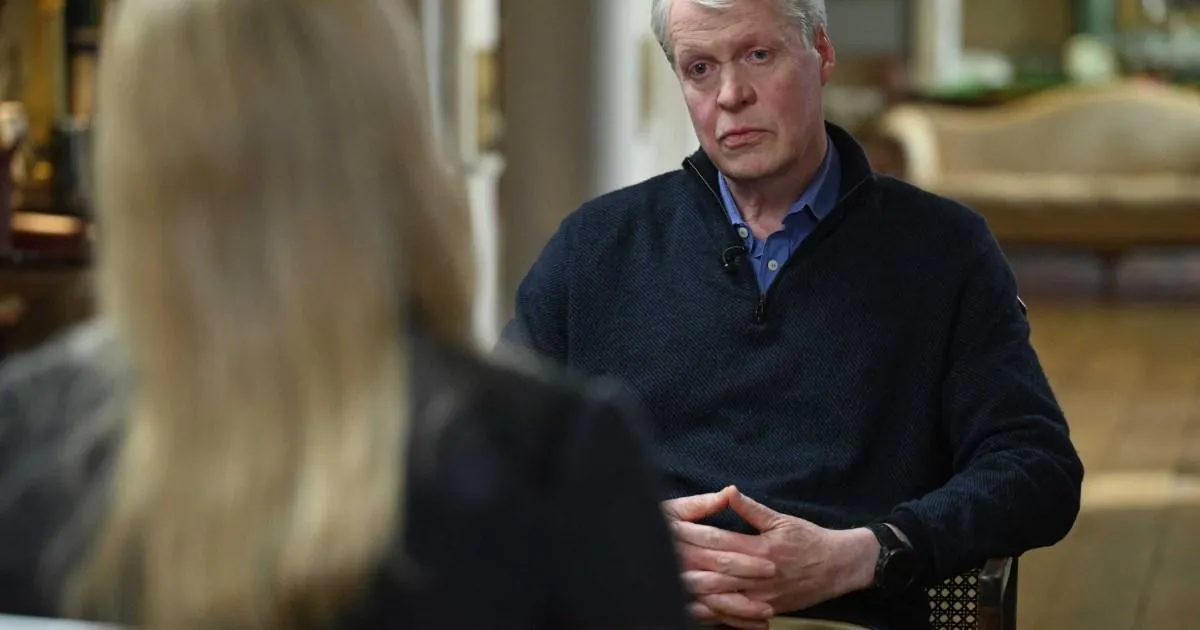
Charles Spencer, the ninth Earl Spencer and the younger brother of Princess Diana, has spent decades guarding the memories of his sister, but now, in a forthcoming memoir and a deeply personal interview with Laura Kuenssberg, he has chosen to speak about the moments that shaped his family’s history and his own lingering pain. The most explosive revelation is that Prince Charles, now King Charles III, allegedly told him after Diana’s death, “Rest assured, we’ll forget her soon enough.” The words, Spencer says, came after a phone call in which the then Prince of Wales reacted with fury to Spencer’s belief that Diana’s young sons should not have to walk behind their mother’s coffin at her funeral. He described the prince as “ballistic,” ranting about duty and family, before ending the call with a callous remark that Spencer has never been able to shake. What makes this even more striking is Spencer’s quiet insistence that Prince William and Prince Harry were not unaware of these painful details. He told the BBC that he does not like to discuss his private conversations with his nephews, but he added, “These words will not be a surprise to them.” That single sentence suggests the brothers have long known something about their father that the public has only now been allowed to glimpse, and it deepens the poignancy of their complex relationship with the crown.
The phone call itself, as Spencer recounted, was a storm of emotion, pride, and grief colliding in the rawest way. Spencer had told an intermediary that he did not think William and Harry, aged fifteen and twelve at the time, should be subjected to the public walk behind Diana’s coffin, a walk that would place their unbearable private sorrow on display before the world’s cameras. When Prince Charles called him, he was clearly displeased. “I gather you don’t think William and Harry should walk behind Diana’s coffin,” Charles said. Spencer answered with the frankness of a brother defending his sister’s memory: “Of course not, sir. She wouldn’t want it.” Charles responded by invoking his own experience, saying he had walked behind Lord Mountbatten’s coffin, to which Spencer replied with devastating clarity, “Yes, but you were 30, and he wasn’t your mother.” At that, the conversation turned. Spencer described the prince going into a rage, attacking the Spencer family’s sense of duty, ranting for what seemed a significant period of time. Spencer listened, waiting for some moment of grace, some acknowledgment of the tragedy, some gentle word about the mother of the prince’s children. Instead, after the storm, Charles allegedly said, “We’ll forget her soon enough.” To Spencer, the tone was just as painful as the words. He said there was a “lightness” in Charles’s voice, a jarring contrast to the devastation everyone else felt. Spencer had received many calls that day from people who were stunned and grieving, but this, he said, felt different. It was as though the future king was already moving on, and that perception has lingered in Spencer’s memory for nearly three decades.
When Buckingham Palace issued a statement suggesting that “the pain of fraternal grief can cloud reason, affect judgment and colour memory,” Spencer responded directly and firmly. “All I can tell you is what was said and what I heard and what shocked me,” he said. “What else would have made me hang up on the king that day, it was something as outrageous as that slur against Diana.” There is a weariness in his defense, a sense that he has been accused of misremembering or exaggerating, but he will not soften his account. He insists, simply, “I’m telling the truth.” In human terms, this is not a political battle or a palace coup; it is a brother who still hears the echo of a hurtful sentence spoken at the worst moment of his life. Spencer’s grief for Diana is not distant or abstract. He remembers the sister who was vibrant, complicated, sometimes difficult, and deeply loved. He remembers the little girl who grew up alongside him on the Althorp estate, the woman who called him with secrets and fears, the mother who tried to protect her sons from a life she found suffocating. To have a palace statement suggest that his memory is distorted by grief is, for him, an insult to Diana herself. He is not trying to rewrite history, he argues; he is trying to preserve it, even if the truth is uncomfortable for the royal family. His calm demeanor in the interview did not hide the raw nerve underneath; it simply showed how long he has carried this wound.
Beyond the accusations and rebuttals, Spencer also spoke with great tenderness about his relationship with William and Harry. He made clear that he will never choose sides between them, even as their rift has become one of the most public family dramas of the modern age. “I’m on my deceased sister’s sons’ side, both of them,” he said, and if either of them ever needed anything, he would be there equally. He described himself as a benign figure, someone who tries not to get drawn into factions, even though he is acutely aware of the pain on both sides. He spoke of wanting the brothers to reconcile, not because it would look good, but because Diana would have wanted it. “A mother would want her two sons to be happy together and love each other,” he said, and those words carry the weight of a man who lost his sister far too soon and knows that William and Harry lost their mother at an even more tender age. He acknowledged that there are “a lot of reasons on both sides” for the estrangement, but he admitted he does not know all the finer details, and he feels it would be intrusive to become more involved than his role as a caring uncle allows. There is a quiet sadness in this part of his interview, a recognition that some wounds cannot be healed by speeches or photographs or public gestures. Some things require time, forgiveness, and the kind of private understanding that no book or memoir can provide.
Spencer also revisited the haunting night when he learned of Diana’s death. He received the first call from his sister Lady Jane Fellowes, who said Diana had been in a crash but “it’s not too serious.” In those early moments, there was still hope. But then came another call, and the story changed: a broken leg, perhaps a head injury, and then the unbearable final truth. “I’m afraid she’s died.” Spencer described the slow, horrifying unfolding of information, how something that began as a little prang somewhere in Paris became the end of a life, the end of so many dreams, and a wound that would never fully close. He also shared something deeply personal from Diana’s final months, a conversation in which she tried to explain why she was getting divorced from Charles. She told her brother that her husband was in love with his valet, a claim that was later repeated in various forms but was almost never spoken so directly. Spencer remembered his own response, not as a defender of the palace, but as a brother worried about his sister’s place in the public imagination. He told Diana, “I do worry that the public will really be, in a way, angry with you for killing the fairy tale that they’ve all subscribed to.” She understood, he said, and the words she spoke to him that day stayed with him. It was as if Diana herself knew that her real story was more complicated than the fairytale, and that unmasking it would cost her something. She was willing to pay that price, but the tragedy is that she did not live long enough to tell her own story fully.
In the end, Spencer hinted that there are secrets still buried, moments left unspoken, but he will not be the one to reveal them. When Kuenssberg suggested that perhaps some family secrets are better left unsaid, he agreed, saying, “They certainly are, and they have been left unsaid.” But will he ever spill more? He shook his head. “Nope, that’s it. That’s me done.” There is a finality in those words, a sense that the forthcoming memoir contains everything he is willing to share with the world, and that after that, he is closing the door. This is not a threat of more revelations, nor a promise of continued commentary. It is the statement of a man who has spent his life balancing love for his sister, duty to his family, and the weight of history. He has written his account, spoken his truth, and now he wants to step back. For readers, the story feels unfinished because, in many ways, it is. Grief is not linear, and the royal family’s relationships are still unfolding. But Spencer’s decision to speak is not about attacking the monarchy or settling old scores; it is about honoring Diana in the only way he feels he truly can, by telling the world what it was like to lose her, to watch her suffer, and to carry her memory forward. His six words from that terrible phone call, “We’ll forget her soon enough,” are not just a piece of palace gossip. They are a reminder that even within families bound by duty and power, words can wound deeply, and memory, with all its imperfections, remains a form of love.