
-
There are moments in the life of a city that arrive without warning, tearing through the fabric of an ordinary day and leaving behind a strange, lingering sense of disbelief. This was precisely the case on a Friday afternoon in Erdington, a bustling pocket of Birmingham, when what should have been the most unremarkable part of the week suddenly turned into something out of a nightmare. At around four o’clock, with the High Street still busy and the daylight still bright, a man entered the Mammas African Kitchen takeaway in a state of high agitation. He was not a customer in search of a meal, nor did he have any connection to the restaurant itself. Instead, he had reportedly been causing trouble in other shops along the High Street, and it was members of the public, frustrated and worried by his erratic behavior, who had chased him into the takeaway in an attempt to contain the situation. But what followed was far from contained. The man made his way behind the counter, the one place that staff rely on as their sanctuary, and began repeatedly slamming a huge knife against the counter with terrifying force. His shouting echoed through the small space, and the staff, who had every reason to believe their lives were in immediate danger, had no choice but to flee. The footage that later surfaced shows a scene that stops the heart: a man with a weapon, exposed by the glass of the counter, his rage on full display, while the world outside continued its afternoon business, oblivious to the violence threatening to spill out.
-
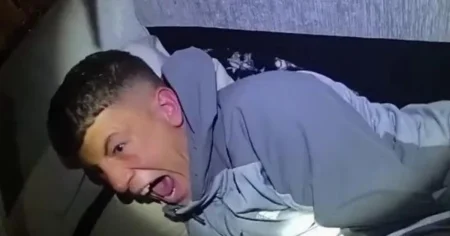
To watch the video is to understand just how fragile public safety can be. The man stands there, framed by the takeaway’s interior, moving with an intensity that can only be described as erratic, his grip on the blade both casual and menacing. He slams the knife down again and again, not as a tool, not as a threat aimed at any single person, but as an expression of pure, unfiltered volatility. The sound of metal hitting the surface is almost audible in the tension of the footage, and his body language suggests a man who has crossed a line from which there is no easy return. What makes it even more unsettling is the setting: a small African kitchen, a place of nourishment and community, turned into a stage for chaos. The workers who had been preparing food moments earlier were forced to abandon their posts, leaving behind their pots, their counters, their sense of safety. One can only imagine the terror of those few minutes, the uncertainty of not knowing whether the man would chase after them, whether the glass barrier that separated him from the street would hold, or whether someone—anyone—would have the courage to intervene. The fact that he had been chased into the premises by members of the public complicates things further. Those who pursued him were not police officers or security guards; they were ordinary people, perhaps shoppers or passersby, who saw something wrong and decided they could not simply look away. Their actions may well have prevented a far worse outcome, but they also placed themselves in harm’s way, turning a simple act of civic responsibility into a confrontation with a knife-wielding man whose intentions remained dangerously unclear.
-
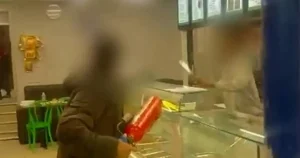
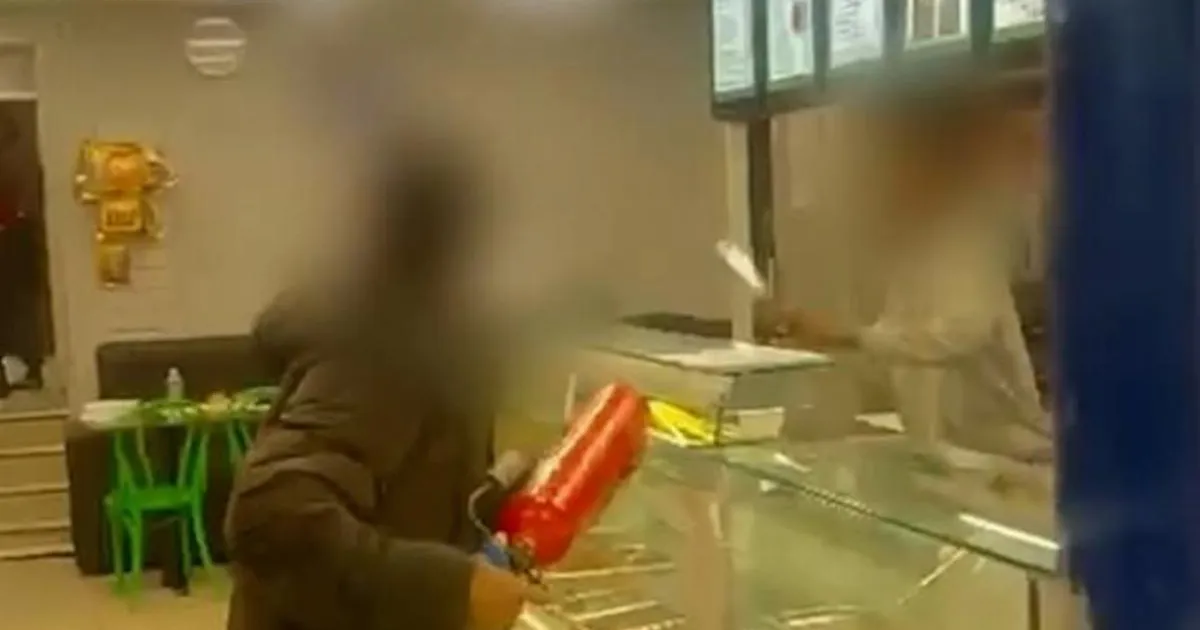
Then there is the second man, the one who appears in the doorway holding a fire extinguisher. There is something both deeply heroic and deeply human about his presence. He does not rush in with reckless abandon; he edges forward, tentative, careful, as if aware that every step could either resolve the situation or trigger a catastrophe. Holding a fire extinguisher, that everyday object designed to fight flames, he had found an improvised shield, a makeshift weapon, a symbol of the fact that ordinary people are often forced to improvise when confronted with extraordinary danger. The footage captures him moving slowly into the takeaway, keeping his eyes fixed on the armed man, trying to establish some kind of presence, some kind of deterrent. The knifeman, for his part, responds with fury. At one point he threatens to throw food at the bystander—an oddly mundane act of aggression given the knife in his other hand, but one that reveals just how disconnected from reality he had become. Other members of the public can be heard appealing for calm, voices overlapping in a desperate attempt to defuse the situation. It is a strange kind of theater, half comedy and half crisis, with a man holding a fire extinguisher facing down a man holding a blade, both of them locked in a standoff that neither seems to know how to end. The bystander eventually backs away, leaving the premises a short time later, his intervention having perhaps achieved what was possible in the moment: a delay, a distraction, a reminder that the man was not alone, that the community was watching, and that his rampage would not go unchallenged.
-
The witness who spoke afterward, choosing to remain anonymous, offered a glimpse into the emotional reality of those moments. “The man was causing a few problems in other shops along the High Street,” they said, explaining that the trouble had begun before he ever reached the takeaway. “I don’t know if he was going to harm anyone but I think he would have done had a couple of people not chased him.” There is a chilling honesty in those words, the acknowledgment that violence was not just possible but probable, and that the only thing standing between the man and catastrophe was the courage of a few ordinary people who decided not to turn away. The witness described how the staff had to flee, how the man was acting “really erratic,” and how worrying it was to see this unfold on a busy high street in broad daylight. Perhaps the most haunting part of their testimony came at the end, when they reflected on the broader context of life in the city: “It was scary but you’re kind of used to seeing these sort of things in Erdington and Birmingham generally. It’s a sign of the times sadly.” That phrase, “sign of the times,” carries so much weight. It speaks to a community that has become acclimatized to the presence of violence, to a public that no longer finds it shocking to see a man with a knife in broad daylight, to a society where fear has been woven into the background of daily life. It is not hopelessness, exactly, but it is a weary acceptance that such things happen, that the world has changed, and that the best one can do is keep moving, keep watching, and hope that someone will step in when needed.
-
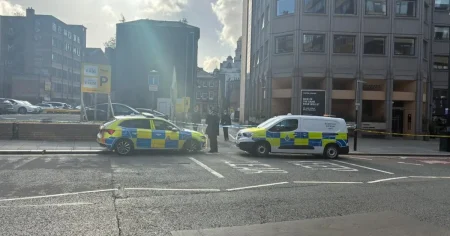
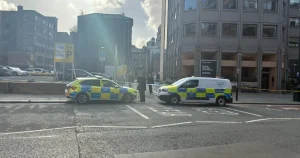
The aftermath was swift, at least in the eyes of the law. Officers from West Midlands Police arrived at the scene shortly after the footage was recorded, and a man in his 40s was arrested on suspicion of criminal damage and assault. A spokesperson for the force confirmed that one person had suffered a minor hand injury during the episode, and although they were treated by paramedics at the scene, they did not require hospital treatment. The suspect remained in custody as of the latest reporting, while the police continued their inquiries. The force also appealed to the public, asking anyone with information to contact them, and provided a crime reference number for those who might have seen something or recorded something that could help piece together the full story. On the surface, this is a straightforward resolution: a violent incident, an arrest, a legal process set in motion. But beneath the official language lies a more complicated truth. The man in his 40s, whose actions were so volatile that they drove staff from their workplace and prompted strangers to confront him, was presumably not simply a villain for the sake of being a villain. He may have been in the grip of a mental health crisis, under the influence of substances, or overwhelmed by personal demons that had nothing to do with the takeaway or the people inside it. That does not excuse what he did, and the knife was real, and the fear was real, and the injury was real. But the human capacity for empathy, even toward those who terrify us, is one of the most difficult and important challenges we face. A community can condemn the act while still wondering about the person, about the circumstances that led him to that counter, about the failures of support systems and social safety nets that allowed a man in distress to become a weapon on a public street.
-
In the end, what remains from this incident is not just a story about violence, but a story about the human spirit in its most complicated forms. There is the courage of the bystander with the fire extinguisher, who saw a dangerous situation and chose to step into it, even if his actions were cautious and provisional. There is the determination of those who chased the man into the takeaway, who refused to let him continue disrupting their neighborhood unchecked. There is the resilience of the staff, who were forced to flee their place of work and then had to deal with the aftermath of a stranger turning their sanctuary into a scene of terror. And there is the weary endurance of witnesses and locals, who have grown accustomed to the rhythm of crisis in their city, who feel the weight of living in a time where such incidents are no longer anomalies but recurring threads in the fabric of urban life. We can ask why the man was there, what drove him to such extremes, and what could have been done to prevent this from happening. We can debate the role of policing, mental health services, community intervention, and the deeper socioeconomic conditions that so often lie beneath acts of public violence. But we should also take a moment to honor the ordinary people who, in the face of danger, did not simply run away. They did not solve the problem, and they probably could not have solved it alone, but they stood there, they held their ground, they appealed for calm, and they reminded us that even in the darkest moments, there are always those willing to reach out, to intervene, to protect, to care. The fire extinguisher may not have been the perfect tool, and the standoff may have been uneasy and unresolved, but it was a testament to the fact that communities are not passive victims of the times in which they live. They push back, they improvise, and they hope that in doing so, they can make the world a little less frightening than it sometimes appears to be. That is not a sign of the times to be accepted; it is a sign of the times to be overcome, one brave act at a time.