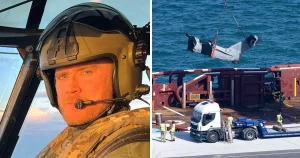



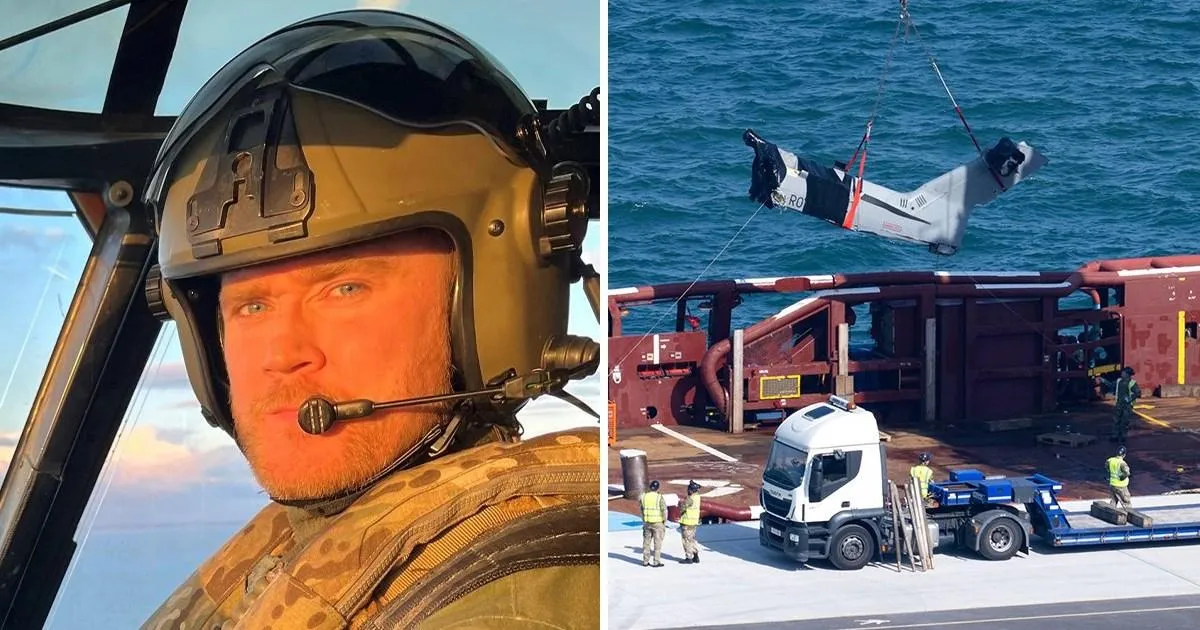
On the evening of September 4, 2024, the English Channel became the setting of a devastating tragedy that claimed the life of a promising young Royal Navy pilot. Lieutenant Rhodri Leyshon, just 31 years old, was at the controls of a Merlin Mk4 helicopter during a night-time training exercise conducted from the decks of HMS Queen Elizabeth, the Royal Navy’s flagship aircraft carrier. The flight had departed from a position roughly 25 miles south of Lyme Regis, Dorset, with the crew expecting a routine drill under the cover of darkness. Instead, within minutes of taking off, the mission unravelled into a catastrophic emergency that left the aircraft plunging into the sea at more than 120 miles per hour. The impact was so violent that the helicopter’s tail was torn from its fuselage. Two crew members were rescued from the water with minor injuries, but Lieutenant Leyshon’s body was not recovered until two hours later. He was taken to hospital, where he was pronounced dead that evening. The loss sent shockwaves through the military community and beyond, not only because of the sudden and violent nature of the crash, but because subsequent investigations would reveal that this was no inevitable accident. It was a sequence of misjudgements, communication failures and procedural gaps that may have cost a gifted officer his life. For his family, the pain was made infinitely worse by the knowledge that his death might have been prevented. His father, Tim Leyshon, expressed the family’s anguish in the starkest terms, saying his son had been “let down by the system.” His mother, Mary Scourfield, spoke with raw grief of a young man who trusted the institution he served with complete faith and loyalty, and who would have done everything in his power to bring the helicopter home safely. In her words, “He had so much more life to live.” Those words hang over the entire inquiry findings like a haunting reminder of the human cost of systemic failure.
The chain of events that led to the crash began before Lieutenant Leyshon and his crew even climbed into the cockpit. The helicopter originally allocated for the exercise had been removed from duty because of a fault with its communications system. A second vehicle was available but was not prepared for flight, so the crew was assigned a third aircraft, which had just been handed over from a previous drill. This kind of last-minute reshuffling is not uncommon in military operations, but it introduced an extra layer of pressure and unfamiliarity. At 8:46pm, just eleven minutes into the flight, a critical component inside the second engine’s fuel pump split apart. The failure caused more fuel than normal to flow into the engine, which in turn accelerated its rotor speed beyond safe parameters. The helicopter’s warning systems responded as they were designed to do, triggering a red master warning indicating an engine failure. But the warning did not specify which of the two engines had developed the fault. In that tense and chaotic moment, the aircraft’s unnamed commander made a series of decisions that the service inquiry would later describe as deeply flawed. Believing that both engines were failing, or that the aircraft had become unflyable, the commander declared a mayday and began to shut down the power plants. Crucially, he switched off two perfectly functioning engines without consulting a second crew member who would normally have been part of any critical decision involving the engine controls. The inquiry noted that this was a deviation from standard operating procedure, where collaboration and cross-checking are supposed to act as a safety net against exactly this kind of error. With the two healthy engines now silent, the only remaining power source was the very engine that had suffered the fuel pump failure. That damaged engine, now running alone, revved so dangerously fast that its own safety systems kicked in and shut it down automatically. Within moments, the helicopter was completely without power, falling from the night sky. The crew attempted what is known as a deliberate ditching, a controlled emergency landing on water, but their belief that the aircraft was unflyable had already sealed their fate. The helicopter struck the surface at more than 120 miles per hour, a speed that made survival almost impossible. The fuselage broke apart on impact, and the sea closed over the wreckage.
The official service inquiry painted a disturbing picture of the circumstances surrounding the crash, pointing not to a single catastrophic mechanical fault but to a constellation of human and organizational shortcomings. Poor communication between the crew members was identified as a central factor, with the panel describing “siloed” behaviour in the cockpit. Instead of functioning as a cohesive team, sharing information and challenging each other’s assumptions, the crew had apparently retreated into isolated roles. In an emergency, that fragmentation can be lethal. The commander, according to the findings, acted on his own assessment without drawing on the full knowledge and experience of those around him, particularly the second crew member whose role included collaboration on critical switches. The inquiry also highlighted that training had been insufficient. The commander had flown only once in the 40 days leading up to the exercise, a remarkably low number for someone expected to lead a complex night-time mission. The report said the pilots lacked experience with deck landings, which is central to carrier-based operations, and the night search operation was hindered by “sub-optimal” visual aids. These findings suggest a broader pattern of pressure and under-preparedness. When the fault occurred, the commander was not operating from a foundation of recent practice and confidence; he was operating from a position of rustiness and uncertainty. The absence of regular flying hours, the lack of familiarity with the specific aircraft, the last-minute substitution of the helicopter, and the degraded visual environment all combined to create a perfect storm. The inquiry’s language was measured, but the implications are clear: the tragedy was not a random stroke of bad luck. It was a failure of systems, of oversight, and of the human factors that military training is supposed to address. For an institution that prides itself on rigorous preparation, the findings were as damning as they were devastating.
For Lieutenant Leyshon’s family, the inquiry’s findings only deepened their grief. His father, Tim Leyshon, did not use the language of accident or fate. He said plainly that his son had been “let down by the system.” Those words carry enormous weight coming from a father who had watched his child dedicate himself to a military career, trusting that the institution would protect him as he served his country. Mary Scourfield, his mother, painted an even more heartbreaking portrait of the man who was lost. She said she knew that Rhodri would have done everything within his power to get the helicopter back. That confidence in his skill and determination is a reminder that the pilot was not a nameless figure in a report, but a real person with family, friends, hopes and plans. She spoke of his ultimate faith in and loyalty towards the organisation and system in which he worked, a faith that made the news of how his death occurred so much harder to bear. To die in service is one thing; to die because of avoidable mistakes, miscommunication and insufficient training is another. The family’s grief is entangled with anger and disappointment, not at the crew members who survived, but at the broader culture that allowed such a promising young life to be cut short. They are also painfully aware that Rhodri had much more to give. In his 31 years, he had already achieved the rare distinction of becoming a Royal Navy pilot, a role that demands extraordinary intelligence, discipline and courage. He had apparently embraced the challenges of carrier-based aviation, operating from one of the most powerful warships in the world. The thought that he had so much more life to live, so many more missions to fly, experiences to enjoy and relationships to build, is an unbearable weight for any parent to carry. Their statement is not just a grieving family’s lament; it is also an indictment of a system that failed to live up to its own values of safety, teamwork and preparation.
The broader significance of this tragedy extends far beyond one family’s loss. It raises urgent questions about how the Royal Navy and other military organisations manage risk, train their personnel and maintain their equipment. The fact that the original helicopter was grounded because of a communications fault is a reminder that even routine maintenance issues can have cascading consequences. When the second helicopter was unprepared for flight and the crew was hurriedly assigned a third, the normal rhythm of pre-flight preparation may have been disrupted. Pilots need time to familiarise themselves with an aircraft, to review its particular characteristics and to mentally prepare for the mission. The inquiry’s finding that the commander had flown only once in the preceding 40 days points to a deeper problem with operational tempo and readiness. In any high-reliability profession, from aviation to medicine to nuclear power, the importance of regular practice cannot be overstated. Skills fade, judgement dulls, and reaction times slow when they are not constantly exercised. Night flying over water is especially demanding, requiring pilots to rely heavily on instruments and instinct, and the absence of recent experience can be the difference between life and death. The “sub-optimal” visual aids mentioned in the report add yet another layer of concern. If the flight deck and surrounding environment were not properly illuminated or equipped to support night operations, the crew was operating with one hand tied behind its back. The inquiry’s description of “siloed” behaviour in the cockpit is perhaps the most troubling finding of all. Aviation safety has long emphasized the importance of crew resource management, which encourages open communication, mutual respect and the willingness of every team member to speak up. When those principles break down, even the most advanced aircraft can become a death trap. This crash is a stark case study in how human error, organisational pressure and insufficient support can combine with tragic results. Military investigators will likely be studying these findings for years, and the lessons learned will hopefully lead to changes in training, communication protocols and equipment maintenance. But those reforms come at an enormous price: the loss of a young officer who should have had decades of life ahead of him.
As the months pass, the memory of Lieutenant Rhodri Leyshon remains a painful and powerful presence. In any death, there is the temptation to look away, to focus on technical details and procedural recommendations. But the deepest truth of this tragedy is a human one. A young man went to work one evening, doing a job he loved, serving his country in a time of peace. He never came home. The sea that night was not a battlefield, and the enemy was not foreign weapons fire. The enemy was confusion, miscommunication and a chain of decisions that should never have been made. That is what makes this story so difficult to reconcile. The Royal Navy has a long and proud tradition of excellence, and the men and women who serve in it routinely perform extraordinary feats under extreme pressure. Lieutenant Leyshon was part of that tradition. He was the kind of person who placed his trust in his training, his aircraft and his colleagues. The service inquiry’s findings show that trust was, in critical moments, not honoured. His family’s words deserve to be remembered not just as a private expression of grief, but as a public demand for accountability. “He had so much more life to live,” his mother said, and those words should echo in every meeting where training budgets are discussed, every briefing where communication protocols are reviewed, and every decision about whether to swap an aircraft at the last minute. Rhodri’s life mattered. His death should not be in vain. The most fitting tribute to his memory would be a genuine commitment to ensuring that no other family has to suffer the same preventable loss. That means investing in realistic training, fostering a culture where every crew member is heard, and maintaining equipment with the utmost care. It means remembering that behind every aircraft, every mission and every report, there is a human being with a name, a family and a future. Lieutenant Rhodri Leyshon was that human being. He was taken too soon, under circumstances that should never have occurred, and he will not be forgotten.