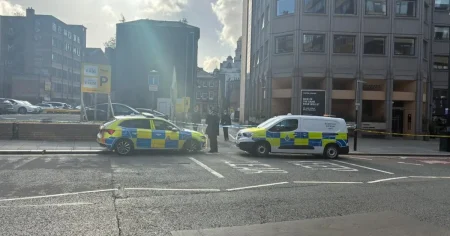



Waking up to the sound of your own scream is unsettling enough; waking up to a torch beam and the shouting of police officers is something else entirely. The bodycam footage released by West Midlands Police captures that exact moment for Asa McIntosh, a 21-year-old drug dealer who had been asleep on a sofa when officers raided his home. The video shows an officer sweeping a bright torch across the room and finding McIntosh still tangled in sleep, his face barely visible in the darkness. As the reality of the raid hits him, he lets out a high-pitched yelp, a sound so unexpected and undignified that it quickly became a talking point on social media. For viewers, it was easy to laugh. One person commented that he “screamed like a girl,” another joked that he had been dreaming of the Oblivion ride at Alton Towers, and someone else suggested he looked as though he thought aliens had come for him. But beneath the comedy lay a much darker story. McIntosh was not some harmless young man caught in the wrong place. He was part of “P Line,” a drug trafficking network worth more than a million pounds, supplying heroin and crack cocaine across Smethwick, Wednesbury, Walsall, and Birmingham. The raid was a carefully planned police operation, and the scream, however human and vulnerable, marked the beginning of a long fall from the glamorous lifestyle he had tried to project online. In that split second, the tough image vanished, and all that was left was a startled young man being pulled from sleep into the cold reality of handcuffs and arrest.
The scale of the operation that McIntosh belonged to was far from amateurish. Birmingham Crown Court heard that “P Line” was a sophisticated drugs business, run like a commercial enterprise with managers, runners, and a dedicated customer base. The group of seven defendants had supplied Class A drugs, including heroin and crack cocaine, to communities in Smethwick, Wednesbury, Walsall, and Birmingham. This was not a handful of street-corner deals; it was a million-pound network that operated seven days a week, with runners working seven-hour shifts across a 22-hour daily window to keep up with demand. Detectives investigating the line found thousands of calls and messages sent and received from phones used to coordinate the operation. The sheer volume of communication showed how carefully the network was managed, with orders, deliveries, and payments being tracked in real time. When police carried out searches at addresses linked to the group, they recovered multiple kilograms of Class A drugs and thousands of pounds in cash. The drug line had become an industry, and like any industry, it left a trail of harm. The drugs being sold were not abstract commodities; they were substances that destroy lives, break families, and fuel violence. For every customer who came looking for a hit, there was a story of addiction, desperation, and loss. The people running P Line may have seen themselves as clever businessmen, but the communities they operated in bore the cost of their trade every single day.
What made the footage of McIntosh so striking was the contrast between his online persona and the terrified figure on the sofa. In other videos shared by police, McIntosh appeared to be living the dream he had once imagined for himself. He showed off a huge wad of cash while rapping about his rise from poverty, claiming that he had once been “broke as a joke.” There he was, flashing money, acting confident, performing the role of a successful young dealer. In another clip, members of the group filmed a massive block of cocaine before promoting it for sale, presenting their criminal product with the kind of pride usually reserved for legitimate business achievements. But the bodycam footage told a different story. When the police arrived, all that bravado evaporated. McIntosh did not look like a wealthy kingpin or a smooth-talking rapper; he looked like a young man caught completely off guard, vulnerable and afraid. Social media viewers were quick to pile on, and their comments were brutal. But the video raised uncomfortable questions about the gap between the image and the reality of drug dealing. The money seemed glamorous, but the lifestyle was built on violence, exploitation, and the suffering of others. In the end, the same hands that had once counted out wads of cash were put in handcuffs, and the same mouth that had rapped about being broke was now letting out a scream that would be watched by thousands.
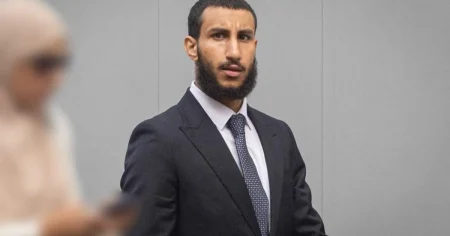
The police investigation that brought down P Line was detailed and relentless. Detectives did not simply stumble onto the operation; they traced phone records, analyzed patterns, and pieced together a picture of a drug line that had been running like a utility service. The phones used by the group were dedicated to the business, buzzing with messages from customers, instructions from organizers, and updates from runners. The court heard that the operation was structured with a clear hierarchy. At the top was Zuhayb Abdi, 30, of no fixed address, who was described as the person running the line. His second in command was Waqas Hussain, 27, from Wells Avenue, Darlaston. Beneath them were the runners and associates, including McIntosh, Bradley Whatmore, Hakeem Ali, Quarnay Lee-Taylor, and Rees Macdonald. Each had a role to play, whether it was holding drugs, managing phones, or moving cash. The group’s meticulous planning was impressive in its own way, but it was also their undoing. The more organized they became, the more digital evidence they left behind. Thousands of calls and messages created a map of the operation, and once police had that map, it was only a matter of time before the doors were kicked in. The searches that followed recovered multiple kilograms of Class A drugs and thousands of pounds in cash, stripping the group of both their product and their profits. For the police, it was a victory in a long-running battle against drug supply in the Black Country and the wider Birmingham area.
All seven members of the P Line drug operation were sentenced to jail after pleading guilty to multiple offences. Abdi admitted two counts of conspiracy to supply controlled drugs of class A cocaine and heroin and was jailed for seven years. Hussain pleaded guilty to two counts of conspiracy to supply class A cocaine and diamorphine, the medical name for heroin, and was sentenced to five years. Macdonald, aged 31 and of no fixed address, admitted two counts of conspiracy to supply class A cocaine and heroin as well as one count of kidnapping, for which he was jailed for six years. McIntosh and the other defendants—Bradley Whatmore, Hakeem Ali, and Quarnay Lee-Taylor—were also jailed for their involvement in the million-pound drug line. The courtroom saw the end of a long process that had begun with raids, arrests, and the seizure of drugs and cash. For the defendants, the sentences meant years of their lives taken away by prison walls. Some of them were young men, still in their twenties, who had perhaps believed that drug dealing would give them an escape from hardship. Instead, they were now facing the consequences of choices that had harmed so many others. The judge’s sentences reflected the seriousness of the crime: this was not petty theft or a moment of poor judgment, but a sustained, organized conspiracy to flood streets with dangerous drugs. In the courtroom, there were no flashy videos or wads of cash, only suits, security guards, and the weight of a future suddenly narrowed by steel doors and timed visits.
Detective Sergeant Adam Buzzard of West Midlands Police made clear why this case mattered. He said that the group ran a significant drugs line around the Black Country and wider area, and that they were meticulous in their planning to ensure the drug line operated all hours of the day, every day. But thanks to the excellent investigative skills of his team, they were able to identify everyone involved and secure significant jail time for all seven. His words carried a simple but powerful message: drugs cause harm within communities, and police are carrying out action day in, day out, to disrupt supply lines across the region. Behind the headlines and the amusing bodycam clip, there is a less visible story of what such drug lines do to neighborhoods. They bring addiction, family breakdown, and violence. They turn public spaces into dangerous places and make ordinary people afraid. They exploit vulnerable people, sometimes coercing them into becoming runners or couriers. The raid that woke McIntosh from his sleep was not an isolated moment of drama; it was part of a wider effort to reclaim streets and communities from the grip of illegal drugs. For McIntosh and his associates, the laughter and mockery on social media may fade, but the sentences will not. The young man who screamed as he was woken by police has plenty of time now to think about the path that led him there, and for the communities that suffered because of P Line, there is at least some comfort in knowing that the line has been cut for good.