


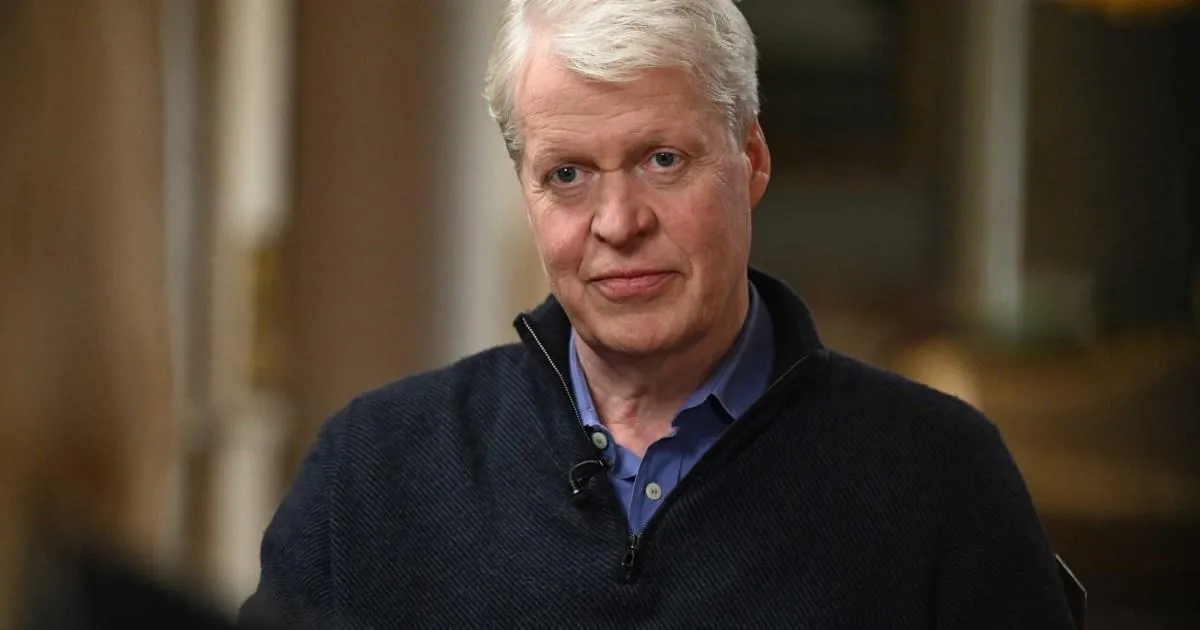
In recent days, Earl Spencer has once again found himself at the center of international attention after publishing a series of claims about his former royal in-laws that can only be described as explosive. For many, the name Earl Spencer still evokes a single, unforgettable image: a young, grieving man in a dark suit at Westminster Abbey, standing before the world at the funeral of his sister, Diana, Princess of Wales. That moment, in September 1997, made him a household name, but it also forever framed him as the brother who dared to challenge the crown. Yet Charles Edward Maurice Spencer, the Ninth Earl Spencer, is far more than a man frozen in a photograph. He is a devoted father, a former journalist, an author, and a custodian of a complicated legacy. He was born into one of Britain’s grandest aristocratic families, with a godmother who happened to be Queen Elizabeth II, and by the time he was a young man, he was already navigating the strange intersection of privilege and public expectation. His recent “bombshell claims” have reawakened attention, prompting many to ask not just what he said, but who he is. The answer is layered. It begins with a childhood spent between enormous wealth and immense emotional complexity, and it continues through three marriages, seven children, and a life spent wrestling with the shadow of his famous sister. He was only thirty-three when she was killed in a car crash in Paris, leaving him to deliver a eulogy that echoed far beyond the Abbey walls. If the public remembers him as an angry brother speaking through grief, he knows that is only a small part of a much longer story. The world has always been fascinated by him, not because he holds a title, but because he dared to be honest in a place where silence is often the rule. For all his old-world grace and stately homes, he remains, at his core, a man shaped by loss, duty, and a fierce desire to protect the memory of the sister he loved.
Born on May 20, 1964, Charles Edward Maurice Spencer entered a world already steeped in history. As the younger brother of Diana Spencer, he grew up in a family that had served the British crown for generations, and his godmother was, appropriately enough, Queen Elizabeth II herself—a mark of the closeness between the Spencers and the monarchy. But that closeness would later become a source of immense tension, especially after Diana married Charles, Prince of Wales, and then saw her life unravel within the palace walls. Long before the royal drama, however, Charles Spencer was simply a boy at Althorp, the magnificent country estate in Northamptonshire that had been the Spencer family seat for centuries. He was educated privately, first at Eton College, one of the most elite schools in England, and later at Oxford University. It was a childhood of privilege, but also one of expectation: he was not the first-born child, as three older sisters had come before him, but as the only boy, the Spencer inheritance was ultimately destined to be his. When his grandfather, the Seventh Earl Spencer, died in 1975, his father became the Eighth Earl; when his father died in 1992, Charles became the Ninth Earl Spencer, a title that carried with it not only land and money, but a weighty sense of public duty. Yet the human reality was more complicated. His parents’ marriage had fractured; his mother, Frances Shand Kydd, had left the family when he was small, and he and Diana both grew up in a household that could feel emotionally cold. The wealth and the titles did not protect them from pain. This is part of why, decades later, when he stood at Diana’s funeral, his grief felt so raw. He was not speaking as an aristocratic politician; he was speaking as a man who had watched his sister struggle, and who had lost her far too soon. His education and his titles gave him a platform, but they did not give him peace. Instead, they gave him a lifelong lesson in the difference between image and truth, between what is shown to the world and what is really felt at home. That lesson would one day explode into the most memorable eulogy of the twentieth century.
Anyone seeking to understand Earl Spencer must look at his family life, which has been marked by love, upheaval, and a recurring pattern of public scrutiny. He married his first wife, Victoria Aitken, in 1989, and together they had four children: his eldest daughter, Kitty Spencer, who would later become a fashion model and international media darling; twin daughters, Lady Eliza Spencer and Lady Amelia Spencer; and a son, Louis Spencer, Viscount Althorp, who carries the family’s future title. That marriage ended in 1997, the same year his sister died, making that year one of the most painful and tumultuous periods of his life. He later married Caroline Freud in 2001, adding two more children to the fold—Edmund Charles Spencer and Lady Lara Spencer—but that marriage also ended, in 2007. His third marriage, to Karen Spencer, lasted from 2011 until their divorce in 2025, and produced a daughter, Lady Charlotte Diana Spencer. The name is significant: she was given the middle name Diana directly in honor of her aunt, Princess Diana. It is a tender, deeply human gesture, one that shows how Diana’s memory remains woven into the everyday fabric of his family. His children have grown up in the same contradictory world he did—blessed with extraordinary opportunity, yet haunted by public fascination. The marriages have not always survived the pressure; being an earl does not exempt you from heartbreak or divorce. But through all of it, he has tried to be a father, not just a figurehead. His eldest daughter, Kitty, has spoken warmly of her father in interviews, describing him as protective and deeply devoted to her and her cousins. The image that emerges is not of a cold aristocrat, but of a man navigating the messy, very ordinary struggles of family life while also carrying a name that the world will never stop scrutinizing. He has also been a steady presence in the lives of Diana’s sons, William and Harry, even if the storms around the royal family have sometimes complicated those relationships. In his family, as in his public life, he has learned that love and duty often pull in opposite directions, and that even a peer of the realm cannot control the outcome. His three marriages, and his seven children, are not simply entries in a peerage; they are the story of a man looking for stability and love in an unstable, often unfeeling spotlight.
For all his lineage, Earl Spencer has never been content to simply live off the family name. In the late 1980s and early 1990s, he worked as a journalist for NBC News, reporting on a range of stories and proving that he could hold his own in a professional, competitive environment. This was no ceremonial role; he was doing fieldwork, filing reports, and experiencing the ordinary pressures of deadlines and editors. It gave him a grounding that many aristocrats lack. But his deepest avocation has long been writing. Over the years, he has authored several books, many of them rooted in his fascination with history, his own family ancestry, and the sprawling, often turbulent saga of the Spencer line. His latest book is due to be released next week, and it is expected to draw fresh attention to his perspective on the royal world he was born into. His writing has often been described as thoughtful and meticulous, not the work of a celebrity but of a genuine historian and storyteller. He has also used his voice to speak publicly about mental health, grief, and the price of fame, drawing on his own experience of losing Diana and watching her be consumed by the very institution that should have protected her. His professional life is, in many ways, a testament to his desire to be more than a title. He has chosen to work, to write, to engage with the world not just as the Ninth Earl Spencer, but as Charles Spencer, a man with a mind of his own. That independence has sometimes caused friction with the royal household, but it has also endeared him to those who value honesty over protocol. As his new book prepares to land, he is doing what he has always done: using words to shape a narrative that cannot be controlled by palaces or press offices. It is no surprise that his claims have “shocked the world.” He understands, better than most, the power of a carefully chosen sentence. When he speaks, people listen—not because of the coronet on his head, but because his words have the weight of lived experience. He has earned the right to be heard, and he has never been shy about using that right. And with a new book on the way, that voice will only grow louder.
No portrait of Earl Spencer would be complete without a return to the moment that defined him in the public imagination: the funeral of Princess Diana. On September 6, 1997, in Westminster Abbey, he delivered a eulogy that was both a tribute and a rebuke. He called her “the unique, the complex, the extraordinary and irreplaceable Diana,” and then he made a statement that rang around the globe: that she was “the most hunted person of the modern age.” He looked directly at the royal family as he said those words, and many believed he was holding them to account for the media frenzy and the lack of protection that had led to her death in Paris. It was an extraordinary moment of public grief and anger, delivered by a man who had just lost his younger sister. He was thirty-three years old, walking through a cathedral full of kings, queens, presidents, and cameras, and somehow he found the strength to speak with a clarity that few others dared. In the years since, he has continued to evoke her memory, often speaking of her with a tenderness that reveals a very personal relationship, far removed from the composed, elegant image the public came to know. He remembers her as a sister, a woman who would laugh, who loved her sons fiercely, who struggled with her own self-worth, and who sought kindness in a world that often felt cold. He has spoken about the last time he saw her, about his regret that he could not do more to shield her from the pressures that surrounded her. That raw, unpolished grief is what made his eulogy, and it is also what makes him so compelling today. He is not, at heart, a political figure or a rebel by instinct. He is a brother who, decades later, still carries the ache of her absence. His recent comments about the royal family cannot be understood without this context: he has spent a lifetime watching how institutions treat people, especially those they claim to love. He has seen what happens when humanity is subordinated to tradition, and he has never fully forgiven it. To hear him speak of Diana is to understand why her memory still matters; to him, she was not a princess in a palace but a flesh-and-blood person, loved and lost.
Now, as he releases another book and makes headlines once again, Earl Spencer is stepping back into a spotlight that he has never entirely escaped. He is in his early sixties, and his life has been a long arc from privileged child to grieving brother to outspoken voice. He has been married three times and divorced three times; he has raised seven children; he has watched his family name become synonymous with both tragedy and resilience. Through it all, he has remained a keeper of Diana’s flame. At Althorp, where her remains rest on an island in the middle of a lake, he has created a private sanctuary, a place for the family to mourn away from tourists and telephoto lenses. He has spoken about the importance of letting the next generation—especially William and Harry—grow up with a sense of their mother’s spirit, not just her tragedy. His relationship with his nephews has been complicated by recent royal fractures, but his devotion to Diana’s memory has never wavered. The “bombshell claims” that have shocked the world are, in many ways, the latest installment in a lifelong reckoning with power, privilege, and responsibility. He is not a man who seeks to topple the monarchy; he is a man who believes that people, even royals, should be held to a human standard. His latest book may be filled with revelations, but the deeper revelation is the same one he offered at Westminster Abbey: that when the mighty fail to protect the vulnerable, someone must speak up. Earl Spencer is that someone. He is a man of tangible influence and old-world title, but he is also, at his core, a brother who honored his sister by refusing to stay silent. And in that sense, his story is not simply about royalty or scandal. It is about the enduring power of love, loss, and the courage to tell the truth, even when it costs you everything. As the next chapter of his life unfolds, one thing is certain: he will not stop writing, speaking, or remembering. His voice is not always comfortable, but it is always real—and in a world that often prefers polish to truth, that is the most human thing about him.