


The azure waters of the Mediterranean had likely promised a routine passage on that seemingly ordinary day. The Express, a catamaran-style passenger ferry, had departed the bustling northern Cypriot port of Kyrenia, known locally as Girne, with its sights set on the Turkish coastal town of Tasucu. For the 258 passengers and the crew members onboard, totaling over 260 souls, the journey was probably a familiar one—a commute for workers, a return trip for families, or the beginning of a holiday for tourists. The deck would have been filled with the murmur of conversations, the laughter of children, and the quiet anticipation of reaching the mainland. Yet, the tranquility of that crossing was destined to be shattered in the most violent and terrifying manner. Just a few miles from the safety of the coastline, the vessel began to take on water. What started as an alarming gush quickly escalated into an uncontrollable flood, causing the massive ship to lurch violently. In a matter of harrowing moments, the ferry that had been a haven of stability was overcome by the unforgiving sea, rolling over and capsizing into the churning depths, leaving its passengers and crew fighting for survival against the cold, angry waves.
The suddenness of the disaster cannot be overstated. One moment, the passengers were likely staring out at the horizon, perhaps sipping tea or dozing off. The next, they were plunged into a primal nightmare. The ship’s internal alarms would have blared, but they were likely drowned out by the screams of fear and the cacophony of shifting furniture, shattered glass, and rushing water. The vessel’s list would have made walking impossible, transforming the sleek corridors into treacherous slides toward the ever-rising sea. Desperate individuals scrambled for life vests, clutching at railings, and trying to reach the upper decks as the ship groaned under the immense pressure of the water flooding its hull. Turkish state-run broadcaster TRT reported that the ship began taking on water critically close to shore, a cruel irony for those onboard who could likely see the land they had just left, yet were helpless to reach it. The sea, described by officials as “quite rough,” further compounded the chaos, tossing the crippled ferry violently before it eventually succumbed to the ocean’s embrace, ultimately coming to rest completely upside down—a grim, steel tomb bobbing just beneath or upon the surface.
In the aftermath of the capsizing, the immediate focus shifted to the desperate fight against time and the elements. The sheer scale of the tragedy began to unfold as news spread, with confirmed figures indicating that at least 260 people had been aboard the ill-fated Express. Of that staggering number, roughly 100 remained unaccounted for in the initial hours, sending a chill of dread through the hearts of families and rescue coordinators alike. The water temperature in the Mediterranean, while not frigid in that season, was still cold enough to induce hypothermia rapidly, especially for those without life jackets or clinging to debris. The rough seas, which had been a contributing factor to the sinking, now became the enemy of the rescue operation, creating massive swells that obscured floating victims from view and made it perilous for smaller boats to navigate the debris field. Treating this as a catastrophic maritime emergency, a massive search and rescue operation was launched immediately, mobilizing every available asset. Three coast guard boats sliced through the heavy waves, racing toward the last known position of the ferry, joined by a flotilla of private vessels that answered the call, their civilian crews risking their own lives to pull survivors from the water.
The rescue effort was a scene of frantic, coordinated chaos. Above the booming waves and the cries for help, the rhythmic thumping of helicopter rotor blades filled the air as an aircraft was dispatched to provide aerial surveillance and assist in the delicate extraction of survivors. From above, the rescuers could see the horrifying sight of the Express’s hull—the red anti-fouling paint of its bottom now exposed to the sky, a stark and surreal monument to the disaster. Down on the surface, the coast guard and volunteer sailors engaged in a back-breaking struggle, heaving shivering, shock-stricken passengers over the gunwales of their boats. Many survivors were found clinging to floating seats, luggage, or pieces of the wreckage. Some had managed to don life jackets, while others were desperately treading water, their strength fading with every passing minute. The physical toll on the rescuers was immense, but the adrenaline fueled them as they pulled body after body from the sea, quickly wrapping them in thermal blankets and administering first aid. Despite the sheer peril of the operation, reports indicated several injuries, but miraculously, there were no initial casualties reported—a fragile glimmer of hope amidst the unfolding devastation.
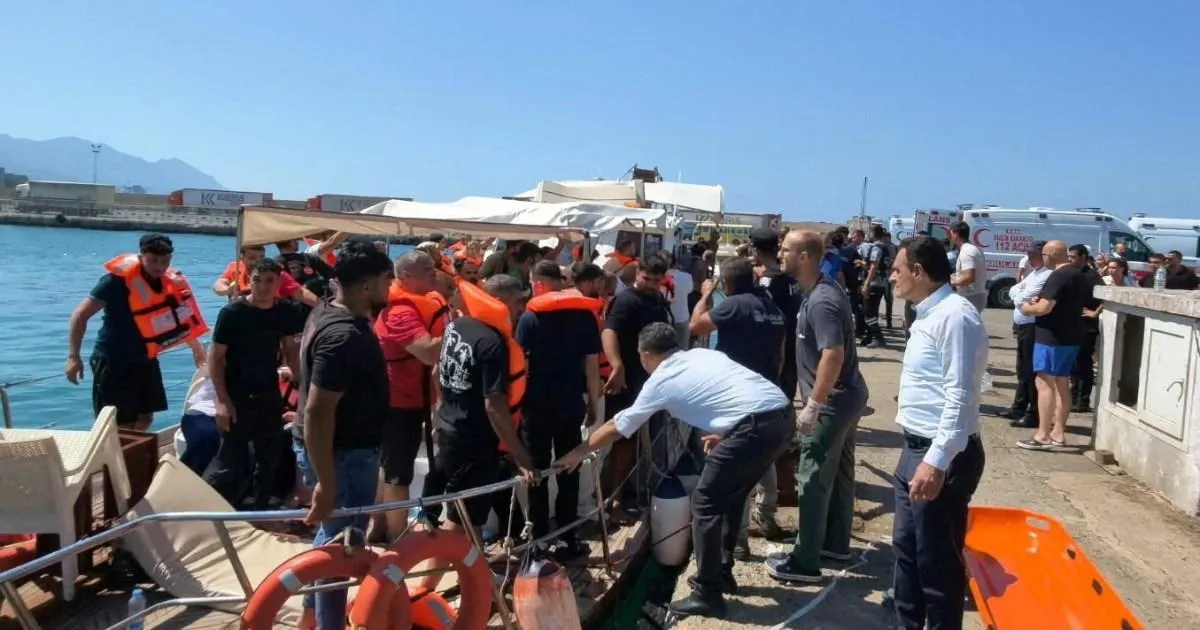
As the first wave of survivors were brought back to the shores of Kyrenia, the harbor transformed into an epicenter of raw human emotion. Ambulances screamed along the docks, their lights washing over the crowds of anxious onlookers who had gathered, hoping to catch a glimpse of a loved one. The survivors who could walk stumbled onto the quay, wrapped in foil blankets, their faces pale and etched with the trauma of what they had just endured. Some were silent, staring blankly ahead, while others broke down in sobs, weeping tears of relief and fear for those still missing. Kyrenia’s mayor, Murat Senkul, stood amidst the commotion, his grave expression telling the story that words could not. He described the situation as “very serious,” and confirmed the agonizing fact that around 100 of those who had been on board had not yet been accounted for. For the families waiting on the shore, every boat that approached the harbor was a moment of agonizing anticipation—was a familiar face among the rescued, or would they be left to wait for more news? The air was thick with uncertainty, the unmet gaze of the empty sea serving as a cruel reminder of the lives still hanging in the balance, and the fragility of the maritime route that connected the island to the mainland.
The gravity of the situation reverberated across the political and administrative spheres of both Northern Cyprus and Turkey. Public Works Minister Erhan Arikli, standing before the press, delivered the grim update that the ship was “now upside down,” a detail that underscored the immense difficulty of the ongoing rescue. He acknowledged the treacherous “quite rough” sea conditions that were complicating the operation, but affirmed the singular priority: “to bring our passengers to land without loss of life.” These words were a prayer as much as a directive. Meanwhile, Cevdet Yilmaz, the Vice President of Turkey, expressed the nation’s profound sorrow, confirming that a coordinated response had been launched by the Turkish Republic of Northern Cyprus and the Republic of Turkey’s Coast Guard units. He assured the public that the search and rescue operations were continuing “without interruption”. The bureaucratic language, while necessary, could not mask the underlying terror of the situation. The fact that the vessel was a catamaran—typically fast and stable—was a haunting detail that highlighted the unpredictable and unforgiving nature of the sea. As darkness potentially threatened to fall, the race against time intensified, with officials and divers preparing to potentially have to search the flooded compartments of the sunken vessel for any trapped survivors, holding onto the last vestiges of hope that the final toll would be one of overwhelming rescue, not one of devastating loss.
Ultimately, this tragic event serves as a stark and poignant reminder of the unpredictable and indifferent power of the ocean. For the passengers of the Express, what began as a mundane journey across a short stretch of water became a struggle for existence against the elements. While the full story of the sinking will be pieced together in the coming days—through investigations into the vessel’s structural integrity, weather forecasts, and the accounts of the survivors—the immediate moment is defined by human resilience and panic. On the Turkish shore in Tasucu, anxious families gathered, glued to their phones and television screens, waiting for news from across the water. The initial reports of “no casualties” offered a sliver of relief, but the realization that 100 people were still missing tempered that optimism with a heavy, suffocating anxiety. The event is a reminder that for all our technological advances in shipbuilding and navigation, we are still at the mercy of the deep. Yet, it is also a testament to the courage of the crews of the small private boats, the coast guard, and the helicopter pilots who dove into the fray without hesitation. As the search continues, with divers poised to investigate the submerged hull, the world holds its breath, hoping for a miracle. The capsized ferry, lying in the shallows off northern Cyprus, has become a symbol of a single, terrifying moment—but the spirit of the survivors and the dedication of the rescuers highlight the enduring human drive to cling to life, even when the ship has turned upside down.