

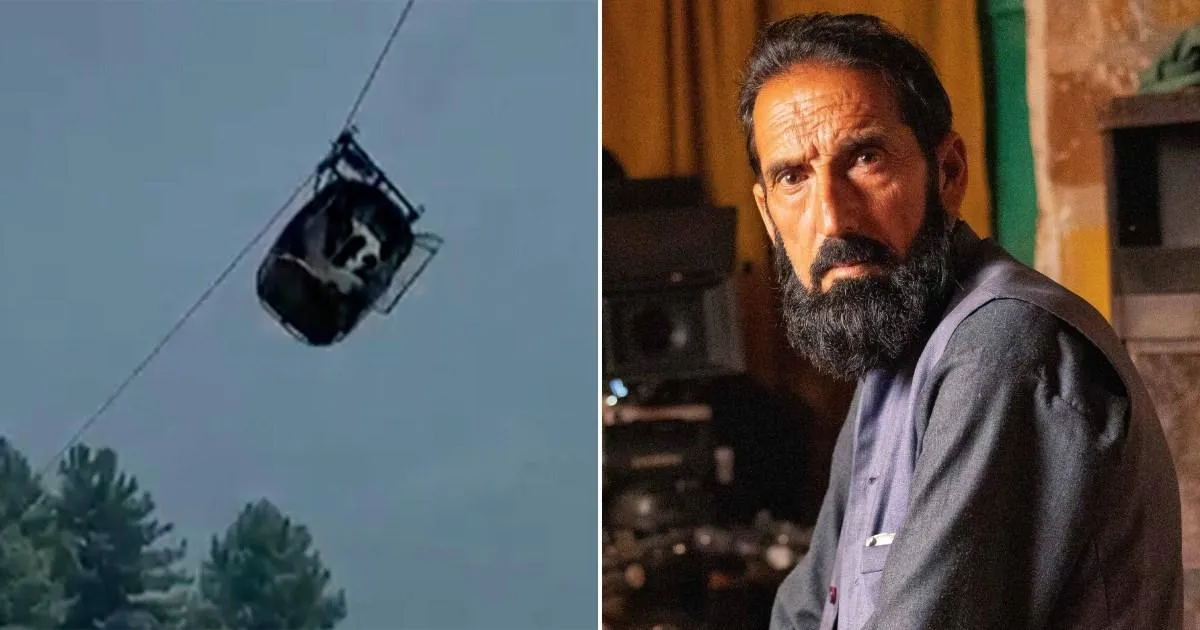
Three years ago, in the steep, windswept mountains of northern Pakistan’s Allai valley, near the town of Battagram, a father’s mind was forced into the most terrible place a parent can go. Umraiz Khan, a government office worker, stood far below a cable car that was hanging by a single broken wire almost nine hundred feet above the ground. His seventeen-year-old son, Irfan, was one of eight schoolboys trapped inside it, on a journey that had started like any other morning. The cable car was not a tourist ride or a stunt;it was a lifeline, a simple metal box slung over the gorge, the kind of everyday conveyance people used because the mountains left them no other choice. The boys had climbed in with their schoolbooks, expecting to alight at the other side within minutes. Instead, the rope suddenly gave way, leaving the cabin suspended over the rocky valley floor, swaying with each gust of wind. Far below, families gathered, shouting, praying, trying to make sense of the impossible sight. As the first hours passed in a blur of phones and frantic movement, Umraiz later told Metro, he found himself doing the unthinkable. Instead of hoping, he was planning. He was calculating how he might retrieve his son’s body from the ground below, how he might identify it among the scattered ruins, how he might carry it home. “I had no choice but to think about how to best pick up my son’s body parts from the ground below,” he said. “How will I know which are his? How will I take them back home? That reality was right in front of me as the cable car was dangling.” The phrase captures a stark truth: rescue was not certain;the apparatus of daily life had turned into a death trap,and no helicopter had yet appeared on the horizon. For hours, strong winds and a scarcity of resources made any attempt to reach the boys seem almost impossible,andevery minute that passed seemed to tighten the rope around the fathers’ hearts.
Just sitting down with Metro to speak about that day, Umraiz said, brings back the same sense of fear. He can still feel it in his chest, the way his breath went shallow when he heard shouting outside his home three years ago. At first he assumed it was a street fight;boys in the village often raised their voices over small things. But the shouts did not sound triumphant or angry;they sounded desperate, like people calling on God for help. He walked toward the source of the commotion,andsomeone pointed at the sky. There was the cable car, dangling uselessly,andsomeone said: his son was inside. He managed to get through to Irfan on the phone. What do you say to a child trapped in a box above a ravine? Umraiz knew that if he let even a slice of his terror enter his voice, it would spread through the line like fire. So he lied with his voice. He made it low, steady, almost cheerful. “I had to pretend I was calm,” he said, his voice shaking as he remembered. “I had to pretend I was confident help was going to come.” The pretense became harder as afternoon turned to evening. They could see the cable car beginning to shudder,andevery attempt to get close to it seemed to make things worse. If too much weight was placed on the wire, it shook violently. No one could get close. No one could climb up. No one knew whether the rope would hold until morning. The first helicopter eventually arrived, but it was forced to fly away; even the downwash from its blades made the cable car swing dangerously,and it could not risk getting near enough to rescue anyone. Watching it retreat into the darkening sky, Umraiz felt the last thread of hope snap inside him. “Seeing it move away from the cable car without having been able to rescue any of the boys confirmed to me that my son is going to die,” he said.
Inside the cable car, the boys were going through their own agonies. Huddled together, they had watched the daylight drain from the sky and the crowd grow below. Drone footage from the rescue operation would later show them clinging to the metal frame, small figures in a tiny box against an immense rock face. They prayed, reciting passages from the Qur’an with the desperate intensity of boys who believe they are about to meet their maker. They wept, not bothering to hide the tears from one another. They could see the rescue attempts unfolding far below, the large crowd gathering to watch, the helicopter coming and going,andeach failed attempt made their hearts sink lower. “We even began trying to come up with our own ideas,” Irfan recalled. “We imagined being able to cross the rope ourselves.” It was a fantasy born of sheer terror and helplessness;there was nowhere to go, no way to climb down, no way to climb up. The cable car shook in the wind, sometimes violently,andeat any moment seemed ready to let go. They clung to the metal frame, to each other, to their faith. They recited verses, repeated prayers,and tried to make peace with what seemed inevitable. Some of the boys were younger than Irfan, children old enough to understand the danger but not old enough to hide their fear. They called for their mothers. They asked if they would ever see home again. No one could answer. Far below, their families could do nothing but watch and wait. The night was closing in,andthe mountains were dark;the temperature was dropping. For the boys, time congealed into a single long tremor. They had no food, no water, no warmth except the press of their bodies. They could hear the wind keening around the broken wire,and the groan of metal that seemed to promise that the next gust would be their last. Yet even in that suspended place, Irfan said, they did not stop trying to imagine a way out. Survival, at first, was not a plan but a stubborn refusal to surrender.
When the helicopter appeared a second time, hope and terror collided. Once again, the cable car began to shake violently as the aircraft drew near—so violently that some of the boys could not bring themselves to reach for the harness being lowered toward them. They were too scared, too frozen, too certain that any sudden movement would send them all plummeting. People on the ground watched as an army soldier slung down from the helicopter, a tiny figure swinging in the wind, trying to anchor himself against the swaying metal box. The rotor wash pounded them;the cable car pitched and groaned. One boy, then another, shrank back from the open door. They could not do it. They could not let go of the frame long enough to step into a harness that seemed as fragile as a thread. But Irfan, he said, had “had enough of crying.” Exhaustion had burned through fear;he stepped forward into the harness, the first of them to be lifted out of the dangling cabin. The image is almost unbearable:a teenage boy, trembling, being winched up into the sky above a valley floorwhere his father had been planning to collect his body parts just hours earlier. Once Irfan was safe, the rescuers found a way to reach the remaining boys. Hours later, still alive, they were brought down one by one using a zip line and a chair lift. The roar from the crowd below, the tears, the prayers of thanks, must have sounded like another world after so long in the silent company of death. But the rescue did not undo what has passed. For Irfan, the memory of hanging above the valley, alone with seven other boys and the broken rope, would never really leave. For his father, the hours of pretending to be strong, of preparing for the worst, left a scar that opened again every time he sat down to talk about that day. The same sense of fear, he said, returned as he recalled the sight of the cable car dangling. The same helplessness. The same raw, almost unbearable love.
Today, almost three years later, Irfan is nearly twenty-one. He and his father say they will never be brave enough to ride a cable car again. The trauma of that day has not faded;it lives in the way Irfan’s voice tightens when he talks about the rope, in the way Umraiz still cannot look at the snapped wire without picturing what might have been. But the cable car that almost killed them is still there, still broken, still hanging over the valley. It has not been repaired. It has not been replaced. For the remote community it once served, the loss is not only psychological;it is a daily, practical crisis. Children cannot get to school. Women cannot reach the doctor. To cross the valley, people have to go down to the river, if they can,andthe river is not always willing to carry them. During heavy rain, it swells into a dangerous, roaring obstacle, impossible to use. For weeks at a time, the community has found itself cut off from the rest of the world, trapped on one side of the valley by the very geography that once made the cable car a lifeline. It is a bitter irony:the helicopter that came to the rescue that day was able to pluck eight boys from the sky, but the ordinary, unglamorous work of building a safe crossing for a village has proved too much for anyone to undertake. Umraiz put it plainly:“We have not been able to cross for weeks because it is too dangerous. We have asked for three years for a bridge, but no one is listening.” The words have the weary, resigned quality of people who have learned not to expect too much. Yet beneath the resignation is anger, frustration,a sense of abandonment by the authorities who helped with the dramatic rescue but have not returned to fix the things that keep people safe from one ordinary day to the next.
Now their story is being told in a documentary, Hanging by A Wire, scheduled to be released in the UK and New York on August 28. It is a film about a miracle, about survival, about the moment when a father prepared to collect his son’s body parts and instead watched him be lifted into a helicopter harness. But it is also about what happens after the cameras leave:a broken cable car, a dangerous river crossing, a community still waiting for a bridge,a plea that has gone unanswered for three years. The documentary asks its viewers to look at the lives behind the headlines,to understand that rescue is not the same as recovery,that survival is not the same as safety. In the faces of Irfan and Umraiz Khan,it captures the particular human cost of living in a place that the world visits only in emergency, then forgets. There is no neat ending. Irfan has grown up, but he carries the memory of the fall that did not happen,thewire that held just long enough,theprayers offered in a shaking metal box high in the mountains. His father carries the memory of a choice he had to confront,theimpossible arithmetic of grief,andthe relief that came too late to undo the damage. Their village still lacks the simple infrastructure,thebridge,the reliable way across the valley,that would make such a catastrophe impossible. And so Hanging by A Wire becomes not just a record of what happened on that terrifying day, but a quiet testament to everything that still remains unresolved. It is a story of survival that is also a story of waiting:waiting for rain to stop,for rivers to fall,for someone in authority to listen,for a future in which children can go to school without having to cling to a thread above a ravine. For the Khans,and for their neighbors,thequestion is not whether they will ever forget. It is whether the rest of the world will remember long enough to help.