


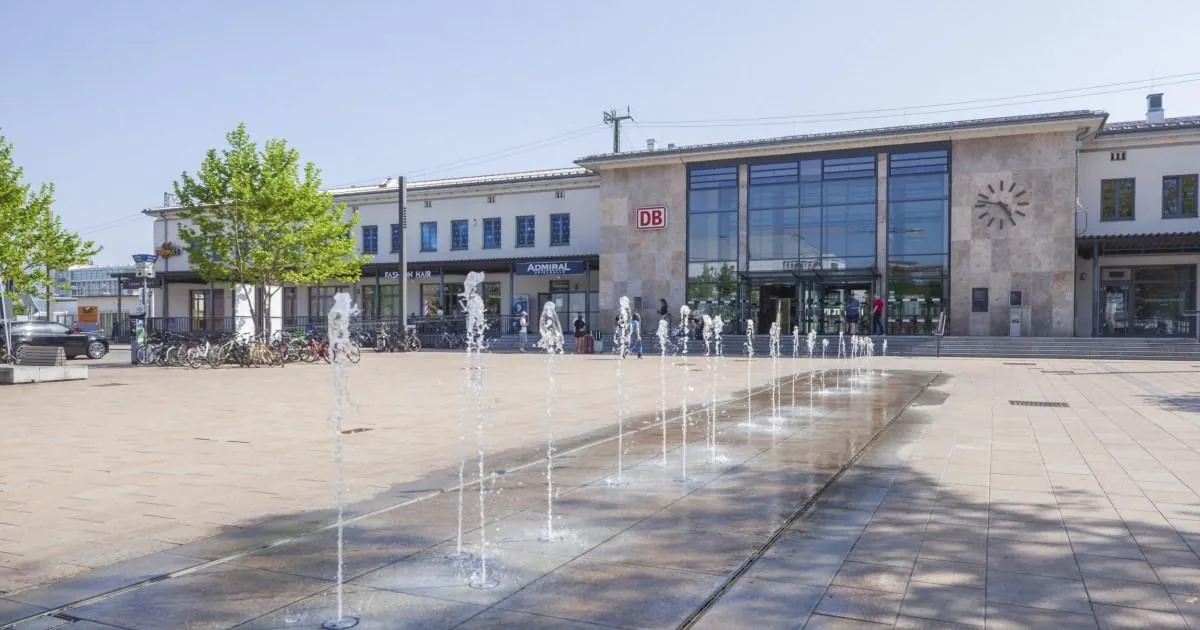
The first light of dawn had not yet broken over the foothills of the Bavarian Alps, and the world was still enveloped in the quiet, cold hush of early Sunday morning. In the town of Rosenheim, nestled near the Austrian border, the streets were mostly silent, the shops shuttered, and the homes dark, save for the occasional porch light casting a dim glow. Yet, at the local railway station, a pivotal transit hub in this corner of southern Germany, the rhythms of night were still in motion. It was at this unassuming locale, a place that typically hums with the transient energy of commuters, business travelers, and backpackers journeying between Munich, Innsbruck, and beyond, that tranquility was shattered by a moment of terrifying, inexplicable violence. A 31-year-old British woman, whose identity remains withheld out of profound respect for her grieving family, became the victim of a brutal, nightmare-inducing knife attack. Far from the safety of her own home, in a foreign but welcoming country, her journey was tragically and brutally terminated. The initial police reports are stark, almost clinical in their cold efficiency: a 31-year-old female victim, a 27-year-old male suspect, a stabbing, a subsequent death. But behind these cold, statistical data points lies a human tragedy of immeasurable depth and complexity. She was not just a number; she was a vibrant soul. She was someone’s daughter, perhaps a sister, a cherished aunt, or a best friend to many. She had stepped onto that platform carrying the ordinary baggage of her life—her recent thoughts, her dreams for the future, her plans for the week ahead, maybe a text message she hadn’t replied to yet. Within a series of heartbeats, everything that defined her existence was violently stolen. The sheer, senseless randomness of the attack is what makes it so profoundly unsettling, a stark and chilling reminder that the safety we often take for granted can be shattered in the blink of an eye, even in a small, idyllic European town.
Rosenheim is a town of unique geographical and cultural significance. It acts as a sentinel, a gateway between Germany and Austria, a picturesque blend of Bavarian tradition and alpine charm. Often referred to as the “gateway to the Alps,” it serves as a brief, scenic interlude for thousands of travelers each day, many of whom are merely passing through on their way to grander destinations—the historic streets of Vienna, the baroque architecture of Salzburg, the ski slopes of the Tyrolean mountains, or the bustling metropolis of Munich. For this British woman, Rosenheim was, in all likelihood, a mere stopover, perhaps a planned change of trains, or maybe she had decided to spend an evening exploring the local beer gardens before continuing her adventure. It is in these liminal spaces, these anonymous transit points between destinations, that one is inherently vulnerable. The predictability of train schedules and the crowded, faceless nature of platforms strip away the protective shell of home, leaving passengers exposed, often lost in their own thoughts, checking their phones for connections or simply staring out into the darkness. At 12:50 AM, the station would have been a ghost town compared to its daytime bustle—a few late-night revelers making their way home, a few shift workers heading to early jobs, and perhaps a handful of weary travelers attempting to catch a few hours of sleep on a bench. The low hum of the overhead lights, the distant echoes of announcements, and the occasional creak of the wind would have provided an eerie soundtrack to the hours leading up to the attack. It was in this quiet, almost serene environment—a setting one would expect to be safe—that this woman found herself face to face with a sudden, inexplicable terror, completely alone in a crowd, her cries for help potentially lost in the cavernous spaces of the station.
The precise details surrounding the attack remain murky, emerging only in fragments from police statements. Authorities have disclosed that a man approached her and engaged her with a knife that would ultimately end her life. Whether words were exchanged, whether there was a preceding altercation, or whether the assault was entirely unprovoked—a lightning strike out of a clear sky—is still under intense investigation. The attack was sudden, brutal, and devastatingly effective. Emergency services were alerted immediately, and the first responders reached the scene within minutes, arriving to find the woman collapsed on the cold, unforgiving concrete of the platform, her lifeblood pooling around her. The atmosphere on that platform must have been one of sheer panic and chaos. Paramedics fought valiantly against time and the severity of her wounds, their urgent efforts to stabilize her, to stem the bleeding, and to keep her heart beating a desperate ballet of medical expertise against an overwhelming enemy. She was rushed, sirens wailing through the deserted streets of Rosenheim, to a nearby hospital, where a team of trauma surgeons took over the fight. In the starkly lit operating room, the battle for her life was waged with the most advanced medical technology available. Yet, despite every measure taken, the damage inflicted was catastrophic. Her body surrendered, her heart stopped, and the fight was ultimately lost. The news of her death rippled outwards from the hospital in slow, painful waves—first to the homicide detectives who had been waiting anxiously for an update, then to the medical examiner, and finally to a British consulate official stationed in Germany, who had the heartbreaking, solemn duty of picking up the phone to call her next of kin. On that devastating Sunday morning, a family on the other side of the English Channel received the news that no family should ever receive, learning that their beloved daughter and sister was gone, murdered in a senseless act of violence in a country she had likely visited for pleasure and adventure.
In a swift and decisive response that likely prevented further tragedy, law enforcement moved with impressive speed. Almost concurrently with the arrival of the emergency services, police units had secured the immediate area and zeroed in on the perpetrator. A 27-year-old German citizen, a resident of the Fürstenfeldbruck district located west of Munich, was taken into custody at the scene. Whether he surrendered, was subdued, or was apprehended within moments of attempting to flee remains unclear, but his rapid arrest was a crucial step in the investigation. The Bavarian State Police have now officially confirmed that an intensive murder investigation is underway, a formal acknowledgment that they are treating this as a premeditated act of homicide until proven otherwise. As the cold light of dawn began to wash over the town, senior detectives set up a command center and began the meticulous, painstaking process of forensic examination and evidence collection. The platform would be sealed off, a sterile white tent erected over the bloodstained area where the woman fell. Investigators in white suits would meticulously scour every inch of the ground for traces of DNA, fingerprints, footprints, or any minute fiber that could link the suspect to the attack. Their focus now shifts to the man sitting in a holding cell, his life also irrevocably shattered, his future grim. The most pressing question echoing in their minds, and in the minds of the public, is the ultimate “why.” Was this a random act of violence perpetrated by a complete stranger with a history of mental illness? Was it a drug-fueled psychosis? Was it a crime of passion, suggesting a prior encounter between the two? Or was it a calculated act of terror intended to sow fear? These are the possibilities that investigators will systematically explore, delving into his personal history, his social media footprint, his psychiatric records, his employment, and his relationships. The man’s silence, or his version of events, will be tested against the hard evidence gathered at the scene.
In the wake of the tragedy, the town of Rosenheim finds itself caught in an uncomfortable glare of international media attention. The incident has cast a long shadow over its reputation as a peaceful, charming community. Residents waking up to their morning coffee were met with stark headlines and a grim reminder that violence can erupt anywhere, even in the most tranquil of settings. The initial shock has slowly given way to a collective sense of grief and unease. The local police have wasted no time in appealing to the public for assistance. In their official statement, they have urgently requested that any witnesses who might have seen the altercation, who might have heard raised voices, a scuffle, or a cry for help emanating from the platform area, contact them immediately. They are also seeking any dashcam footage from nearby roads, CCTV from local businesses, or, most importantly, mobile phone videos that bystanders might have recorded without realizing the gravity of the situation. The police are not merely looking for technical evidence; they are appealing to the fundamental human ability to observe, remember, and connect. They are hoping to jog the memory of a traveler who was sitting nearby, maybe half-asleep or scrolling through their phone, who might have seen a man acting strangely or a woman looking distressed. The community, both local residents and the transient population of travelers, are grappling with the reality of what happened. For those passing through, the incident is a stark warning, a chilling reminder of their own mortality and the unpredictable nature of the world. As the day progresses, a small, impromptu memorial may begin to take shape near the station entrance—flowers laid with trembling hands, candles flickering against the wind, and handwritten notes in both English and German expressing sorrow and solidarity for a woman they never knew. This outpouring of grief transcends borders, a testament to the universal understanding that a life lost to violence is a tragedy that belongs to all of humanity.
This tragic event unfolding in the quiet station of Rosenheim is far more than just a fleeting news article or a headline to be scanned over breakfast. It serves as a profound and deeply unsettling meditation on the fragile nature of human existence and the sheer unpredictability of fate. We all go about our daily lives, boarding trains, walking through stations, carrying our bags and our worries, operating under the implicit assumption that today will be like yesterday, and that tomorrow will follow the same safe, predictable pattern. Yet, for this 31-year-old British woman, that implicit trust in the world was violently and permanently shattered. Her story compels us to pause and reflect on our own mortality, to cherish the mundane moments we often overlook, to hold our partners, our parents, our children a little tighter, and to be acutely mindful of the world around us. The empathy we feel for her family is overwhelming and visceral. They are now forced to navigate a devastating, sudden void, their grief compounded by the geographical distance and the intensely public nature of their loss. They are not alone in their sorrow; a collective well of sympathy has opened up across two nations. As the legal process grinds forward—the suspect awaiting formal charges, the forensic analysis continuing, the psychological assessments pending—we are left to grapple with the uncomfortable truth that vulnerability is an inherent part of the human condition. But we are also resilient. In the face of such horror, communities band together, police work tirelessly to ensure justice, and strangers offer condolences despite the language barriers. The media, while reporting the facts, also serves a role in humanizing the victim, reminding the audience that behind the crime statistics is a real person with a real life that was brutally ended. While the cameras will eventually move on, and the news cycle will shift to other stories, the memory of this woman, and the senseless way her life was extinguished, will linger in Rosenheim for a long time. Her name remains shielded for now, protected by privacy laws and the wish of her family to grieve in peace, but her humanity is universal. We are left only to hope that justice is served swiftly and justly, that the suspect is held fully accountable for his actions, and that her family, in time, can find some measure of peace amidst the wreckage of their shattered lives. In the end, we are starkly reminded that the world is a small place, and that a crime committed on a German train platform echoes far beyond its borders, touching hearts and prompting introspection everywhere. It is a sobering, heartbreaking lesson in the value of a single life.