


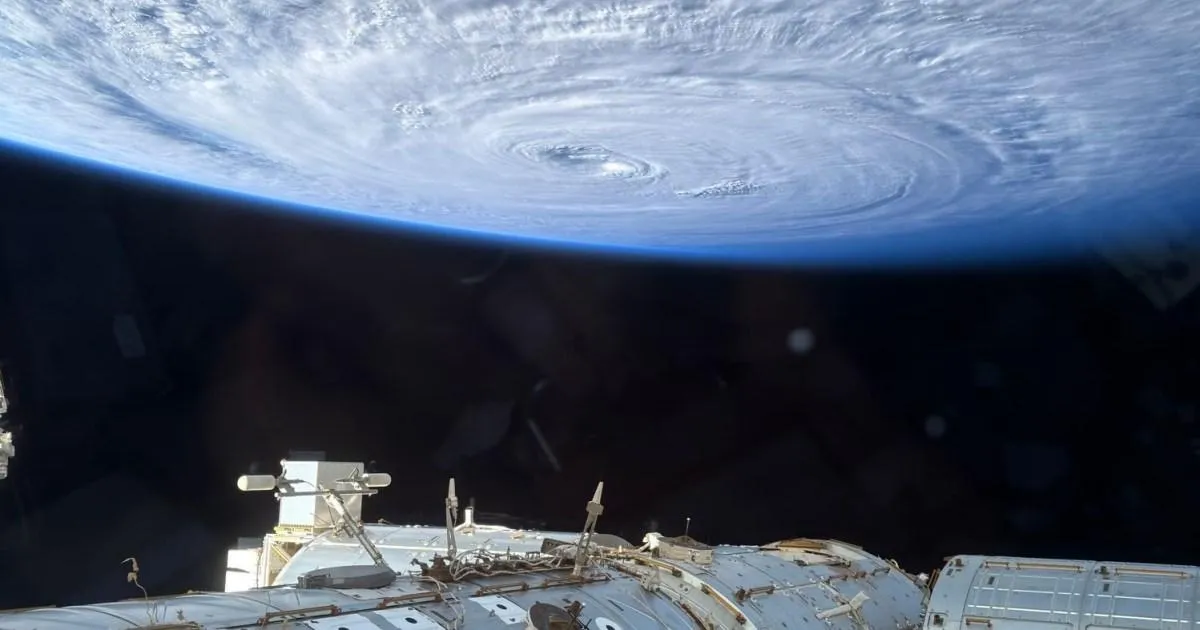
The perspective of our planet changes entirely when you move 250 miles above the surface, where the frantic pace of terrestrial life fades into a silent, swirling tapestry of clouds and deep blue oceans. Recently, NASA astronaut Anil Menon, currently stationed aboard the International Space Station (ISS), captured a moment of profound raw power that serves as a sobering reminder of nature’s volatility. While floating in the station’s iconic Cupola—a multi-windowed observatory designed specifically for Earth-gazing—Menon looked down to find a super typhoon churning across the Pacific. The resulting image is not just a scientific record; it is a breathtaking portrait of a colossal weather system that looks both fragile and terrifyingly dominant from the safety of orbit.
What makes this particular photograph truly remarkable—beyond the subject matter itself—is the mundane piece of technology used to capture it. We often associate space exploration imagery with specialized, bulky camera equipment, high-end lenses, and rigorous stabilization mounts. However, as NASA has begun allowing astronauts to carry personal smartphones on their missions, Menon was able to snap this image using nothing more than his iPhone. The fact that a standard consumer device can resolve such intricate detail from low Earth orbit is a testament to how far mobile technology has come. Standing in the cupola, with the vast expanse of the Pacific spread out beneath him, Menon simply pulled out his phone and documented a storm that was, at that very moment, threatening millions of lives.
The image itself is a masterclass in atmospheric composition, revealing a tightly wound spiral of towering cloud bands that curl around a distinct, hauntingly clear eye. It is the kind of sight that humbles the observer, highlighting the sheer scale of meteorological forces that we often take for granted until they make landfall. While Menon did not explicitly label the storm in his social media post, reports suggest the image captures Super Typhoon Dolphin. At the time the photo was taken, the system was drawing energy from exceptionally warm ocean waters, fueling its rapid intensification before it began its aggressive trek toward the coast of Japan and parts of China.
Down on the ground, the reality of the storm was far less poetic and significantly more chaotic. While the view from the ISS was silent and serene, the impact of Typhoon Dolphin on the mainland was devastating. As the storm neared the Zhejiang province in China, it brought with it ferocious winds gusting at 94 mph and relentless, torrential rain. The scale of the human response was massive; authorities were forced to evacuate over one million people from their homes to escape the path of the storm. The imagery from the ground—submerged trees, battered infrastructure, and flooded streets—stands in stark, painful contrast to the pristine, swirling marble captured from space.
This juxtaposition of the astronaut’s vantage point and the displaced resident’s experience highlights the growing gap between our technological reach and our vulnerability to the climate. Astronauts are afforded the “overview effect,” a cognitive shift that comes from seeing the Earth as a singular, unified, and fragile home. From the Cupola, there are no borders, no evacuation zones, and no economic data points—only the beautiful, complex, and sometimes violent weather patterns that sustain and threaten life simultaneously. Menon’s ability to share this perspective instantly via a smartphone bridges that gap, allowing those of us on the surface to see the storm not just as a news headline, but as a visceral, planetary event.
Ultimately, this viral photo serves as a bridge between the clinical observation of meteorology and the emotional weight of a natural disaster. It reminds us that while we are reaching for the stars and extending our presence into the void of space, we remain inextricably linked to the temperamental atmosphere of the only home we have. As we move forward, integrating everyday tools like smartphones into the ISS experience helps to humanize space travel, making these high-altitude perspectives more accessible and relatable. Whether you are viewing it from a screen in your pocket or through the glass of a cupola in orbit, the sight of a super typhoon remains a powerful symbol of nature’s indifference and the resilience required by those caught in its wake.