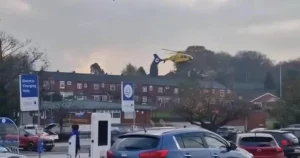



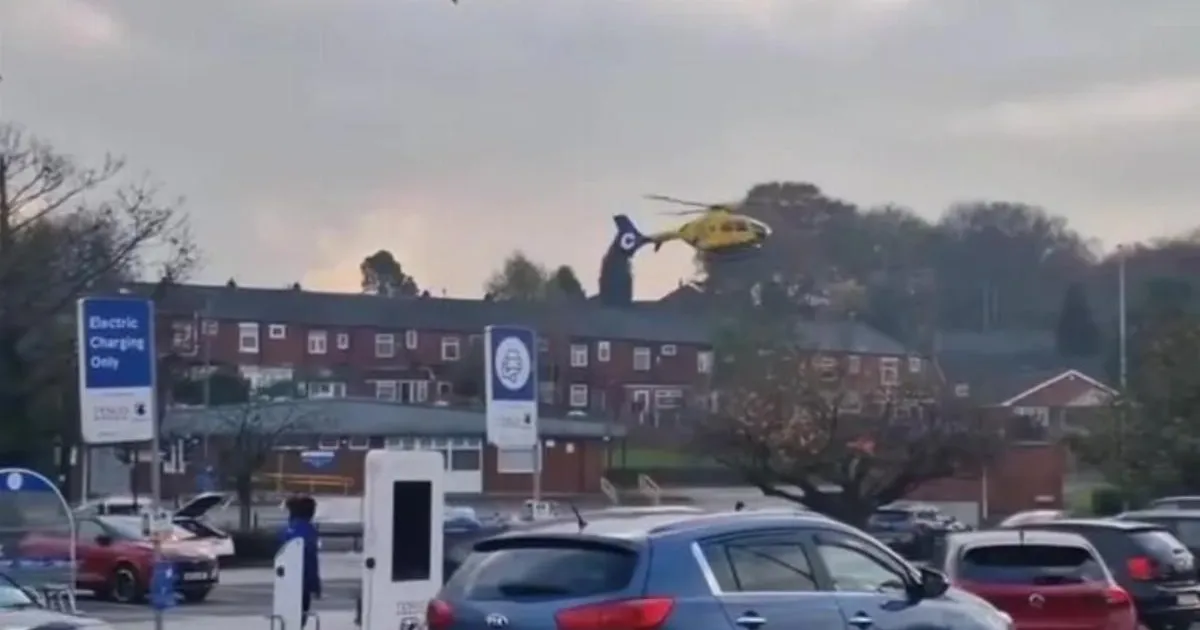
On an otherwise ordinary afternoon in Rochdale, the familiar rhythm of a supermarket trip was shattered by a sudden medical emergency that ended in tragedy. Emergency services rushed to the Tesco store on Silk Street, close to the town centre, after reports that a woman in her fifties had fallen seriously ill. What should have been a simple errand—perhaps a quick stop for groceries, a meal for the evening, or everyday essentials—turned into a heart-stopping scene. An air ambulance landed in the car park, its arrival captured in images posted online and witnessed by stunned shoppers. The woman, whose name has not yet been released, was first helped by Tesco staff, who provided treatment before paramedics reached her. Despite the urgency of the multi-agency response, she sadly died at the scene. Greater Manchester Police confirmed that officers received a call relating to a medical episode at 3.05pm, while the North West Ambulance Service dispatched both a road ambulance and a rapid response vehicle. The sheer scale of the emergency response, including the helicopter, reflected how serious her condition was thought to be. For the family, this is a blow that no amount of preparation could soften: the news that someone who left home only hours earlier will never return. For those in the store, the memory of seeing emergency teams race through the aisles will not easily fade. And for the wider community, it is a sombre reminder that tragedy does not announce itself. It can find us in the most everyday locations, turning the mundane into the moment our lives change forever. The shop, the car park, the street outside—all became places of desperate hope, and ultimately of grief.
The timeline of the emergency shows how quickly things escalated from normal routine to desperate action. At just after 3pm, staff inside the Tesco became aware that something was seriously wrong with the woman, and without waiting for professional help to arrive, they stepped in to offer initial assistance. Their actions demonstrated the kind of calm, instinctive compassion that can make a difference in the critical first moments of a medical crisis, giving responders the best possible chance to continue treatment when they reached her side. According to the Manchester Evening News, shoppers were asked to leave the store and move their vehicles from the car park to help clear the way for emergency services. Shortly afterwards, officers from Greater Manchester Police arrived, along with paramedics from the North West Ambulance Service, who sent both a road ambulance and a rapid response vehicle. The decision to land an air ambulance in the car park was a measure of how critical her condition was believed to be. In the midst of all this, the car park—usually a place of trolleys, boot-repairs, and quick exchanges—was transformed into a staging ground for a life-and-death operation. Social media posts later described how people were not permitted to enter the car park or the store while the incident was unfolding. For the shoppers inside, there must have been a strange and frightening disorientation: the familiar lights, the aisles, the announcements over the tannoy, all suddenly overtaken by sirens, radios, and urgent voices. Yet the public appears to have responded with patience and cooperation, understanding that the crisis nearby was far more important than their own plans. The contrast between the mundane and the traumatic was stark, and it is a reminder that medical emergencies do not respect the places we consider safe or routine. They can happen in a supermarket aisle, in a queue at the checkout, or while reaching for a jar of coffee, and they transform ordinary spaces into sites of intense human vulnerability.
At the centre of this tragedy is a woman whose name has not yet been made public, out of respect for her family and the ongoing process of notifying relatives. Greater Manchester Police have confirmed that her next of kin have been informed, which means that somewhere in the Rochdale area, a family is now grappling with the sudden and shocking loss of someone they love. It is impossible to know what her life held—whether she was a grandmother, a colleague, a caregiver, a neighbour who always waved from across the street—but the fact that she was in her fifties suggests she may have had decades of memories, relationships, and experiences behind her, and many hopes for the years ahead. Losing someone so suddenly, in a place as ordinary as a supermarket, carries a particular kind of pain. There is no time to say goodbye, no chance to prepare, no gradual understanding that allows the mind to catch up with the heart. Instead, there is only a phone call, or a visit from a police officer, and the world changes forever. In the coming days, friends and family will gather, share memories, and try to make sense of what happened. They will likely want to understand the exact circumstances of her final moments, and to know that she was not alone and that people did everything they could to help her. The kindness of strangers—the store staff who knelt beside her, the paramedics who raced to her side, the air ambulance crew who battled to save her—may offer some small comfort. But no amount of professional skill or human compassion can erase the pain of a life cut short. What the public can do, in this moment, is respect the family’s privacy and hold them in their thoughts as they begin the long process of mourning.
The response to the emergency was a testament to the coordination, skill, and dedication of public servants who deal with such situations every day. Reports indicate that the North West Ambulance Service dispatched a road ambulance and a rapid response vehicle, while the air ambulance landing in the car park brought additional medical expertise and equipment to the scene. For the staff at Tesco, the incident was no doubt overwhelming, but they appear to have acted with composure and humanity, providing initial treatment and helping to clear the area so that emergency crews could work unimpeded. Shoppers, too, were asked to move their vehicles and leave the store, a disruption that was both necessary and, in the circumstances, remarkable for the way it was handled. The decision to land a helicopter in such a location would have involved careful assessment of space, obstacles, and safety, and it is a credit to the pilots and ground teams that the operation was completed without further incident. Beyond the immediate responders, there were likely police officers managing crowds, store employees guiding confused customers, and members of the public doing their best to stay out of the way while hoping for a better outcome. In moments like these, the deep infrastructure of our communities becomes visible: the people who run toward danger rather than away from it, and the everyday citizens who understand that sometimes the most helpful thing is to step back and make room. Their collective effort did not change the final outcome, but it meant that the woman received the best possible chance, and that her final moments were met with dignity, urgency, and care rather than confusion or neglect. It also means that those who tried to save her will carry the weight of that day, and they too deserve gratitude and compassion in the aftermath.
For the people who were in or near the Tesco store at the time, the emotional impact of this incident cannot be underestimated. Witnessing a medical emergency is a jarring experience that can leave traces of anxiety and sadness long after the sirens have faded. The image of an air ambulance touching down in a supermarket car park, of paramedics running through automatic doors, of a trolley abandoned in the middle of an aisle—these are the kinds of scenes that stay in the mind and resurface at unexpected moments. Social media posts suggested that access to the car park and store was closed off while the emergency response was underway, leaving some people stranded, waiting for news, or simply trying to process what had happened. In the age of instant communication, word spread quickly, and many who were not present also felt the weight of the news, because tragedies like this touch something universal in us. We all understand what it means to go about our ordinary lives, unaware that in the next aisle someone is fighting for theirs. For the staff member who tried to help, the paramedic who worked in vain, and the bystanders who watched from a distance, there may be a need in the coming weeks to talk through what they experienced. The memory of that afternoon will not easily fade, and the ripple effects will be felt not only by the woman’s family but by everyone whose path crossed hers in those final moments. It is a heavy burden, and one that deserves kindness, patience, and support. In the aftermath of such events, communities often find ways to come together, whether through shared prayers, quiet words of sympathy, or simply the silent acknowledgment that we are all connected by our vulnerability to the unexpected.
Ultimately, this is a story about the fragility of life and the importance of appreciating the ordinary moments we so often take for granted. A woman went to a supermarket on a weekday afternoon, probably with no idea that it would be her last journey. Her death, though tragic, has already had an impact on a wider circle: the emergency responders who will carry the memory of the call, the shoppers who witnessed something they were not prepared to see, and the family now facing a future that has been permanently altered. There are no easy lessons to draw from such a loss, no neat moral that can make sense of it. But there is, perhaps, a quiet reminder to be gentle with one another, to hold our loved ones a little closer, and to appreciate the people who show up in times of crisis. It is also a moment to acknowledge the professionalism and humanity of the emergency services, who responded with speed and skill, and to thank the store staff and members of the public who did what they could in an impossible situation. As the police continue to investigate the circumstances surrounding the medical emergency, and as the family begins to mourn, the community in Rochdale will likely find its own way to honour a woman whose name may not be widely known, but whose passing has touched many. In the end, what remains is not just the tragedy of a sudden death, but the shared experience of a community reminded of its own humanity. And that, perhaps, is a small but meaningful legacy: a moment of collective care amid the daily routines of a town, a brief pause in the car park of a supermarket, where strangers became witnesses, helpers, and mourners, bound together by the loss of a life that mattered.