


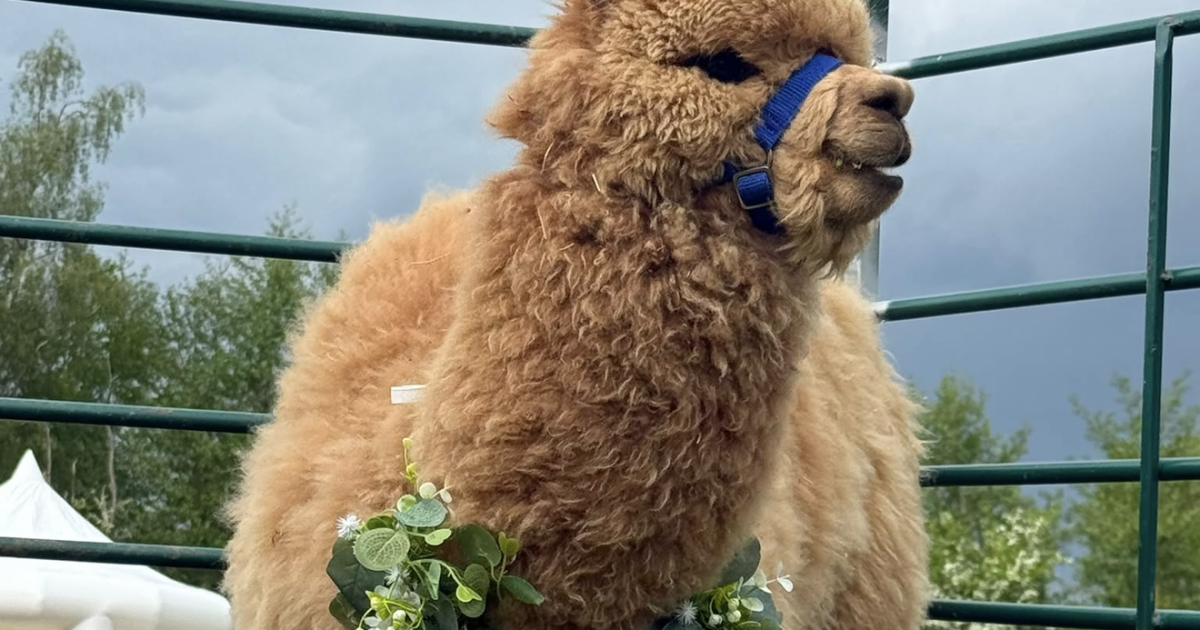
Nestled in the quiet Essex countryside, Alpaca Acres is a sanctuary that seems to hum with a gentle, healing energy. It’s a place where the soft, curious faces of alpacas greet visitors, where children’s laughter mingles with the contented snorts of pigs, and where the air feels lighter, just for a moment. But behind this pastoral serenity lies a story of profound struggle, pitting the very essence of compassion against the unyielding letter of bureaucratic law. At the heart of this conflict is Dawn Goulding, a 55-year-old woman who has dedicated her life—and her body—to saving the lives of neglected and abused animals, only to find herself facing the very real threat of losing everything. Her farm, a thriving community hub and a lifeline for over a hundred creatures, is under imminent threat of closure because, in the eyes of the local council, her work doesn’t generate enough profit to justify her living on the land she so lovingly tends.
The core of the dispute is a stark and seemingly simple matter of planning permission. Dawn moved to the 10-acre estate in Great Tey, near Colchester, in 2017, building a life and a purpose around the animals she rescued. She transformed the land into a petting zoo and a sanctuary, a place where the forgotten and abused could find safety and love. However, strict regulations governing agricultural land dictate that those living on it must demonstrate the financial viability of their business. For Dawn, who runs Alpaca Acres as a non-profit Community Interest Company (CIC), this requirement feels like an impossible standard—a test that measures the worth of her life’s work in pounds and pence. The council has determined that her business does not make enough money to warrant a permanent residence, effectively forcing her to choose between her home and the animals that depend on her for their very survival. The emotional weight of this decision is immense, as she faces the stark reality that her home is not seen as a place of refuge, but merely as a planning application that failed to meet its criteria.
Dawn’s story is one of relentless dedication, often against the odds. A life-changing leg injury sustained in 2020 could have ended her ability to care for her menagerie, but it only steeled her resolve. Unable to walk, drive, or bend down, she would drag herself across the paddocks on crutches, her leg encased in a heavy metal brace, or side-saddle a quadbike with a blanket wrapped around her to feed and tend to her animals. She speaks of the animals as her purpose—the reason she had to get up every day, even when the pain was unbearable. “They only had me to rely on,” she says. This commitment extends beyond the farm’s borders. Alpaca Acres is not just an animal sanctuary; it is a therapeutic haven for people in care homes, women’s refuges, and army veterans. She collaborates with charities like Help for Heroes, running recovery programs that offer solace and purpose to those struggling with their own battles. Her farm has won awards for its work, including the best family attraction at the Muddy Stilettos lifestyle awards, a testament to the joy and comfort it brings to hundreds of people.
The farm itself is home to over 100 animals, a diverse family that includes not only the titular alpacas but also goats, pigs, and even donkeys that arrived with visible scars of past abuse—starved and beaten. For Dawn, turning away an animal in need is not an option, even if it means sacrificing her own comfort. “I don’t earn a penny,” she confesses with a weary honesty. “I still some weeks struggle from one week to the next because I find it very hard to turn a rescue down. If it means us being on beans and toast or that animal losing its life, the animal comes in.” This unwavering compassion is the driving force of her existence, a philosophy that powers the farm through its financial precarity. Her dedication was acknowledged just weeks before the eviction threat, when Colchester City Council proudly showcased Alpaca Acres on its social media channels, lauding the farm as an example of why the council had received an RSPCA gold award for its commitment to animal welfare. The bitter irony of this praise, set against the subsequent threat of eviction, is not lost on Dawn, who feels she has been reduced to a number by the very people who once celebrated her work.
The current crisis began in earnest when Dawn was given a year to leave the land in October 2025. She had already taken down the log cabin where she lived, complying with the initial order, and submitted a new application for a mobile caravan to remain on-site. The council rejected this too, arguing that her enterprise did not meet the required thresholds for financial viability and long-term sustainability. This rejection is particularly damaging as alpacas do not have a fixed birthing season, meaning the animals require round-the-clock care, a commitment that is simply impossible to maintain from a distance. Dawn is now facing the prospect of a potential Magistrates Court hearing, with the council insisting that her profit needs to be 20 per cent of her takings for her to be allowed to reside there. For a non-profit organization whose entire ethos is to pour every penny back into the welfare of the animals and the community, this is not just a bureaucratic hurdle—it’s a philosophical impasse. She feels that those in power view her only as an application form, a number on a desk, disconnected from the living, breathing lives at stake.
The contradiction at the heart of the council’s decision is starkly illustrated by the fact that permission has been granted for 150 new homes just up the road from her farm, while her modest request for a caravan has been denied. For the people who visit, who bring their children to see the animals, who attend yoga classes in the field, or who find a moment of peace in the presence of the creatures, the farm is an indispensable part of the community’s fabric. It is a place where human and animal suffering can begin to heal, where inspiration is drawn not from what is lost but from what remains. Dawn’s own story of recovery is a living example of this resilience. “It’s been life changing,” she says of her injury. “But when you have people like who we have come here, it makes you think about what you have still got, not what you haven’t got anymore, and it gives other people inspiration not to quit.”
In response, Colchester City Council has defended its position, stating that planning decisions are based solely on material planning considerations and must adhere to existing policies and evidence. A spokesperson acknowledged the “genuine agricultural enterprise” but maintained that the application did not fully meet all requirements, including financial viability and long-term sustainability. They emphasized that the council’s role in animal welfare licensing is separate from planning policy. For Dawn, this separation is cold comfort. She faces the heart-wrenching reality that she may have to abandon the animals she has saved and the community she has built, all because her contribution is measured not in lives touched or rescued, but in a profit margin. Her fight is for the simple right to live alongside the animals she has sworn to protect, a right that seems to have been lost in translation between her world of unconditional compassion and a system that speaks only in figures and regulations. The future of Alpaca Acres hangs in the balance, a poignant question about what we truly value as a society: the bottom line, or the depth of our humanity.