


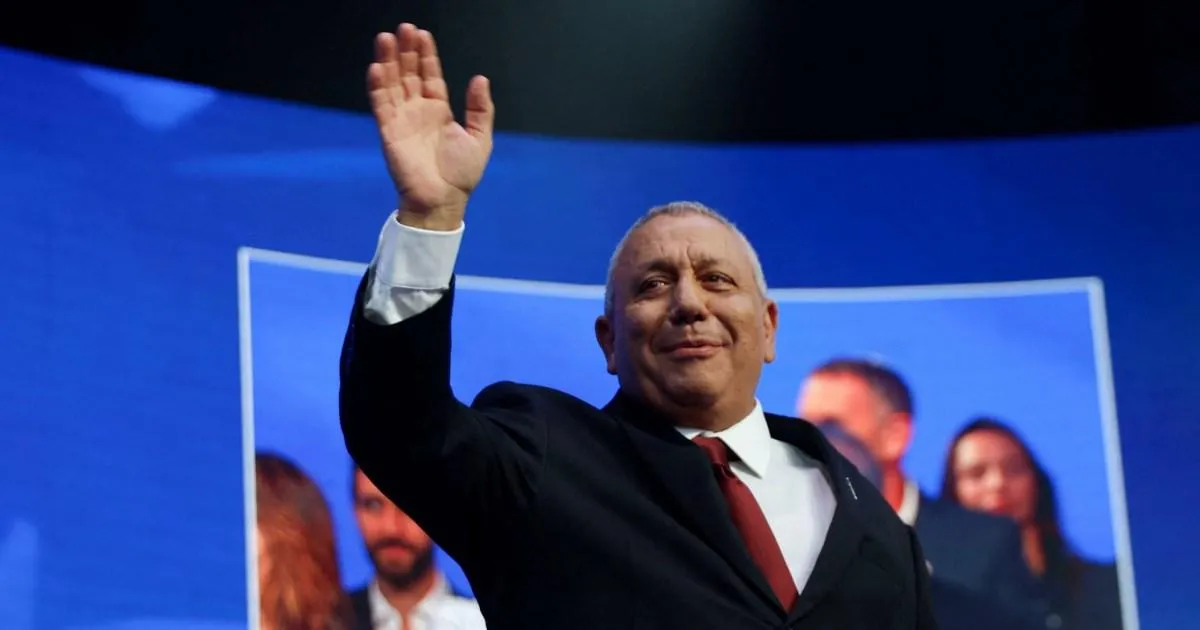
On Saturday evening, Israel’s president, Isaac Herzog, made a decision that sent ripples through the country’s political establishment: he asked Gadi Eisenkot, the leader of the opposition, to try to form the next government. It was a significant symbolic moment, and a clear setback for Benjamin Netanyahu, who has spent weeks hoping to find a way to remain in power. The election last month left the country in a strange and tense stalemate. No single party or bloc won the 61 seats needed for a majority in the Knesset, Israel’s parliament. Netanyahu’s camp came closer than Eisenkot’s, but not close enough. In the end, the balance of power shifted into the hands of Arab-led parties, who have long been excluded from Israeli coalition-building. By throwing their support behind Eisenkot, they have given him a narrow but real opportunity to become the country’s next prime minister. Eisenkot now has 28 days to assemble a coalition, and if he needs more time, he could be granted an additional 14 days. That is not a lot of time in Israeli politics, where coalitions are often patchwork affairs built on last-minute compromises. But Eisenkot, a reserved former chief of staff of the Israel Defence Forces, responded with a calm promise: he would build a “national emergency government” to deal with the serious challenges facing the country. “I will do everything to ensure we are worthy,” he said. For the first time in a long while, the country is looking at a possible future without Netanyahu at the helm. Imagine being handed a task that most people in your position would consider impossible: convince parties that despise each other to sit together, all while the country remains deeply divided and conflicts continue on multiple fronts. That is the scale of what Eisenkot faces. For a man who spent decades in uniform, accustomed to clear orders and clear enemies, politics must feel like a very different kind of battlefield. Yet he stepped forward without hesitation, acknowledging the weight of the moment in his brief public remarks. His acceptance of the mandate was not a victory lap; it was more like a soldier accepting a dangerous mission. And in doing so, he turned the page on a chapter that many Israelis had begun to think would never close.
To understand what this means, it helps to start with the numbers, because they are working against everyone. Israel’s parliament, the Knesset, is a deeply fractured place. No party has won an outright majority on its own in the country’s history. Instead, a government is built by stitching together a coalition of smaller parties until together they control at least 61 of the 120 seats. In last month’s election, Netanyahu’s right-religious bloc won 53 seats, while Eisenkot’s core centre-left to right coalition took 48. That leaves both sides far short of the magic number, and the gap between them is smaller than it looks but harder to bridge. The Arab-led parties, traditionally grouped together and often ignored in coalition talks, now hold the key. Their nomination of Eisenkot as the man to lead the next government was not an endorsement of his entire platform; it was a strategic move aimed at ending Netanyahu’s long dominance. The calculation was simple: if the only way to remove the prime minister is to back his rival, then that is what must be done. Eisenkot does not need every Arab legislator’s vote, but he needs enough of them to cross the finish line. And that creates a delicate dance. He cannot be seen as too dependent on Arab parties, because that would alienate the more nationalist members of his own potential coalition. But without them, he has no path at all. This is the kind of puzzle that has broken many politicians before him. Every handshake is a signal, every public statement a negotiation. He has less than a month, plus a possible 14-day extension, to turn a mess of numbers and egos into a functioning government. Meanwhile, Netanyahu is not simply disappearing. He controls a large bloc and a powerful party machine, and he will fight every step of the way. The coming weeks will be a test not just of Eisenkot’s political skill, but of whether Israeli politics can move beyond the stalemate that has consumed it.
Gadi Eisenkot is not a typical politician. At 66, he comes to this moment with a soldier’s resume and a newcomer’s uncertainty. For most of his career, he was quiet and careful, climbing the ranks of the Israel Defence Forces until he became its chief of staff. He saw war from the inside, planned operations, and lost close friends, and that kind of experience tends to make a person pragmatic rather than ideological. He entered politics only in 2022, a late arrival in a profession often dominated by people who have spent their whole lives in smoke-filled committee rooms. His military background gives him an authority that many other politicians lack; when he talks about security, he does so as someone who has actually commanded soldiers. But it also makes him something of an outsider in the messy, small-scale world of coalition politics. He leads the centrist Yashar party, and he briefly served in Netanyahu’s war cabinet after the Gaza conflict began. But he left and became one of the most pointed critics of the prime minister’s handling of the military campaign. That experience gave him a front-row seat to the very problems he now hopes to fix. His personal story adds another layer. Eisenkot is the son of Moroccan immigrants, and if he eventually becomes prime minister, he would be the first leader of Mizrahi heritage—the term used for Jewish communities with roots in North Africa or the Middle East. In a country where the political and cultural elite has often been dominated by those of European descent, that would be a historic change. It also gives him a different perspective on Israeli society, one shaped by the experiences of families who came from Arab lands and had to build new lives from scratch. He is not flashy or charismatic in the way Netanyahu is. He does not dominate the airwaves with dramatic speeches. His style is quieter, more deliberate. But in a nation exhausted by political crises and security threats, that steadiness might be exactly what voters want. Whether it is enough to hold a coalition together is another question entirely.
Eisenkot is often described as a centrist, but that label hides more than it reveals. On the most fundamental issue in Israeli politics, the conflict with the Palestinians, he has made it clear that he does not support a two-state solution. In that sense, he is not a standard-bearer of the left. He believes strongly in security, in military deterrence, and in maintaining Israeli control over the West Bank. But he has also been willing to criticise Israel’s own right-wing fringes in ways that many of his rivals refuse to do. He has described recent settler violence against Palestinians as “Jewish terror,” a phrase that is almost never used by Netanyahu and his allies. That combination of positions makes him hard to categorize. He is a hard-liner on statehood and a critic of extremists within his own camp. He speaks the language of the security establishment but rejects the impunity with which some settlers have terrorized Palestinian communities. This is a man who understands that strength and morality are not opposites. In his brief response to President Herzog, he promised to form a “national emergency government,” a phrase he seems to use deliberately. He wants to move away from the usual talk of left and right and instead frame the task as a collective effort to steer the country through a difficult period. The question, of course, is whether the people he needs to build that coalition are willing to put aside their own agendas for the sake of a national unity project. Many are not. Some of his potential partners are as ideological as Netanyahu, and they will not simply hand Eisenkot their support because he asks nicely. But by positioning himself as the candidate of emergency and stability, he is trying to create space for a broader conversation—one that might, at least for a few months, allow old enemies to work together. Whether that is a genuine vision or just a clever political strategy will become clearer in the next few weeks.
Yet the road ahead is full of traps. Eisenkot has three possible routes to a majority, and each one comes with serious complications. The first is the path that currently seems most open: a coalition with Arab-led parties. But this is deeply awkward for him. Before the election, he dismissed the possibility outright, and many of the Jewish parties he would need to sit alongside have built their entire platforms on excluding Arab voices from power. To now turn around and make them part of his government would be a major reversal, one that could make him look untrustworthy and would almost certainly provoke attacks from Netanyahu. The second route is an agreement with the ultra-orthodox Jewish parties. That would be more ideologically comfortable for some of his allies, but Eisenkot himself has previously rejected them. The ultra-orthodox parties, for their part, have traditionally preferred Netanyahu and his religious-nationalist allies. Asking them to switch sides at a time when they can still bargain with the prime minister would require a generous offer, and even then, their leaders may not be willing to burn bridges. The third possibility is the most dramatic and the least likely: a unity government with Netanyahu himself. After months of fighting, after Eisenkot’s public criticism of the prime minister’s military strategy, and after Netanyahu’s desperate efforts to cling to power, the idea of the two men sharing a cabinet seems almost absurd. But in Israeli politics, absurdity has a long history. If Eisenkot cannot reach a majority any other way, he might decide that a temporary partnership with Netanyahu is the least bad option. It would be a humiliating compromise for someone who came into politics to change the system. It would also leave Netanyahu with a powerful position inside the very government that was supposed to replace him. Any one of these options would require Eisenkot to swallow his pride and make promises he has previously refused to make. That is what coalition politics does to even the most principled leaders.
If Eisenkot fails, he will not be the end of the story. The presidency would then give another candidate a chance to attempt the impossible. And if no government can be formed within 100 days of the election results being announced, the country would be thrown back to the polls for another election—the same exhausting loop that Israelis have experienced multiple times in recent years. Nobody wants that. The public is tired of permanent campaigning, of political paralysis, of seeing the same faces argue for months without any visible outcome. The fact that Eisenkot is being given this opportunity is, in itself, a symptom of how broken the system has become. But it also offers a small glimmer of hope. He is not the usual product of Israeli political elites. He is a military man, a son of immigrants, a relative newcomer, and a person who has shown an unusual willingness to break with his own side. Whether those qualities are enough to turn a tangled web of parties into a stable government remains to be seen. What is certain is that the coming days will be intense, messy, and full of negotiations conducted behind closed doors. For now, the ball is in Eisenkot’s court. He has promised to do everything in his power to build a government worthy of the country’s trust. The Israeli public, exhausted but still watching closely, is waiting to see whether he really means it. It would not be the first time a soldier has stepped into the political arena with high hopes, only to discover that war is far simpler than politics. But it might be the first time in a long while that the country has had a genuine chance to turn the page. That alone makes this moment worth watching, not just for Israel, but for anyone who has ever wondered whether political deadlock can finally be broken.