

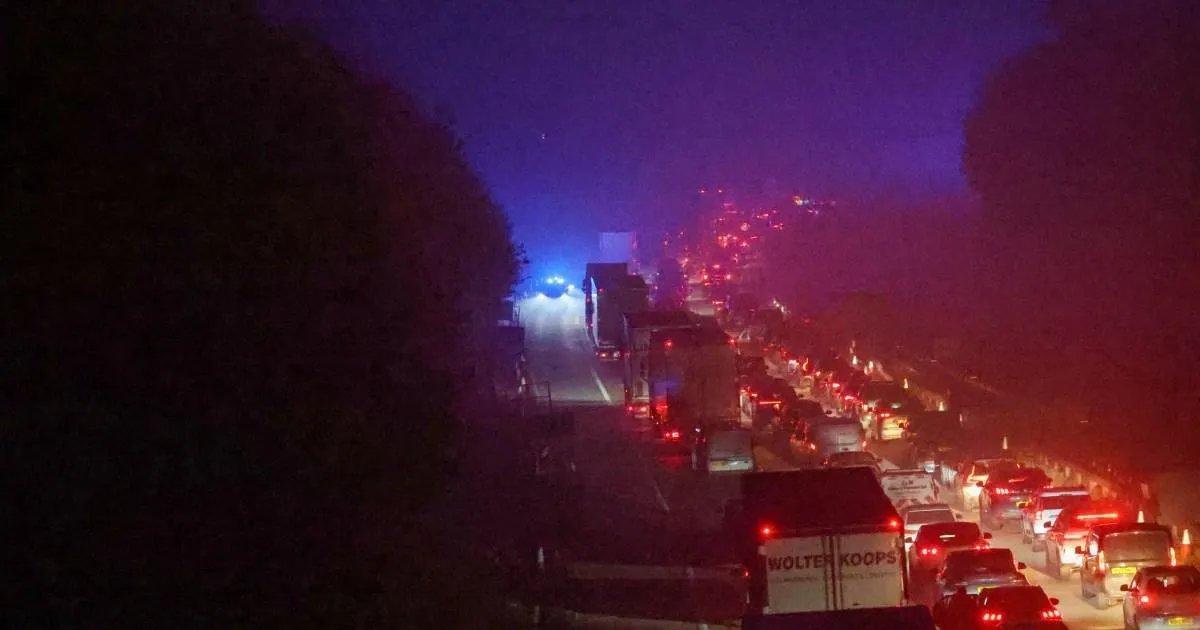
The M20 motorway in Kent, a vital artery frequently used for commutes and holiday travel to the coast, was violently disrupted on a Saturday evening when a routine flow of traffic transformed into a scene of utter devastation. At 6:41 PM, emergency services received frantic calls reporting a catastrophic multi-vehicle collision between junctions 9 and 8 near Hollingbourne, Maidstone. As darkness enveloped the landscape, the sheer scale of the incident began to unfold—more than thirty vehicles, including cars, lorries, and vans, became entangled in a horrific mass of twisted metal, shattered glass, and strewn debris. For motorists heading home after a weekend getaway or driving into the night for a late dinner, what should have been an ordinary journey turned into a terrifying nightmare. The road, normally alive with the rhythmic hum of engines and headlights, ground to a sudden, deafening halt. Passengers were thrown from their seats, vehicles were crushed and compressed into one another, and the smooth, reliable thoroughfare morphed into a physical barrier of wreckage and pain. This was not a simple traffic incident; it was a massive human disaster unfolding on a major highway, prompting the immediate mobilization of a substantial emergency response, with the grim understanding that behind every crumpled vehicle lay a waiting family, a set of plans, and a personal story that would be irrevocably altered in a single, catastrophic moment.
The response from the emergency services was swift, overwhelming, and profoundly heroic. Kent Fire and Rescue Service, upon receiving the distress calls, immediately scrambled a formidable array of resources, including three heavy fire engines and a specialized technical rescue unit equipped with hydraulic cutting gear and stabilization tools. As the first units arrived at the scene, they were greeted by a landscape of astonishing destruction. Vehicles were strewn haphazardly across all lanes, some flipped upside down, others crushed relentlessly against the central reservation barriers. The immediate priority for the firefighters was twofold: to prevent further hazards like fires and to rescue the living. They systematically worked through the mangled wrecks, breaking windows, carefully cutting through reinforced frames, and delicately peeling back layers of metal to reach those who were trapped and injured inside. Above them, the deafening roar of an air ambulance split the dark sky, its powerful searchlight cutting through the gloom as it sought a safe landing zone on the hard shoulder or adjacent field. This was a meticulously coordinated ballet of chaos and expertise, a testament to years of training. Paramedics from the South East Coast Ambulance Service moved swiftly amongst the casualties, performing triage—a brutal but necessary system of prioritizing those with the most critical, life-threatening injuries over those with lesser wounds. Amidst the groaning of twisted steel and the cries of the injured, the crews maintained a steely, focused calm, their professionalism overriding the natural human shock at the sight of such carnage. Within this maelstrom of emergencies, two individuals were discovered to be in particularly dire, serious condition. Their injuries were so severe and complex that the decision was made to airlift one of them directly to a major trauma center in London, a journey that offered the best possible chance of survival through advanced, round-the-clock specialist care. The second critically injured person was transported at breakneck speed by road to a local hospital, sirens wailing through the Kentish night, accompanied by a police escort to clear the route and shave precious minutes off the journey. For these brave men and women on the ground, this was a high-stakes race against time, and their immediate, selfless actions formed the fragile, vital line between tragedy and hope.
As the emergency services battled the metal and medical emergencies, the profound human toll of the accident began to crystallize in stark focus. Beyond the two individuals fighting for their lives in hospitals, the incident left a trail of physical and psychological scars across a much wider circle of people. In total, eleven people were treated by paramedics at the scene for a variety of injuries. For many, the wounds were not catastrophic—cuts, bruises, whiplash—but the emotional shock was immeasurable and pervasive. The sudden, cold impact of the collision, the deafening roar of crunching metal, the chaos of screaming and confusion—these sensations leave invisible marks that linger long after the physical pain has subsided. These eleven survivors were loaded into ambulances, wrapped in crinkly foil blankets to ward off the cold and the creeping shock, receiving not just medical attention but a reassuring touch, a kind word, and a gentle presence in a moment of absolute turmoil. Consider the drivers who walked away physically unharmed but who are now haunted by the image of a car skidding helplessly into another, or the sound of a parent screaming for a child in the pitch-black dark. The ripple effect extends far beyond the cold tarmac. Throughout the evening, families across Kent and beyond received devastating phone calls informing them a loved one had been involved in a multi-car pile-up on the M20. They sat by their phones, anxiously refreshing news websites, waiting for updates, praying they would hear a familiar voice. For the two individuals in critical care, their families now face a long, agonizing vigil in sterile hospital corridors, clinging to the expertise of surgical teams and holding onto a desperate hope. The broader community of motorists, those who witnessed the aftermath from a safe distance but were not directly impacted, will also carry the heavy psychological weight of that vision for years. The true cost of this collision cannot be measured merely in vehicle damage statistics or hospital intake numbers; it is measured in the nightmares, the sleepless nights, the disrupted plans, and the immense, lingering anxiety that now permeates any future journey down that once-familiar, now infamous, stretch of motorway.
Sunday morning dawned grey and somber over the Kent countryside, and the stark, physical evidence of the previous night’s chaos remained grimly visible for all to see. Despite the intense, round-the-clock efforts of the emergency services and road maintenance crews, the sheer scale of the cleanup operation was so immense that the carriageway remained completely shut in both directions. National Highways issued a stark and urgent advisory to motorists, warning that the road would likely remain closed “for several hours while recovery and clear up operations continue.” The task ahead of the recovery teams was nothing short of Herculean. They weren’t just dealing with a minor fender bender; they were tasked with untangling a 30-vehicle wreck, removing broken-down or severely damaged cars and heavy goods vehicles, clearing thousands of pieces of sharp, dangerous debris from the carriageway, repairing the damaged crash barriers, and sweeping gallons of leaked oil, diesel, and coolant from the asphalt. Massive cranes were brought in to lift the heaviest wreckage, while specialist crews worked meticulously to safely remove hazardous materials from any ruptured fuel tanks. For motorists who had not heeded the warnings or who had set out early on Sunday, they were met with a wall of stationary traffic and a seemingly endless sea of red tail lights stretching to the horizon. Those who had been stranded overnight—some having to sleep fitfully in their cars due to the complete shutdown—faced a cold, frustrating, and disorienting morning. The closure caused massive traffic chaos across the entire county of Kent, forcing thousands of vehicles onto rural B-roads and local A-roads, transforming quiet, picturesque village streets into temporary motorways. The economic impact was also being acutely felt, as logistics companies expecting time-sensitive deliveries faced costly delays, and holidaymakers bound for the Channel ports were forced into exhausting, lengthy detours. The frustration among drivers was palpable, yet it was tempered by a deep, unspoken understanding of the severity of what had occurred. This was not merely an inconvenience; it was the physical manifestation of a major, life-altering incident and a stark, visceral reminder that the roadways we so often take for granted can, in the blink of an eye, become incredibly dangerous places.
As the physical cleanup of the wreckage continued, the official investigation into the cause of the massive pile-up began in earnest, with authorities piecing together the fragments of the event. A spokesperson for Kent Fire and Rescue Service confirmed their role in the response, stating, “Kent Fire and Rescue Service was called to reports of a serious collision involving multiple vehicles on the M20 London-bound carriageway, between Junction 9 and 8 near Hollingbourne, Maidstone.” They detailed the deployment of their resources, noting the crucial humanitarian aspect of their work: “Crews helped make sure everyone was safely out of the vehicles.” This seemingly simple statement belies the immense complexity and danger of the task—determining which wrecked vehicle might still contain a trapped passenger, or whether a damaged engine was on the verge of catastrophic fire. Kent Police also released a comprehensive statement, confirming the strict, absolute closures on both the London-bound and coast-bound carriageways between junctions 9 and 8, and warned they were likely to remain overnight. Their plea to the public was direct and urgent: “Motorists not involved in the incident should avoid the area and should seek alternative routes.” Furthermore, the police took the vital step of appealing to the public for assistance, specifically asking for any dash cam footage that might illuminate the exact chain of events leading up to the catastrophic collision. They requested that anyone with footage or information contact them via their live chat function, quoting a specific incident reference number. This appeal humanizes the police work, transforming the investigation from a cold, bureaucratic procedure into a community-wide request for help. The question on everyone’s mind was simple and haunting: how could over thirty vehicles collide on an open motorway? Was it a sudden, invisible patch of black ice? A blinding flash of dense fog? A lorry driver who failed to brake in time? Or simply a tragic cascade of human error, where one sudden, unexpected stop caused a chain-reaction of impacts that spiraled completely out of control? The answers lay trapped within the twisted wreckage and within the memory cards of countless cameras in the vehicles involved, waiting to be carefully pieced together by collision investigators determined to find the truth, provide closure, and prevent such an unprecedented tragedy from ever happening again.
Ultimately, the M20 collision serves as a stark and deeply humanizing reminder of the fragility of our existence on the fast-paced infrastructure of the modern world. We step into our cars with a sense of invincibility, trusting the reliable asphalt, our brakes, and the competence of the other drivers around us, but in a single heartbeat, that trust can shatter into a million pieces. For those directly involved, this Saturday night will act as a demarcation line in their lives—a definitive “before” and “after” moment. The journey that began as a routine drive home or an adventurous trip to the coast ended in raw fear, adrenaline, and the shocking, visceral sight of twisted metal. For the wider community, this incident brings into sharp focus the exceptional bravery, dedication, and professionalism of our emergency services—the firefighters who courageously crawl into mangled vehicles, the paramedics who perform medical miracles on cold, hard tarmac, and the air ambulance crews who fly at terrifying speeds through the night to save a life. Their relentless, coordinated efforts turned a potential mass-casualty event into a story of survived tragedy, where although two people now face a difficult and painful road to recovery in the hospital, the statistical reality of a 30-plus vehicle pile-up could have been far, far deadlier. As the last cranes leave the site and the M20 slowly reopens to a hesitant, cautious flow of traffic, the physical scars will fade from the road, but the memory will linger indelibly for the survivors and their families. It is a poignant, sobering warning to all of us about the profound importance of vigilance, road safety, and recognizing that when we are behind the wheel, we hold not only our own lives but the precious lives of countless complete strangers in our hands. Our collective thoughts remain with the two individuals in serious condition and all those affected by this harrowing event, hoping for their full and speedy recovery. In the face of such immense turmoil, the community’s resilience, and the incredible dedication of those who ran towards the danger rather than away from it, shine as a powerful testament to the enduring strength of the human spirit. It serves as a clear call to check our speed, eliminate distractions, and always drive defensively for the road ahead—because you never know when someone else’s journey might end in a way that you could have helped prevent.