

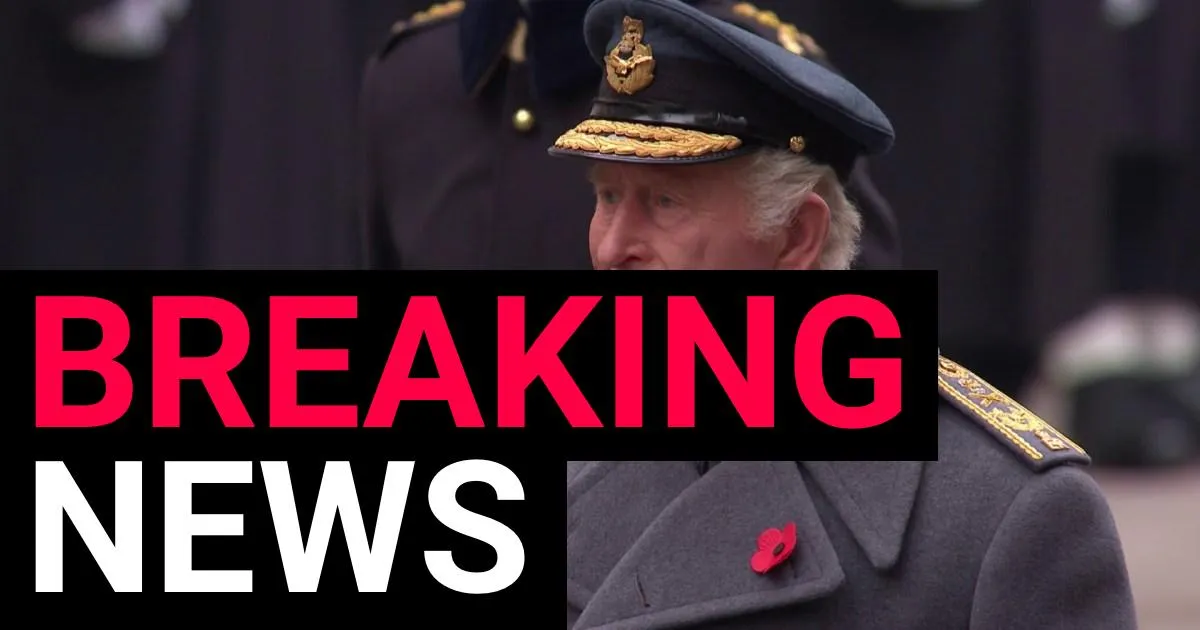
At eleven o’clock on a grey autumn morning, the heart of London fell silent. Thousands of people had lined Whitehall long before the first note of ceremony, their breath visible in the cold air, their poppies bright against dark coats. They came alone or with families, elderly veterans leaning on younger shoulders, parents holding children too young to fully understand but old enough to sense that they were part of something important. The atmosphere was expectant, heavy with emotion. This was the National Service of Remembrance, the one day of the year when the nation stops to honour those who have died in conflict. King Charles stood at the centre of it all, a figure of quiet gravitas beside the Cenotaph, joined by the Princess Royal and other members of the Royal Family. Senior politicians were there too, along with thousands of ordinary people who had gathered to pay their respects. Then came the silence. Two minutes. In the course of ordinary life, two minutes is almost nothing—the time it takes to boil a kettle, to send a text, to wait for a train. But in that sacred pause, two minutes became a lifetime. The noise of the city faded away. Traffic halted. Conversations stopped. Thousands of people stood as still as stone, their minds turned toward the fallen. The silence was not empty; it was alive with memory. At 11.02am, a gunshot broke the hush, sharp and startling, and then the Buglers of the Royal Marines played the Last Post. Its notes seemed to hang in the air, thin and silver, carrying the sorrow of a century of conflict. For those standing in Whitehall, and for millions watching from their homes, it was a moment of profound connection across time—a bridge between the living and the dead.
After the Last Post, the ceremony moved into its next phase: the laying of wreaths. King Charles stepped forward, laying the first wreath at the Cenotaph in recognition of the fallen from conflicts dating back to the First World War. It was a gesture steeped in ritual, but no less moving for it. His son followed, then other senior royals, each placing their tribute with deliberate care. Near the Cenotaph stood several former prime ministers—Sir John Major, Sir Tony Blair, Gordon Brown, Lord Cameron, Baroness May, Boris Johnson, Liz Truss, Rishi Sunak, and Sir Keir Starmer—together despite their differences, united in humility. Andy Burnham joined them, a reminder that remembrance transcends party politics. In a moment that briefly lightened the gravity of the occasion, Liz Truss was seen holding her wreath the wrong way, a small, all-too-human mistake that drew a little whispered attention. It was a fleeting slip, quickly corrected, but it served as a reminder that even in the most polished ceremonies, people are still people. The laying of wreaths is an act of gratitude. Each poppy, each laurel, each silent bow acknowledges an irrecoverable debt. For the politicians standing there, many of whom have made decisions about war and peace, the gesture carries a particular weight. They were not simply performing a duty; they were confronting the consequences of leadership and the sacrifices demanded of those who serve. And for the Royal Family, whose members have worn military uniform and stood by the armed forces through generations, the ritual was personal as well as public.
After the wreath-laying, the focus shifted to those who wore the uniform. Approximately ten thousand veterans were set to take part in the Royal British Legion’s march-past after the service, representing more than three hundred different Armed Forces and civilian organisations. It is the heartbeat of Remembrance Sunday—a long, steady stream of men and women marching through Whitehall, saluting as they pass the Cenotaph. The veterans range from the very young to the very old. There are bereaved children, carrying the memory of parents who died in service. There are military cadets, just beginning their relationship with the armed forces. And there are some of the last surviving veterans of the Second World War, now in their nineties and even older, moving slowly but with heads held high. Watching them, one can sense the passing of time. Each year there are fewer of them. Each year their stories become more precious. The march-past is not just a parade; it is a living history book, written in faces and medals and the proud but tired eyes of those who served. Some veterans smile and wave at the crowds. Others seem lost in their own thoughts. A few wipe away tears as they hear the applause and see the sea of flags. The younger marchers often walk beside older ones, a visible symbol of continuity. The bond between generations of service remains unbroken. And the crowds, many of whom have been standing for hours, respond with cheers and clapping, but also with an almost reverential respect. For those watching, it is impossible not to be moved. These are not abstract heroes from old photographs. They are real people, with families, histories, and wounds—some visible, many hidden.
The scene that stretched along Whitehall was a sea of poppies and military uniforms. Hundreds of people had lined the route long before the ceremony began, some arriving more than two hours early to claim a spot near the front, not wanting to miss a single moment. They wore poppies on their coats, their hats, their bags. Children held small flags. Veterans wore berets and blazers adorned with medals. The mood was not festive, exactly, but it was warm. There was a sense of shared purpose, of strangers bound by a common thread. Conversations were quiet and respectful. People offered each other space, helped elderly marchers find their way, and looked after one another. In an age when the world can feel divided, Remembrance Sunday has a rare ability to bring people together. It asks nothing of us except to remember. It makes no demands on our politics or beliefs. It simply invites us to stand still for a moment and think about those who gave everything. For many, the poppy itself is a powerful symbol. It recalls the battlefields of Flanders, where poppies grew among the graves of soldiers. It is fragile and short-lived, like life itself. Wearing one is a small act of defiance against forgetting. As the crowds waited, the atmosphere was punctuated by the occasional sound of a distant siren or the sharp call of a bugle being tested. The wait only deepened the anticipation. When the silence finally came, it was not a sudden shock but a natural culmination—the moment everyone had been waiting for. The city seemed to exhale. And when it was over, the applause that followed was not just for the veterans, but for the ideals they represent: sacrifice, courage, love of country, and the hope that peace might one day be permanent.
Remembrance Sunday is anchored in the First World War, the conflict that gave birth to the Cenotaph and the tradition of the two-minute silence. The Cenotaph, whose name means “empty tomb,” was designed to stand in for all the graves that could not be marked—the soldiers buried at sea, the missing, the unidentified, the thousands upon thousands whose bodies were never recovered. It is a profoundly simple structure, and perhaps that is why it remains so moving. It does not glorify war. It does not celebrate victory. It acknowledges loss. On this day, the wreaths laid at its base honour the fallen from conflicts dating back to that first terrible war—the Second World War, Korea, Northern Ireland, the Falklands, Iraq, Afghanistan, and the many smaller conflicts and peacekeeping missions that have followed. Each generation has been touched by loss. Each generation has known the pain of a folded flag and a last goodbye. The service at the Cenotaph reminds us that the cost of war is not paid in abstract terms, but in human lives. It is paid in the grief of mothers and fathers, in the childhoods interrupted by the news of a parent killed far from home, in the quiet battles faced by veterans long after they return. The words “We will remember them” are not just a slogan. They are a promise. And every year, that promise is renewed by the people who stand in the cold, who pin a poppy to their collar, who wipe away a tear as the Last Post sounds. To remember is not simply to look back; it is to accept the responsibility that comes with gratitude. It is to ensure that the sacrifices of the past are not allowed to fade into the comfortable distance of history.
As the ceremony drew to a close and the march-past wound its way through Whitehall, the crowds began to disperse, but the memory of the morning lingered. It lingered in the quiet faces of the veterans, in the proud smiles of their families, in the small, hand-drawn poppies left by children around the railings. Remembrance Sunday is not always easy. It forces us to confront things we might prefer to look away from: the horror of war, the fragility of peace, the reality that freedom has never been free. But it also offers something precious—a chance to say thank you. Thank you to the fallen, who cannot hear us, but whose names and deeds are still spoken. Thank you to the veterans, who carry their memories with them every day, not just on this Sunday. Thank you to the families, the wives and husbands, the children and grandchildren, who share their loved ones with the rest of us and who bear a grief that never entirely goes away. And there is hope in that thanks. Hope that by remembering, we might learn. Hope that the lessons of the past will guide the choices of the future. Hope that the peace we enjoy today will be protected and cherished by the generations who follow. For King Charles, for the politicians, for the veterans and the crowds, Remembrance Sunday is a day of quiet heroism—not the heroism of the battlefield, but the heroism of memory itself. It is the simple, stubborn refusal to forget. And as long as there are people willing to stand in the cold, to wear a poppy, to pause in silence for two minutes, the stories will never end. In that way, the fallen are never really gone. They live on in the silence, in the tears, in the quiet determination to keep their memory alive. And that, perhaps, is the greatest tribute of all.