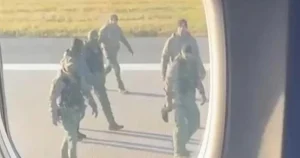


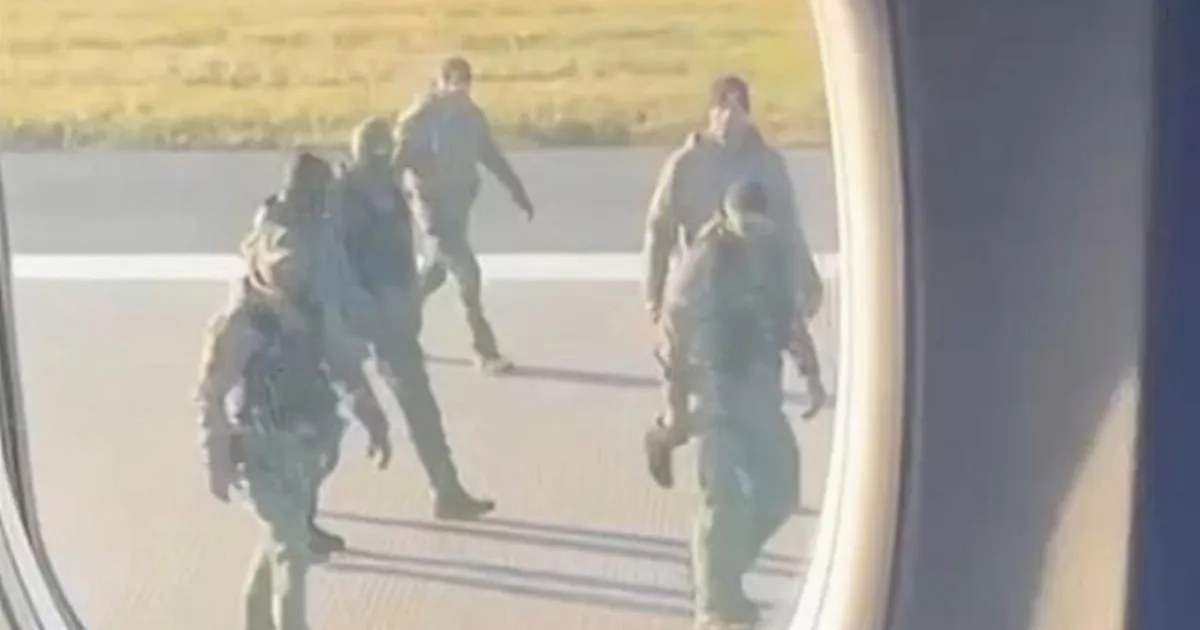
Imagine for a moment that you are sitting on a plane, the seatbelt sign has just clicked off, and you are reaching for your phone or a book, ready to relax into the journey. Then the pilot’s voice comes over the intercom, calm but serious: there has been a security threat, and the aircraft will be landing as soon as possible. In the past week, across Europe, this exact nightmare has unfolded again and again. Dozens of flights have been targeted by bomb threats, and at least 25 planes were impacted in a single day alone by what governments have called malicious hoaxes. Earlier in the week, flights departing from the UK and Ireland were also caught up in security alerts. The threats were claimed by a group calling itself “Fighters of the Male State,” which reportedly vowed to “turn the skies red” with explosions and said it was targeting a “feminist regime” while hoping to “make our mark on history.” Authorities are unsure whether the group is directly linked to “Male State,” a Russian far-right misogynistic online hate community, but the rhetoric is chilling. What makes this even more unsettling is that, after all the emergency landings, evacuations, and fear, searches revealed no explosives and no evidence that the threats were genuine. Yet for the passengers on those planes, the fear was absolutely real, and the emotional impact of being told your flight might explode is not something that disappears when the police give the all-clear.
So what actually happens when an airline receives a bomb threat? It is not a simple or casual process. According to Joji Waites, director of flight safety, policy and regulation for the British Airline Pilots’ Association, threats are initially assessed as either credible, partially credible, or not credible. If a threat is deemed credible, the flight crew is informed immediately, and the captain takes charge of deciding what to do next, guided by a specialised safety checklist. For planes still on the ground, the response is usually evacuation: passengers are rushed down emergency slides and moved as far away from the aircraft as possible. For planes already in the air, the priority is to land as soon and as safely as possible, even if that means an emergency diversion to the nearest airport. This is not a decision taken lightly, because a diversion can be disruptive, expensive, and frightening, but pilots are trained to manage exactly these kinds of high-stress situations. “Pilots are highly trained and skilled professionals,” Waites added. “Their expertise is invaluable in ensuring passenger safety and keeping aviation one of the safest forms of transport there is.” Airlines, airport operators, and law enforcement generally follow guidelines developed by the European Union Aviation Safety Agency and the International Civil Aviation Organization, which conducts audits to ensure compliance. Flight crew training includes live situational exercises covering various threats, including how to search for explosives that may have been smuggled on board. It is a system built on caution, procedure, and the assumption that every threat must be treated as real until proven otherwise. In other words, even a hoax is handled with the same seriousness as an actual terrorist attack, which is exactly why these hoaxes cause so much disruption.
But that disruption does not come cheap. Aviation security expert Philip Baum, a visiting professor of aviation security at Coventry University, explained that diverting a flight because of an unruly passenger or a bomb threat can cost nearly £200,000. In this week’s cases, the costs may be somewhat lower because most of the disrupted flights were short-haul, with less likelihood of overnight delays for passengers and crews. Still, when multiple flights are diverted across multiple countries in a single day, the financial impact adds up quickly. There may be something even more concerning behind these empty threats, however. Jacob Funk Kirkegaard, a senior fellow at the Bruegel think tank in Brussels, suggested that the intent “appears to be to sow chaos, uncertainty, about the reliability of air traffic across Europe.” He also raised the possibility that the threats are being used as a kind of “stress test” for European security systems. Are authorities in Poland responding at the same speed and with the same urgency as authorities in Italy? Are there differences in communication, coordination, or decision-making that could be exploited in future attacks? If so, then each hoax is not just a day of inconvenience, but a lesson for those who wish to do harm. The threat may be empty in terms of explosives, but it is loaded with information about how countries react, where gaps exist, and how quickly the machinery of airport security can be thrown into motion. For airlines, airports, and governments, this is a worrying possibility: the enemy is not planting bombs, but mapping the system.
For passengers, the legal and financial reality of these incidents is another layer of frustration. The Civil Aviation Authority has said that people affected by bomb hoaxes are unlikely to receive compensation. Under European and UK aviation rules, a bomb threat would likely be classed as an “extraordinary circumstance,” meaning the delay or cancellation was not the responsibility of the airline. Security risks are explicitly included in this category. That means airlines are not required to pay the standard compensation that might apply to other delays or cancellations. However, airlines still have a duty of care toward their passengers. Rory Boland, editor of Which? Travel, emphasised that while compensation may not be available, passengers have rights to food and drink, and to a hotel stay if the delay is long enough. They also have the right to choose between a refund and being rerouted to their destination at the earliest opportunity. But he also warned that in these exceptional circumstances, passengers may face longer delays than usual, particularly if the destination airport is temporarily closed to allow the threat to be assessed and managed. For someone sitting in a terminal, watching their flight disappear from the board, this can feel deeply unfair. The threat was a hoax, yet they are the ones paying the price in missed connections, lost working hours, disrupted holidays, and general exhaustion. A sandwich voucher and a hotel room are helpful, but they do not make up for a wedding that was missed, an important meeting that was cancelled, or the nagging fear that stays with you long after the plane has landed safely.
The human dimension of this story is perhaps the most important part. Behind every emergency landing and every airport evacuation are real people, with real nerves, families, and plans. Some passengers may have been on their way home, while others were starting the adventure of a lifetime. For a few terrifying hours, they sat on the tarmac or in an airport terminal, watching police officers and bomb disposal units move through their luggage, wondering if they would ever see their loved ones again. The phrase “turn the skies red” is designed to haunt people, to plant images of fire and falling aircraft in their minds. It is psychological warfare, and it works. The group’s apparent targeting of a “feminist regime” suggests a hateful ideology that wants to make society feel unsafe, not just physically but emotionally. What is remarkable, however, is the way so many passengers and airline staff have responded. There have been no reports of panic or chaos aboard the affected flights. Instead, there have been pilots calmly bringing planes down safely, cabin crew reassuring nervous passengers, and airport workers moving with speed and precision. People have waited together, shared information, and comforted strangers. This is not to romanticise a frightening experience, but to recognise that the system works, and that ordinary people show resilience in extraordinary moments. The skies have not been turned red. No one has been hurt. But the emotional aftershock is real, and it is a reminder that security is not just about metal detectors and checked baggage; it is about the quiet courage of passengers who have to sit with fear until they can finally stand on solid ground.
As the week draws to a close, authorities are still investigating who is behind these threats and what they hope to achieve. The group calling itself “Fighters of the Male State” may be a fringe online movement, but its threats have reached across an entire continent and forced governments to take notice. Whether these hoaxes are intended to test defences, spread confusion, or simply cause chaos for the sake of chaos, they have succeeded in disrupting thousands of lives. They have also exposed a vulnerability in modern air travel: the fact that a few anonymous emails can send dozens of planes off course and cost airlines hundreds of thousands of pounds. But the response has also shown strength. Every threat was taken seriously, every plane was checked, and every passenger was protected, even when it turned out that there was no danger. The hoaxers may have wanted to make their mark on history, but they have only revealed the professionalism and dedication of the people who keep flying safe. For passengers, the best way forward is to stay vigilant, to trust the crews and authorities who have trained for these moments, and to remember that aviation remains one of the safest forms of transport in the world. The fear is understandable, the anger is justified, but the skies are still open. In the end, the real story is not about bombs that were never found, but about the millions of ordinary journeys that continue every day, and the quiet strength of people who refuse to let fear ground them.