


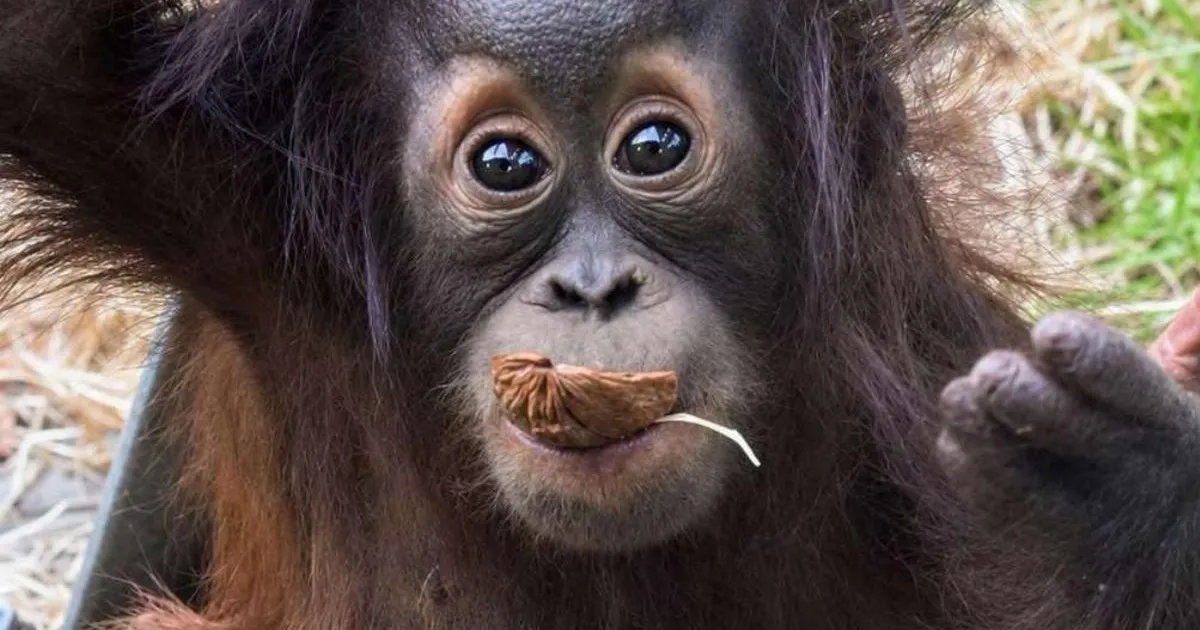
There is a kind of silence that follows the death of an animal that has become part of your daily life—a hush where there once was laughter, a stillness where there once was motion. That silence now hangs over Wingham Wildlife Park in Kent, where Tonic, a baby orangutan with a shock of magnificent hair and a personality far too big for his small body, has died at just 15 months old. Tonic made history in July 2025 when he was born at the park, a moment of pure joy and disbelief for keepers who had waited so long for that first breath. He was the first orangutan ever to be born there, a rare and precious arrival at a time when his species is fighting for survival in the wild. From the beginning, Tonic seemed to understand that he was someone special. He would swing and tumble and stare at visitors with wide, curious eyes, his cheeky antics becoming the stuff of legend around the park. Every photograph captured another layer of his charm—the way his tiny hands gripped his mother’s fur, the way his mischievous face appeared around corners, the way he could turn a quiet afternoon into a performance. Staff have said that watching him grow was a privilege, and in those same words you can feel the depth of their pain. For fifteen months, Tonic brought joy to everyone who knew him, and now, in a single sudden moment, that joy has been replaced by grief.
The tragedy did not unfold overnight, and that makes it all the more heartbreaking. Tonic had been unwell throughout the week leading up to his death, and his keepers were by his side constantly, monitoring every small change in his condition. The veterinary team at Wingham Wildlife Park poured all their knowledge and love into caring for him, hoping that with enough attention and medicine his little body would find the strength to fight. At one point, it seemed their prayers were answered. The park released a statement describing how Tonic showed really positive signs of improvement and gave everyone hope that he was beginning to recover. For a few hours, the collective anxiety began to ease. Keepers may have allowed themselves to imagine a future with him—his first birthday, his awkward teenage years, his growth into a powerful and gentle adult. But hope is fragile, and nature can be cruelly unpredictable. His condition suddenly took a severe turn, and despite every measure taken, despite all the dedication and love in the world, Tonic slipped away. The park’s statement said it best: the team was devastated. Those are small words for such a vast feeling. Tonic was described as incredibly special, with a magnificent coat and an unmistakable little personality, one of a kind in every possible way. The team acknowledged that he leaves behind a huge hole in all their hearts, and that he will be missed more than words can express. For anyone who has ever loved an animal, that pain is familiar, but that does not make it any easier to bear.
Now, the focus at Wingham Wildlife Park has turned to the one closest to him—his mother, Awan. Awan arrived at the park in 2024 after a journey that took her to a new home between Canterbury and Sandwich, and she quickly fell for Jin, the quiet and handsome male who had been living at the park since coming over from Dorset’s Monkey World in 2019. Their bond was undeniable, and Tonic was the beautiful fruit of their love. Keepers watched Awan with a mixture of pride and tenderness, learning to read her moods, celebrating her patience and her fiercely protective instincts. She was a great mother, attentive and gentle, and she would often position herself so that visitors could see Tonic safely nestled in her arms. Now she must face something no mother should have to face—the loss of her child. The park has said that their priority is caring for Awan, and that is no simple task. Orangutans are deeply intelligent and emotionally complex, creatures who form strong attachments and who are thought to grieve in ways that mirror our own. But mother orangutans in the wild famously stay with their babies for years, nursing them and teaching them every skill they need to survive. Tonic was still so dependent, still so young, and his absence will weigh on Awan’s heart. Keepers will watch her carefully, looking for signs of depression, encouraging her to eat, offering her comfort and companionship. She will not be rushed through her grief. She will be allowed to pace, to rest, to sit quietly and stare at the space where her baby used to be. It is a heart-wrenching reality, but it is also a testament to the deep bond between mother and child that humans and orangutans share.
Tonic’s short life also serves as a reminder of just how vulnerable his species is. Orangutans are extraordinary creatures, the heaviest tree-dwelling animals in the world, capable of weighing up to 200 pounds and standing more than a metre tall. They can live for half a century, and in that time they develop complex cultures, using tools, building intricate nests in the rainforest canopy, and raising their young with patience and devotion. Their name means “person of the forest,” and anyone who has watched one at close range will understand why. There is a profound intelligence in their eyes, a quiet awareness that seems to say more than words ever could. But all three subspecies—the Bornean, the Sumatran, and the Tapanuli—are now critically endangered, according to the International Union for Conservation of Nature. A century ago, there were more than 230,000 orangutans living in the wild. Today, the number has fallen to around 110,000. That shocking decline is the result of deforestation, poaching, and the devastating wildfires that tear through the rainforests of southeast Asia as the climate warms. Every palm oil plantation carved out of the forest means fewer places for orangutans to live. Every baby taken illegally from its mother means another broken family, another lost future. Tonic was born in a safe place, cared for by experienced keepers and protected from the dangers his wild cousins face every single day. But his death is a stark reminder that conservation is not just about numbers—it is about individual lives, each one precious, each one a thread in a fragile tapestry that is unravelling.
This is not the first loss Wingham Wildlife Park has mourned recently, and the weight of that grief is almost too much to understand. Less than a month before Tonic passed away, the park said goodbye to Mai, its much-loved red panda. Mai arrived at Wingham as a ten-month-old cub in April 2014 and quickly became a favourite among visitors, with her fiery fur, her banded tail, and her gentle, curious nature. For more than a decade, she brought warmth to the park, quiet and unassuming but always present, a familiar face in a changing world. As Mai grew older, however, her body began to fail her. She developed severe arthritis, a painful condition that made it difficult for her to move around with the same grace she once had. The loss of several teeth made it harder and harder for her to eat, and despite the best efforts of veterinary and animal care teams, her quality of life continued to decline. Eventually, they had to make the most difficult decision a caregiver can make. They chose to end her suffering peacefully, to let her go with dignity and love, rather than allow her to live in pain. It is a decision that weighs heavily on anyone who has made it, even when it is the right thing to do. To lose Mai and then Tonic, two beloved animals in such a short span of time, has left the park staff reeling. But it also reminds us of the nature of their work: they open their hearts to every creature in their care, knowing full well that hearts can be broken.
In the end, the best way to honour Tonic’s memory is not to dwell solely on the sorrow, but to let his life fuel a deeper commitment to the animals who remain. His time at Wingham Wildlife Park was short, but it had meaning. He brought people closer to nature, made them care about orangutans, and reminded the world that these animals are not just statistics on an endangered species list—they are individuals with personalities, mothers who love them, and futures that hang in the balance. The park’s team will continue to care for Awan and Jin, and they will continue their work to help protect wild orangutans. Visitors who came to see Tonic can do their own part by supporting sustainable palm oil, by learning about the origins of the products they buy, and by refusing to forget that these animals are disappearing. Grief is the price of love, and the fact that so many people feel this loss so deeply is a beautiful thing. It proves that empathy still exists, that humans can still be moved by the fate of another species, that a little baby orangutan from a wildlife park in Kent can touch hearts around the world. Tonic will be missed more than words can express, but he will never be forgotten. Every time a visitor stops at the orangutan enclosure and sees Awan and Jin, every time someone decides to make a small change to help protect the rainforest, Tonic’s brief and beautiful life will echo on. He came, he charmed, and he left. But in his wake, he has left something just as precious as his own life—a spark of hope that will not be extinguished.